ISOUSB211: ISOUSB211 Packet Corruption during Enumeration?

Part Number: ISOUSB211

We manufacture a commercial USB galvanic isolator utilzing the ISOUSB211 and have identified a repeatable enumeration failure with the AudioQuest DragonFly Red USB DAC (Hardware v1.0, firmware v1.0.8) and a short list of other audio equipment. Yet, the majority of USB devices enumerate successfully.

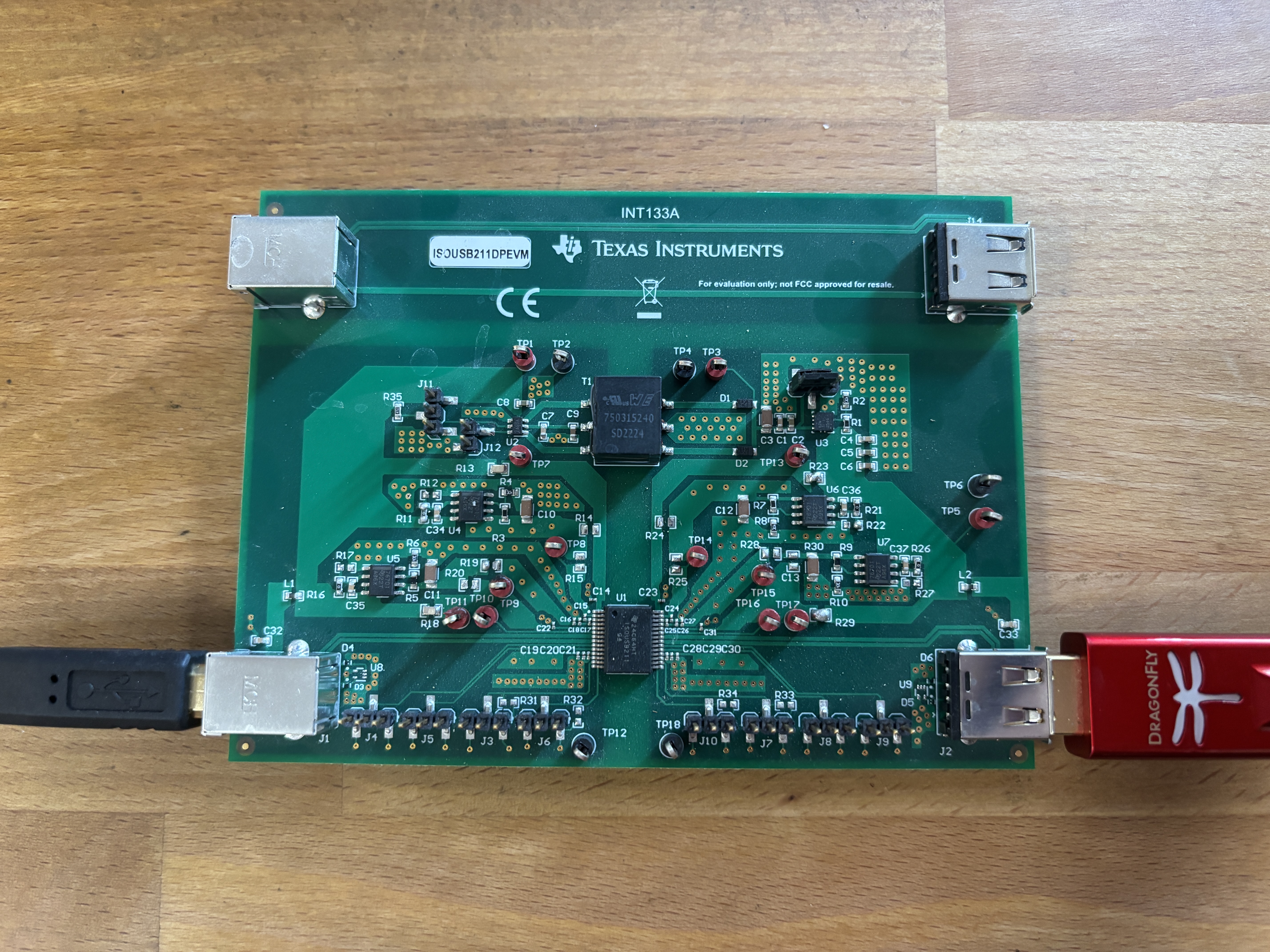
The enumeration failure has been reproduced on TI's own ISOUSB211DPEVM, confirming this is not specific to our implementation. This report focuses on the DragonFly Red for its simplicity and small current consumption of approximately 40 mA @ 5.V

The DragonFly Red enumerates and operates normally when connected directly to a host without the ISOUSB211 in the signal path.

 USB Capture via Total Phase Beagle 480 (Host PC --> ISOUSB211DPEVM --> DragonFly Red) 

| Index | Time | Sp | Len | Err | Record | Summary |
|-------|------|----|-----|-----|--------|---------|
| 0 | 0:00.000.000 | | | | Capture started | Thu Apr 16 12:10:00 2026 |
| 1 | 0:00.000.000 | | | | Host connected | |
| 2 | 0:02.239.859 | HS | | | High-speed | |
| 3 | 0:02.239.877 | HS | 2 B | B | **CORRUPTED packet** | E3 FF |
| 4 | 0:02.239.878 | LS | | U | Low-speed | |
| 5 | 0:02.239.878 | LS | 10.8 us | U | Reset / Keep-alive / Ta... | |
| 6 | 0:02.239.889 | LS | | | Low-speed | |
| 7 | 0:02.239.890 | LS | 14.4 us | U | Reset / Keep-alive / Ta... | |
| 8 | 0:02.239.904 | LS | | | Low-speed | |
| 9 | 0:02.239.904 | LS | 18.9 us | U | Reset / Keep-alive / Ta... | |
| 10 | 0:02.255.119 | LS | 935 us | | Reset / Chirp J / Tiny J | |
| 11 | 0:02.256.054 | | 164 ms | T | Reset / Target disconnect... | |
| 12 | 0:03.415.950 | | 164 ms | T | Reset / Chirp J / Tiny J | |

The ISOUSB211DPEVM is momentarily negotiated (index 2), but the very first data packet is corrupted (index 3: `E3 FF`). The link then drops to Low-Speed and cycles through rapid Reset/Keep-alive sequences (indices 4–9) before falling back to a Chirp J / Tiny J failure pattern (index 10). A target disconnect follows (index 11), and one more failed chirp attempt occurs before all activity ceases.

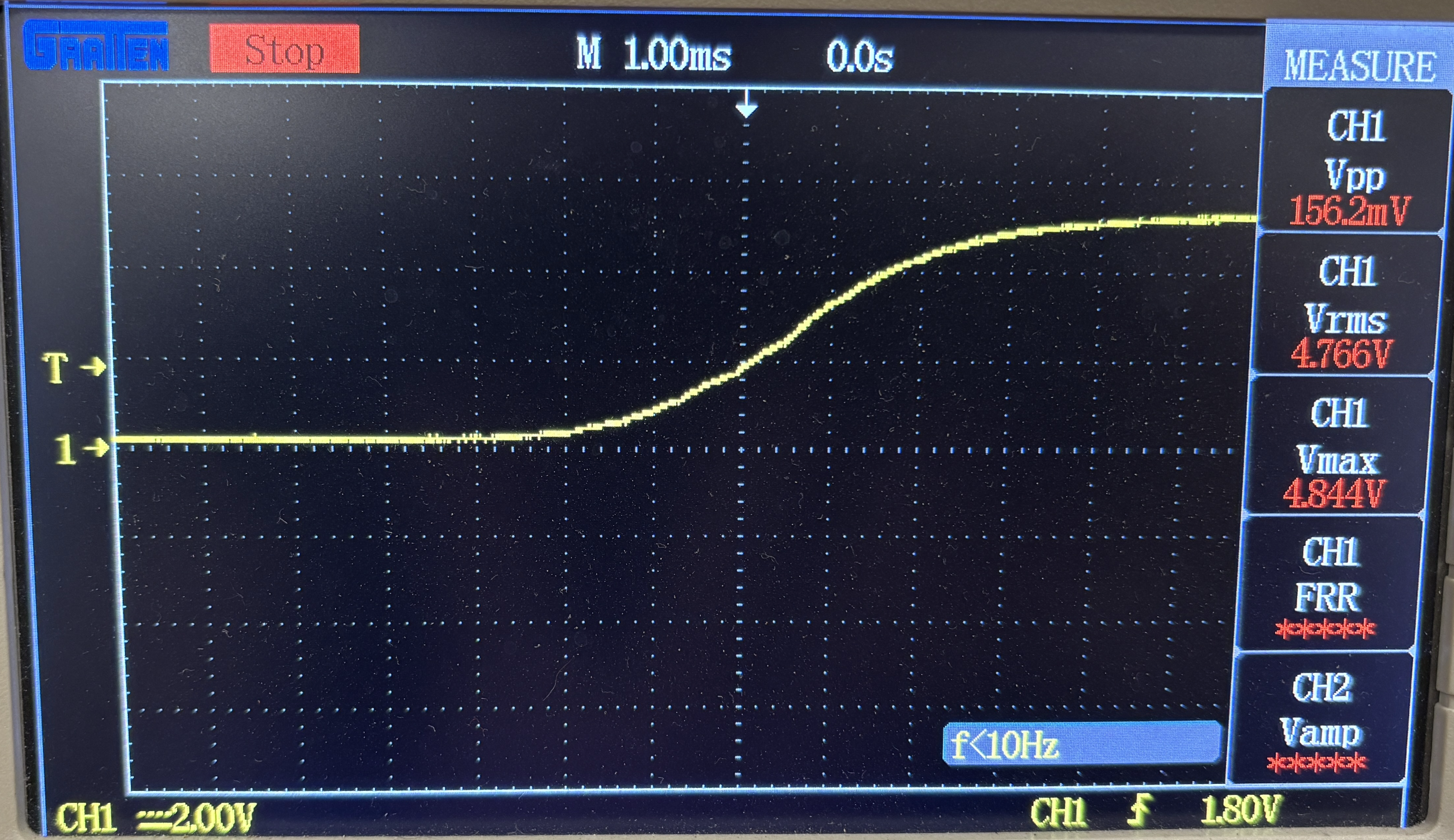
I initially suspected target 5V rail instablity during enumeration. Since we see the same behavior from our own board, I tried tripling capacitance at the target side 5V regulator (TPS73701), and at its IN and OUTPUT pins. No change. 

The target 5V rail initializes smoothly, free of oscillation:
Questions

  1. The corrupted `E3 FF` packet on the DPEVM immediately after Hi-Speed negotiation suggests the ISOUSB211's signal equalization or retiming may be distorting the DragonFly's response. Is there any tuning or configuration that could address this?
  2. Are there any planned silicon revisions or errata that address Hi-Speed handshake compatibility?

Happy to share additional debugging information as needed.

  • Hi John,

    Thanks for reaching out. Please allow us to review the information and come back to you on Monday, thanks.


    Regards,
    Koteshwar Rao

  • Hi Koteshway,

    Just following up. Do you have any ideas to share?

    Best regards,

    John

  • Hi John,

    Apologies for missing to come back to you on this. Please allow my team member to come back to you on Monday, thanks.


    Regards,
    Koteshwar Rao

  • Hi Koteshway - Any ideas?

  • Hi John,

    Thanks for the detailed and clear inputs above.

    Apologies for the delay here. I was away due to medical reasons.

    Can you please share the zoomed in picture of the ISOUSB211 device tested on EVM which shows these failures.

    Few other questions to understand the complete behavior:

    1. How repeatable is this behavior with failing ISOUSB211 device? - Is it random or 100% repeatable using that one device?
      1. Does the behavior change after reconnecting the DragonFly few times?
    2. Does power cycling the ISOUSB211 on the Dragonfly Side helps in establishing the connection after the power up?

    Regards
    Varun

  • Hi Varun,

    1. It is 100% repeatable with this particular model of USB device.
      1. Behavior stays the same upon reconnecting many times.
    2. No, it does not help.

    Here is video demonstration:

    photos.app.goo.gl/W49ZfSVuCrHiy9G59

  • Hi John,

    Thanks for clearing the questions and demo video. A 100% repeatable error is surprising indeed.

    Thanks for the picture but I need a zoomed-in image of ISOUSB211 device on the EVM from where I can read the numbers imprinted on top. Can you please help with that.

    Now coming back to the issue, is this behavior same across all kinds of peripheral devices including DragonFly? - Can you quickly check using a typical USB flash drive, if the USB drive is being detected or not using the same ISOUSB211 which does not enumerate with DragonFly. This is needed to understand if there's any kind of peripheral dependency.

    Let us know.

    Regards
    Varun

  • Hi Varun,

    Sorry about that! The image must have been resized upon upload. Is this what you need to see?

    Now coming back to the issue, is this behavior same across all kinds of peripheral devices including DragonFly? - Can you quickly check using a typical USB flash drive, if the USB drive is being detected or not using the same ISOUSB211 which does not enumerate with DragonFly. This is needed to understand if there's any kind of peripheral dependency.

    Most devices enumerate correctly. The Dragonfly is 1 of 3 audio devices we have documented which fail to enumerate only when using ISOUSB211; all such devices enumerate correctly without ISOUSB211 in the USB path. My list is by no means exhaustive. I'll be glad to send a Dragonfly to you for analysis if that would be helpful.

    Best regards,

    John

  • Hi John,

    Thanks for the image. Allow me some time to investigate this in background.

    Most devices enumerate correctly. The Dragonfly is 1 of 3 audio devices we have documented which fail to enumerate only when using ISOUSB211; all such devices enumerate correctly without ISOUSB211 in the USB path.

    Just to be clear on the facts shared in this statement -

    1. When you say, "Most devices enumerate correctly", you mean peripheral device or the ISOUSB211 device?
    2. By saying "Dragonfly is 1 of 3 audio devices we have documented which fail to enumerate" - do you mean to say that only audio devices show this enumeration issue?
      1. Can you please check the same ISOUSB211, which fails enumeration with Dragonfly, by connecting a Hi-Speed USB flash drive and check for functionality.

    Question:

    Is there an issue with LS or FS operation of this particular ISOUSB211? - Connecting a wired USB mouse (LS device) for functionality can help confirm this.

    Regards
    Varun

  • Varun,

    1. Most peripheral devices enumerate correctly. Documented peripheral issues are consistent with multiple ISOUSB211DPEVMs and our own ISOUSB211 based boards.
    2. We are an audio company and have tested primarily with audio devices.
      1. Yes, a Hi-Speed USB flash drive enumerates successfully (tested Sandisk Ultra USB 3.0 64 GB)
      2. Yes, a LS mouse enumerates successfully (tested Logitech p/n 810-002182)

    We purchased the Audioquest Dragonfly after one of our customers indicated that our ISOUSB211 based product would not connect to his Dragonfly. We confirmed the behavior is 100% repeatable. Power consumption has been ruled out. 

    Best regards,

    John

  • Hi John,

    Thanks for the inputs.

    The above information helps in understanding the selective communication/enumeration failure of the system.

    Let me take a step back and ask this - Is the dragonfly audio device a USB2.0 compliant device? Do you have that confirmation with proof?

    Also, when you tested your manufactured board before shipping to customer - how did you verify the functionality before shipping?

    Regards
    Varun

  • Hi Varun,

    Attached is a full USB descriptor dump from the DragonFly Red (captured via TDD v2.19). The relevant highlights:

    - bcdUSB = 0x0200 — the device self-identifies as USB 2.0
    - It operates at Full-Speed as a USB Audio Class 1.0 device with asynchronous isochronous endpoints — a standard and compliant USB 2.0 profile
    - The descriptor structure (AC interface, AS interface, format type, endpoint descriptors) is well-formed and consistent with the UAC 1.0 specification

    The Dragonfly enumerates and functions correctly on every host we've tested, including multiple Windows PCs, Macs, and Linux machines (without the ISOUSB211 in the path). It only fails with the ISOUSB211 present, and this is reproducible on both our board and TI's own DPEVM.

    > Also, when you tested your manufactured board before shipping to customer - how did you verify the functionality before shipping?

    We perform a functional test on all of our own ISOUSB211 based hardware using an Apple USB C to 3.5mm adapter with standard headphones:
    https://www.apple.com/shop/product/mw2q3am/a/usb-c-to-35-mm-headphone-jack-adapter

    Information for device AudioQuest DragonFly Red v1.0 (VID=0x21B4 PID=0x0082):
    
    ------------------------------
    Connection Information:
    ------------------------------
    Device current bus speed: FullSpeed
    Device supports USB 1.1 specification
    Device supports USB 2.0 specification
    Device address: 0x0038
    Current configuration value: 0x01
    Number of open pipes: 3
    
    
    ------------------------------
    Device Descriptor:
    ------------------------------
    0x12	bLength
    0x01	bDescriptorType
    0x0200	bcdUSB
    0x00	bDeviceClass      
    0x00	bDeviceSubClass   
    0x00	bDeviceProtocol   
    0x40	bMaxPacketSize0   (64 bytes)
    0x21B4	idVendor
    0x0082	idProduct
    0x0108	bcdDevice
    0x01	iManufacturer   "AudioQuest"
    0x02	iProduct        "AudioQuest DragonFly Red v1.0"
    0x03	iSerialNumber   "AQDFRD0100046235"
    0x01	bNumConfigurations
    
    
    -------------------------
    Configuration Descriptor:
    -------------------------
    0x09	bLength
    0x02	bDescriptorType
    0x0098	wTotalLength   (152 bytes)
    0x03	bNumInterfaces
    0x01	bConfigurationValue
    0x00	iConfiguration
    0x80	bmAttributes   (Bus-powered Device)
    0x14	bMaxPower      (40 mA)
    
    Interface Descriptor:
    ------------------------------
    0x09	bLength
    0x04	bDescriptorType
    0x00	bInterfaceNumber
    0x00	bAlternateSetting
    0x00	bNumEndPoints
    0x01	bInterfaceClass      (Audio Device Class)
    0x01	bInterfaceSubClass   (Audio Control Interface)
    0x00	bInterfaceProtocol   (Audio Protocol undefined)
    0x00	iInterface
    
    AC Interface Header Descriptor:
    ------------------------------
    0x09	bLength
    0x24	bDescriptorType
    0x01	bDescriptorSubtype
    0x0100	bcdADC
    0x0027	wTotalLength   (39 bytes)
    0x01	bInCollection
    0x01	baInterfaceNr(1)
    
    AC Input Terminal Descriptor:
    ------------------------------
    0x0C	bLength
    0x24	bDescriptorType
    0x02	bDescriptorSubtype
    0x09	bTerminalID
    0x0101	wTerminalType   (USB Streaming)
    0x00	bAssocTerminal
    0x02	bNrChannels   (2 channels)
    0x0003	wChannelConfig
    0x00	iChannelNames
    0x00	iTerminal
    
    AC Feature Unit Descriptor:
    ------------------------------
    0x09	bLength
    0x24	bDescriptorType
    0x06	bDescriptorSubtype
    0x05	bUnitID
    0x09	bSourceID
    0x02	bControlSize
    bmaControls: 
     0x03	Channel(0) - Mute / Volume
    0x00	iFeature
    
    
    AC Output Terminal Descriptor:
    ------------------------------
    0x09	bLength
    0x24	bDescriptorType
    0x03	bDescriptorSubtype
    0x02	bTerminalID
    0x0301	wTerminalType   (Speaker)
    0x00	bAssocTerminal
    0x05	bSourceID
    0x00	iTerminal
    
    Interface Descriptor:
    ------------------------------
    0x09	bLength
    0x04	bDescriptorType
    0x01	bInterfaceNumber
    0x00	bAlternateSetting
    0x00	bNumEndPoints
    0x01	bInterfaceClass      (Audio Device Class)
    0x02	bInterfaceSubClass   (Audio Streaming Interface)
    0x00	bInterfaceProtocol   (Audio Protocol undefined)
    0x00	iInterface
    
    Interface Descriptor:
    ------------------------------
    0x09	bLength
    0x04	bDescriptorType
    0x01	bInterfaceNumber
    0x01	bAlternateSetting
    0x02	bNumEndPoints
    0x01	bInterfaceClass      (Audio Device Class)
    0x02	bInterfaceSubClass   (Audio Streaming Interface)
    0x00	bInterfaceProtocol   (Audio Protocol undefined)
    0x00	iInterface
    
    AS Interface Descriptor:
    ------------------------------
    0x07	bLength
    0x24	bDescriptorType
    0x01	bDescriptorSubtype
    0x09	bTerminalLink
    0x01	bDelay
    0x0001	wFormatTag   (PCM)
    
    AS Format Type 1 Descriptor:
    ------------------------------
    0x14	bLength
    0x24	bDescriptorType
    0x02	bDescriptorSubtype
    0x01	bFormatType   (FORMAT_TYPE_1)
    0x02	bNrChannels   (2 channels)
    0x03	bSubframeSize
    0x18	bBitResolution   (24 bits per sample)
    0x04	bSamFreqType   (Discrete sampling frequencies)
    0x00AC44 	tSamFreq(1)   (44100 Hz)
    0x00BB80 	tSamFreq(2)   (48000 Hz)
    0x015888 	tSamFreq(3)   (88200 Hz)
    0x017700 	tSamFreq(4)   (96000 Hz)
    
    Endpoint Descriptor (Audio/MIDI 1.0):
    ------------------------------
    0x09	bLength
    0x05	bDescriptorType
    0x01	bEndpointAddress  (OUT endpoint 1)
    0x05	bmAttributes      (Transfer: Isochronous / Synch: Asynchronous / Usage: Data)
    0x024C	wMaxPacketSize    (1 x 588 bytes)
    0x01	bInterval         (1 frames)
    0x00	bRefresh
    0x81	bSynchAddress
    
    AS Isochronous Data Endpoint Descriptor:
    ------------------------------
    0x07	bLength
    0x25	bDescriptorType
    0x01	bDescriptorSubtype
    0x01	bmAttributes   (Sampling Frequency)
    0x00	bLockDelayUnits   (undefined)
    0x0000	wLockDelay
    
    Endpoint Descriptor (Audio/MIDI 1.0):
    ------------------------------
    0x09	bLength
    0x05	bDescriptorType
    0x81	bEndpointAddress  (IN endpoint 1)
    0x05	bmAttributes      (Transfer: Isochronous / Synch: Asynchronous / Usage: Data)
    0x0003	wMaxPacketSize    (1 x 3 bytes)
    0x01	bInterval         (1 frames)
    0x05	bRefresh
    0x00	bSynchAddress
    
    Interface Descriptor:
    ------------------------------
    0x09	bLength
    0x04	bDescriptorType
    0x02	bInterfaceNumber
    0x00	bAlternateSetting
    0x01	bNumEndPoints
    0x03	bInterfaceClass      (Human Interface Device Class)
    0x00	bInterfaceSubClass   
    0x00	bInterfaceProtocol   
    0x05	iInterface   "DragonFly HID MQA"
    
    HID Descriptor:
    ------------------------------
    0x09	bLength
    0x21	bDescriptorType
    0x0111	bcdHID
    0x00	bCountryCode
    0x01	bNumDescriptors
    0x22	bDescriptorType   (Report descriptor)
    0x0015	bDescriptorLength
    
    Endpoint Descriptor:
    ------------------------------
    0x07	bLength
    0x05	bDescriptorType
    0x82	bEndpointAddress  (IN endpoint 2)
    0x03	bmAttributes      (Transfer: Interrupt / Synch: None / Usage: Data)
    0x0040	wMaxPacketSize    (1 x 64 bytes)
    0x20	bInterval         (32 frames)
    
    Microsoft OS Descriptor is not available. Error code: 0x0000001F
    
    
    --------------------------------
    String Descriptor Table
    --------------------------------
    Index  LANGID  String
    0x00   0x0000  0x0409 
    0x01   0x0409  "AudioQuest"
    0x02   0x0409  "AudioQuest DragonFly Red v1.0"
    0x03   0x0409  "AQDFRD0100046235"
    0x05   0x0409  "DragonFly HID MQA"
    
    ------------------------------
    
    Connection path for device: 
    USB xHCI Compliant Host Controller
    Root Hub
    Generic USB Hub
    Generic USB Hub
    AudioQuest DragonFly Red v1.0 (VID=0x21B4 PID=0x0082) Port: 4
    
    Running on: Windows 10 or greater (Build Version 26200)
    
    Brought to you by TDD v2.19.0, Dec  5 2023, 12:08:38
    

  • Hi John,

    Thanks for the inputs.

    It operates at Full-Speed as a USB Audio Class 1.0 device with asynchronous isochronous endpoints — a standard and compliant USB 2.0 profile
    - The descriptor structure (AC interface, AS interface, format type, endpoint descriptors) is well-formed and consistent with the UAC 1.0 specification

    Unfortunately, I don't have correct expertise to comment on this currently. Neither ISOUSB211 has been tested with such profile, hence we cannot comment on if it is guaranteed to pass with such an interface.

    This is also because the ISOUSB211 works okay with other peripherals and there's no systematic issue with audio in general since you validated using Apple USBC to 3.5mm Adaptor - So there's a systematic failure only with the DragonFly's USB interface, for which I don't know the root cause for.

    This issue will need some involvement with AudioQuest as well in understanding the internal interface on how they are implementing the USB to audio coversion.

    Can you please also accept my friend request for discussing few points offline which cannot be shared on public forum.

    Regards
    Varun

  • Varun,

    To be clear, the problem is not limited to the AudioQuest Dragonfly. The same enumeration failure occurs with USB equipment from other brands including RodeCaster, Teengage Engineering, and more. All such USB devices work correctly without ISOUSB211 in the signal path.

    I opened this ticket to make Texas Instruments aware of a potential issue with ISOUSB211 which should at the very least be documented in a technical sense. Is there anyone in the isolation department willing to investigate? I will be glad to ship sample hardware to Texas Instruments for a proper engineering review. Please feel free to reach out to me directly.

    John

  • Hi John,

    Apologies for the issue and Thanks for letting us know that this is a systematic issue with USB to Audio kind of converters

    We will reach out to you offline once we have more clarity on this issue ourselves. This is a first of it's kind issue that we're hearing and too with very selective peripheral hardware (USB to Audio Converters so to say)

    In the meantime, what we would like to understand is how many USB hubs budget do these USB to Audio Converts eat up in the 7 Tier USB tree 

    Regards
    Varun