ISO3086: Regarding 4M Changes of the Device

Part Number: ISO3086

Hi team,

Our customer is using this device in a mass-production model, and we have confirmed the 4M change based on the PCN notification issued in 2023.

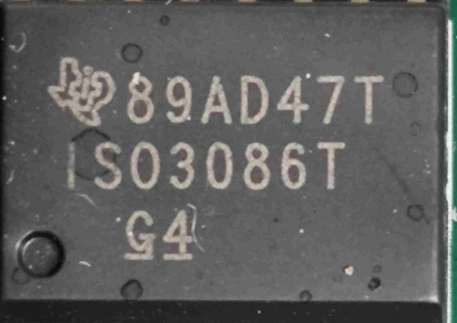
With this 4M change, we observed a reduction of approximately 5 mA in current consumption when comparing device 1 to device 2. However, for IC 3, which is from the same lot as 2, we have observed a phenomenon where the current consumption is approximately 15 mA lower than that of 2.

Questions:

  • Although ICs 2 and 3 have different markings, can you confirm whether they are indeed from the same lot?
    We are currently confirming the reel label information with the customer.

  • Is it possible to estimate the cause of the difference in current consumption based on package differences between 2 and 3?

  1. Pre-PCN device

image.png

2. Post-PCN device (approx. 5 mA lower current consumption than (1))

image.png

3. Post-PCN device (approx. 15 mA lower current consumption than (2))
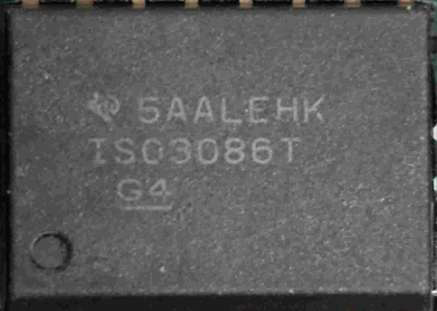
image.png

Best regards,

Kyohei

  • Hi Kyohei-san,

    Thanks for reaching out. Please allow us to review the information you have shared and get back to you. Thanks.


    Regards,
    Koteshwar Rao

  • Hi Koteshwar-san,

    Thank you for your support.

    Please kindly review the above.
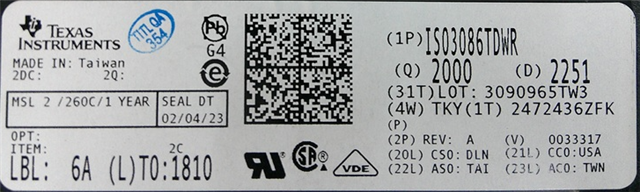
    We have additionally obtained the package label information, so please see the details below.

    In addition, we have received the customer's circuit diagram, and I would like to send it via private message.
    I have sent you a friend request, so I would appreciate it if you could accept it.

    Best regards,

    Kyohei

  • Hi Koteshwar-san,

    Thank you for your support.

    I have an additional question.
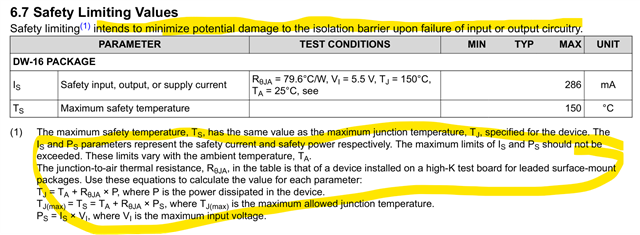
    How was the “Is” value in the figure below measured?

    Is my understanding correct that it represents the sum of the current consumption from Vcc1 and Vcc2?

    Best regards,

    Kyohei

  • Hi Kyohei-san,

    Thanks for sharing additional information.

    To better understand the situation, could you please help me with the below.

    1. The 5mA and 15mA reduction observed, can you please confirm if this is current measured on ICC1 of ISO3086T, ICC2 or overall customer product current?
    2. Could you please share the test conditions? What were the values of VCC1, VCC2, D, DE, RE\, R, A, B, Y, Z when the issue was observed?
    3. Please share the schematic which will help with some of the test conditions.

    Once these information are shared, I will be able to better comment if this is expected or if there was any issue. Thanks.


    Regards,
    Koteshwar Rao

  • Hi Koteshwar-san,

    Thank you for your support.

    • 1. The measurement is taken based on the total current of the customer’s product. The acceptable range is 30 mA to 45 mA. However, units that fail inspection show a reduction down to approximately 15 mA.
    • We will confirm item 2 with the customer.
    • 3. Regarding the schematic, we will send it via private message. We have sent a friend request, so could you please approve it?
    • Also, please let us know about the question we raised yesterday.
    • How was the “Is” value in the figure below measured?

      Is my understanding correct that it represents the sum of the current consumption from Vcc1 and Vcc2?

    • To the best of my understanding, this device only specifies a maximum value. Therefore, I believe that the customer’s observed behavior of reduced current consumption falls outside the specified range.

    Best regards,

    Kyohei

  • Hi Kyohei,

    Do let us know on the Point 2 when you get them from the customer - I'll check the lot information in the background and let you know by tomorrow EoD.

    The acceptable range is 30 mA to 45 mA. However, units that fail inspection show a reduction down to approximately 15 mA.

    Do you mean to say that ICC1+ICC2 = 15mA for the post-PCN device?


    On the Is question - Please note that this is not a measured value, rather a maximum total allowable current inside the device so that the internal power dissipation does not raise the junction temperature beyond 150C, which can potentially damage the Isolation barrier.

    Please refer the highlighted section for detailed explanation.

    Regards
    Varun

  • Hi Varun-san,

    Thank you for your support.

    Please kindly review the lot information.

    Regarding the current consumption values, there is a situation where products judged as good within the post‑PCN lots show a mixture of 30–45 mA and approximately 15 mA.

    The current consumption measurements are taken using a digital multimeter to measure the current between 5V and GND supplied from an external DC power supply.

    Although the measurement reflects the entire 5V board, the only change made to the board is the ISO3086 chip.

    Best regards,

    Kyohei

  • Hi Kyohei,

    I've just verified that IC 2 is a pre-PCN device and not a post-PCN device, which is why you don't see much different with respect to IC 1.

    We have additionally obtained the package label information, so please see the details below.

    Also, the package label information share above also indicates pre-PCN device. 


    The post-PCN device is only IC 3 which shows 15mA of ICC1+ICC2 and is well under datasheet spec after PCN - Hence there is no issue here.

    Regards
    Varun

  • Hi Varun-san,

    Thank you for your support.

    After confirming with the customer, we have received the following feedback. Please review:

    • Regarding the PCN mentioned here, is our understanding correct that it refers to the contents of the 4M change request notified in September 2023?

    • In your previous response, you indicated that IC① and IC② are from the same reel, while IC③ is from a different reel; however, this is not accurate.
      IC① is a mounted product from around 2021 (reel label unknown), and IC② and IC③ are from the same reel, which is the reel label we provided.
      Is it possible that ICs before and after the PCN change are mixed within the same reel?

    • When the customer checked last year, our understanding was that due to the 4M change in September 2023, the current consumption was reduced by approximately 5 mA from IC① to IC②.
      What could be the reason that IC③ shows an additional reduction of approximately 15 mA compared to IC②?

    • Even with a reduction of approximately 15 mA, the device still meets the datasheet specifications. Can we say that there are no changes in other characteristics?

    • In this investigation, the issue is not that the current consumption value is lower, but that the reason why it deviates from the specified value is unclear.
      Therefore, if it can be determined that there are no changes in datasheet characteristics, but that there were process changes (e.g., manufacturing process changes) for which appropriate procedures (such as a 4M change request) were followed, and that the reduction in current consumption is valid and acceptable, then this would not be considered an issue. In such a case, the matter could be resolved by taking appropriate actions accordingly.

    • For this PCN, to what extent should we expect variation in current consumption?
      Previously, there was a variation of approximately 5 mA; however, since the validity of the 4M change was confirmed, we lowered the lower limit of the acceptable range by about 5 mA and allowed inspection to pass.

    Best regards,
    Kyohei
  • Hi Kyohei,

    Yes, you understanding is absolutely correct.

    Regards
    Varun

  • Hi Varun-san,

    It appears that the edited post has not been reflected, so please review again.

    1. In the previous response, it was stated that IC (1) and IC (2) came from the same reel, while IC (3) came from a different reel. However, this is not accurate.
      IC (1) is a mounted product from around 2021 (reel label unknown), and IC (2) and IC (3) are from the same reel, which is the reel label provided.
      Is it possible that ICs before and after the PCN change are mixed within the same reel?

    2. Based on last year’s customer confirmation, it was understood that due to the 4M change in September 2023, the current consumption was reduced by approximately 5 mA from IC (1) to IC (2).
      What is the reason that IC (3) shows an additional reduction of approximately 15 mA compared to IC (2)?

    3. Even with a reduction of approximately 15 mA, this device still meets the datasheet specifications. Can it be said that there are no changes in other characteristics?

    4. The issue in this investigation is not that the current consumption is lower, but that the reason for the deviation from the specified value is unclear.
      Therefore, if it can be determined that there is no change in datasheet characteristics, and if there has been a manufacturing process change (e.g., a change in the manufacturing process) with the necessary procedures followed (such as a 4M change request), and the reduction in current consumption is valid and within the acceptable range, then this should not be considered a problem. In such a case, appropriate actions can resolve the issue.

    5. Regarding this PCN, what level of variation in current consumption should be expected?
      Previously, there was an approximate variation of 5 mA. However, since the validity of the 4M change was confirmed, the lower limit of the acceptable range was reduced by approximately 5 mA, and the inspection passed.

    Best regards,

    Kyohei

  • Hi Kyohei,

    Thanks for the clarifications.

    I request you to not edit the previous responses as it can disrupt the flow and make it difficult for others to respond - you can always put a new reply with new facts, and we can reply to that.

    Now coming to the new questions one by one:

    1. IC(2) and IC(3) can be part of the same shipment under two different boxes but cannot be combined in the same reel. This is simply not possible because IC(2) and IC(3) are reeled at two different dedicated sites as pre-PCN and post-PCN material.
      Please double check with customer on this - there must be some mistake here in reporting the reel labels. Kindly double check.
      1. Just so we're clear here - This label that you have shared above indicates pre-PCN material. IC(2) is a pre-PCN device and the PCN changes do not apply to IC(2).
    2. The 4M change does not apply to IC(1) vs IC(2) but rather IC(1)/IC(2) vs IC(3).
      1. the variation of 5mA between IC(1) and IC(2) is very normal and can be due to process variation in pre-PCN material as well.
      2. The IC(3) on the other hand is actually on lower side of supply current- which is why a net higher reduction of ICC is seen.
        1. I'll try to get more details on the current variation possibility and reach out to your email. (Some of those details can not be shared publicly)
    3. Yes, the datasheet parameters for Electrical characteristics are exactly same between the pre-PCN and post-PCN, 
      1. post-PCN devices can be considered more power efficient as it delivers pre-PCN performance in lower current consumption overall (Just another way of looking at things). I cannot share anything more on this aspect.
    4. There has been no change to device after 4M change issued in September 2023.
    5. As mentioned already, I'll see the details on min current possible internally and get back on email.
      1. to be honest since pre-PCN material also does not commit a lower level of ICC - the 5mA could have been possibly violated even with pre-PCN material at some time of time due to process shifts.
      2. However, the post-PCN variation can be different from 5mA which was historically the case with pre-PCN material as per customer.

    Regards
    Varun

  • Hi Varun-san,

    Thank you for your conformation.

    Based on our shipment records, we were also able to confirm that ICs ① and ② are pre-PCN devices, while IC ③ is a post-PCN device.

    We understand that you will provide further information by email regarding the reason for the reduced current consumption observed in IC ③ and the expected magnitude of the reduction. Thank you for your support.

    I have one additional question. Regarding IC ③, you mentioned that it is positioned on the lower side of the supply current distribution after the PCN, and therefore the ICC itself is lower. Could you please clarify what exactly this means?

    Does this imply that the supply current specification has changed, or that the typical ICC has shifted due to the process change? We would appreciate it if you could provide a bit more detail on this point.

    Best regards,

    Kyohei

  • Hi Kyohei,

    Thanks for the confirmation on the shipment.

    I want to make one thing clear, we cannot share the reason of current reduction since it is in datasheet limits.

    I have one additional question. Regarding IC ③, you mentioned that it is positioned on the lower side of the supply current distribution after the PCN, and therefore the ICC itself is lower. Could you please clarify what exactly this means?

    Apologies for the confusion, but I meant to say it as just another way of looking at the post-PCN device rather than considering it as a problem which is being investigated. Please do not refer it as a change in specification.

    Please note that there is no change in supply current specifications between pre and post PCN devices.. 

    or that the typical ICC has shifted due to the process change?

    Yes, this is exactly the scne\ario here due to change in fab site (RFAB) as mentioned in 4M changes. This does not mean that we have a change in supply current specifications. Please convey this to customer as well.

    I also checked internally and there is no change in the pre-PCN and post-PCN supply current specification. Hence I don;t have any other information to share here.

    As long as the device is under the datasheet limits - which is the case for both pre as well post PCN devices - we're good with no issues at all..

    Closing this thread now.

    Regards
    Varun

  • Hi Varun-san,

    Thank you for your explanation.

    We understand that the change in current consumption is due to the process change associated with the fab transfer, and that the device remains within the datasheet specifications, so there is no issue from a quality standpoint.

    However, our customer is concerned about the variation in current consumption and has temporarily halted mass production. Therefore, we would appreciate some additional clarification.

    • Even among pre-PCN devices, the current consumption varies by approximately 5 mA. Since this variation is significantly smaller than the specified maximum value (Is = 286 mA), would it be reasonable to consider this as normal device-to-device variation?

    • For post-PCN devices, a decrease in current consumption of approximately 15 mA has been observed compared to pre-PCN devices due to the process change. What would be the maximum reduction that could realistically be expected? We understand that it may be difficult to provide a strict definition, but even a rough guideline—for example, whether a reduction exceeding 50 mA would be unlikely—would be very helpful.

    If this information cannot be disclosed publicly, we would appreciate it if you could contact us via private message or email.

    Best regards,

    Kyohei

  • Hi Kyohei,

    Thanks for your understanding.

    Even among pre-PCN devices, the current consumption varies by approximately 5 mA. Since this variation is significantly smaller than the specified maximum value (Is = 286 mA), would it be reasonable to consider this as normal device-to-device variation?

    What I would like to state here is that even for pre-PCN there was a possibility of seeing >5mA of current variation if there would have been a major process shift - but luckily customer did not get such a device ever, which is fairly possible.


    For post-PCN devices, a decrease in current consumption of approximately 15 mA has been observed compared to pre-PCN devices due to the process change. What would be the maximum reduction that could realistically be expected? We understand that it may be difficult to provide a strict definition, but even a rough guideline—for example, whether a reduction exceeding 50 mA would be unlikely—would be very helpful

    Let me see, if I can share the minimum numbers privately so that there is no future concern that customer has. Will reach out to you via email.

    Regards
    Varun

  • Hi Varun-san,

    Thank you for your confirmation.


    Regarding the approximately 5 mA variation observed among devices manufactured before the PCN, since this is not related to a process change, is it correct to understand that a variation of less than 5 mA is attributable to inherent device-to-device variation, such as:


    • Leakage current variation across the isolation barrier
    • Variation in internal bias circuits
    • Switching-current variation caused by the internal clock


    Also, is it correct to assume that the maximum magnitude of this variation is approximately 5 mA?


    In addition, we understand that you will provide the expected range of reduction in supply current for post-PCN devices via email.

    Best regards,

    Kyohei

  • Hi Kyohei,

    it correct to understand that a variation of less than 5 mA is attributable to inherent device-to-device variation,

    Possibly Yes.

    Also, is it correct to assume that the maximum magnitude of this variation is approximately 5 mA?

    Again, we cannot quantify and quote this variation separately. The Variation can be anything, but the final supply current numbers will always be under datasheet limits.

    I have quoted this again and again in my previous responses that customer should NOT get biased with the previously seen 5mA variation datapoint.

    As long as TI is delivering devices that matches datasheet specs - we do not have any obligation to provide any further internal details.

    Closing this thread now.

    Regards
    Varun

  • Hi Varun-san,

    Thank you for your support.

    We understand the information regarding the pre-PCN devices. For the post-PCN devices, we would appreciate it if you could inform us by email of the amount of variation in the current consumption compared with the pre-PCN devices.
    Best regards,
    Kyohei
  • Hi Kyohei,

    Yes, I am trying to get the variation internally from our teams and will reach out to you over email.

    I would like to re-state that I totally understand that customer is surprised by a reduction in device current but a reduction in supply current values DOES NOT imply a Quality Issue until and unless there's an issue affecting device functionality or any other datasheet parameters values.

    Regards
    Varun

  • Hi Varun-san,

    Thank you for your confirmation.

    I understand that your product division is currently investigating the reduction in current consumption of the post-PCN device compared with the pre-PCN device.Could you please let us know when you expect to complete this investigation?

    We have already explained to the customer that the reduction in current consumption is within the specification limits and is attributable to the process change, and the customer has understood and accepted this explanation. However, the customer is requesting additional details in order to address the observed change. Therefore, we would appreciate your continued support and investigation of this matter.

    Best regards,

    Kyohei

  • Hi Kyohei-san,

    Thank you for following up.
    Please allow Varun to check on this tomorrow and get back to you, thanks.


    Regards,
    Koteshwar Rao

  • Hi Varun-san, Koteshwar-san,

    Thank you for your support.

    Could you please let us know by when you will be able to confirm the amount of reduction in current consumption of the post-PCN device compared with the pre-PCN device?
    Best regards,
    Kyohei
  • Hi Kyohei,

    Our team is internally working on getting the data and should be available next week - will reach out you via email directly.

    I would like to iterate this again that we're not going to share any comparative data between pre-PCN and post-PCN as I have already stated the reasons before multiple times.

    All we can share is a minimum ICC number which will again be applicable to both pre-PCN and post-PCN devices. This min value provided by us along with the datasheet max value determines the complete range/variation of supply current numbers that customers can expect throughout the lifetime of the device.

    Regards
    Varun

  • Hi Varun-san,

    Thank you for your support.

    Understood. I will wait for your update as you mentioned that you will contact me sometime this week.
    Best regards,
    Kyohei
  • Hi Koyehi,

    Yes, you should receive a mail from us by Wednesday, July 8.

    Regards
    Varun