This thread has been locked.

If you have a related question, please click the "Ask a related question" button in the top right corner. The newly created question will be automatically linked to this question.

TMS320F280023C: Overheating/potential failure of device

Part Number: TMS320F280023C


Hi there,

I have a new design utilizing this microcontroller and both my prototypes have this chip getting very hot but so far no visual sign of actual failure (burn marks e.t.c). My 3.3V supply should be more than adequate in terms of thermal as well as current output for this chip and it is also overheating with its output voltage dropping to 2V.

Any idea what could cause this chip to overheat ? I have looked at obvious things like GPIO overloading but there is nothing out of the ordinary. The only thing I noticed which is different from my design VS the recommendations is I do not have an ADC capacitor between pins VREFHI and VREFLO as I am not using the ADC, could this cause this kind of failure (I would suspect not?) ?  Also I do not have an external clock attached but this device has an internal clock. 

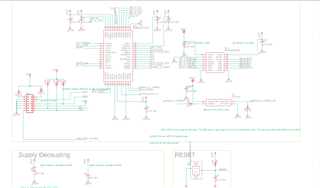
I have attached a screenshot of my uC interface. Thanks in advance for your help.
  • Well the first step to solving this is to find out why the voltage is sagging. Likely something is drawing lots of current causing this, but it could be due to something browning out the V regulator's supply.

    When you say: 

    both my prototypes have this chip getting very hot

    are you referring to the F280023C device?

    If so: I have seen many devices fail due to EOS or ESD. For ESD it really comes down to the fact that it doesn't take too much static to destroy components when handling them. For EOS this would likely be something design related. Is everything connected to the device 3.3V electronics? This device is not 5V tolerance. I guess one other possible, although unlikely mode of failure would be that you over heated the device while soldering it, it can handle quite a lot of heat, but can be damaged by sustaned high temps.

    How long did it take before the devices started getting hot?

    Can you still connect to the devices, I assume "no"?

    The ADC cap should be fine, and understood, no need for an external X-tal.

    Regards,
    Cody 

  • Thanks for the reply. I have removed the F280023C and can conclude it was the cause of the voltage sag as the regulator output is back to 3.3V.  My guess is it is damaged per your ESD/EOS suggestion. It is just a bit odd that this has happened to both prototype boards. I will have to solder on new chips to see whether the new ones work, or whether it is something in the design - I have no 5V interface to these chips so this should not be a problem.  

  • Steven,

    Knowing that this was the C2000 i looked a little closer at the schematic. You have connected VDD to 3.3V. This will cause the damage you are describing. VDD is an 1.2V rail. VDD can be either generated internally, or externally, but in either case it should not be connected to 3.3V. In most cases we do recommend that you do connect the VDD pins externally.

    I would probably recommend double checking the "Connections for Unused Pins" and "Pin Attributes" tables as well to make sure you don't have another error.

    Regards,
    Cody 

  • Hi Cody,

    Thanks - this is probably it. An unfortunate one :(