This thread has been locked.

If you have a related question, please click the "Ask a related question" button in the top right corner. The newly created question will be automatically linked to this question.

TMS320F280039C: HEX generated from CCS and HEX read out from Uniflash appear different

Part Number: TMS320F280039C
Other Parts Discussed in Thread: UNIFLASH, C2000WARE

Dear Champs,

I am asking this for our customer.

The user used CCS to generate Intel HEX and then programmed it onto F28003x by Uniflash.

Then, he used Uniflash to read out all flash content (0x80000 to 0xAFFFF) into Intel HEX from the programmed F28003x.

Then, when he compared them by a HEX editor, he found these two HEX files looked different.

Questions:

1. Why are these two HEX files different?

2. They are asking if and how they can read out the flash content and ensure they are same in HEX files or other supported formats by a HEX editor?

Wayne Huang

  • Hi Wayne,

    Is it about the erased locations' values 0xFFFF in the output from the UniFlash?

    Or the endianness?

    Thanks and regards,
    Vamsi

  • Dear Vamsi,

    I think 0xFFFF is related, but I am not sure if some others are related.

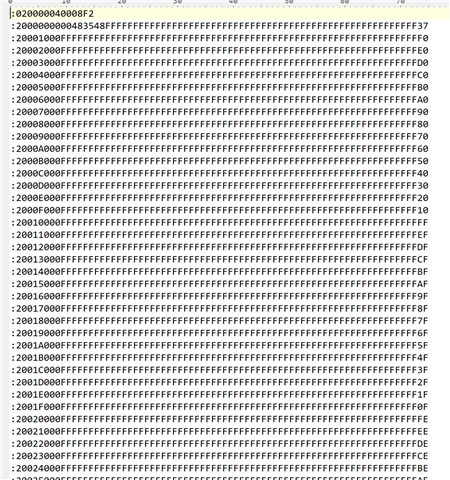
    For example, this is from Uniflash.

    This is the original HEX from CCS.

    In fact, I have compared the checksum generated by CCS and the checksum read out by Uniflash and they are same.

    But the user wants to use another HEX editor to confirm.

    That is, by a third party tool to confirm this redundantly to ensure they are same.

  • Dear Wayne,

    To me, it looks like the erase words are all downloaded since the download from Uniflash includes all of the locations in the given memory range.

    I will assign this to our UniFlash team to help you further (I will be out of office for a week).

    Thanks and regards,
    Vamsi

  • Dear Vamsi,

    I think so too.

    Therefore, would you please ask CCS or Uniflash team to clarify this.

    Is there any option in CCS HEX generation that can be used to generate the same Intel HEX as what Uniflash does?

    Wayne Huang

  • To me, it looks like the erase words are all downloaded since the download from Uniflash includes all of the locations in the given memory range.

    Agreed. UniFlash would dump the entire memory contents vs the original hex file only having the actual data.

  • Is there any option in CCS HEX generation that can be used to generate the same Intel HEX as what Uniflash does?

    You can use the --fill option to specify a fill value for the holes.

    See section 12.9.2 of the document below for more information:

    https://dev.ti.com/tirex/explore/node?node=A__AOdGk9wdSbLdIvwSK2ZCFw__ccs_devtools__FUz-xrs__LATEST

    Thanks

    ki

  • The reply by Ki is partially correct.  There is more to it.  

    In the same document referenced by Ki, search for the sub-chapter titled Image Mode and the --fill Option .  Learn how to put a ROMS directive in a command file.  That ROMS directive will describe the memory range of interest (probably all of flash).  Use image mode and the --fill option.

    A different solution to consider ...  Read this forum post, and the rest of the thread.  That shows how to change the linker command file to fill the memory range(s) that correspond to flash.

    Please understand that, while I am confident these solutions will work, I cannot guarantee it.  The output of the hex utility hex2000, and the dump feature of UniFlash, are not designed or tested to match each other.  That we can find a way to make that work is an unintended feature.  

    Thanks and regards,

    -George

  • Dear Ki, George,

    Would you please test it and confirm us first because these tools CCS hex untility/Uniflash are both from your team?

    I think only the authors of CCS hex utility/Uniflash know how these HEX files are generated.

    Wayne Huang

  • Hi Wayne,

    Would you please test it and confirm us first because these tools CCS hex untility/Uniflash are both from your team?

    I'm not quite sure what you wish for us to test. As George mentioned, you typically do not compare hex files where one is basically a memory dump and the other generated from the build tools. Both the UniFlash memory dump functionality and the Hex Conversion Utility are tested separately to ensure validity and accuracy.

    On a side note, the Hex Conversion Utility that CCS uses to generate the hex file is from a different team (Compiler team) than the one which creates UniFlash (CCS team).

    Thanks

    ki

  • I'm not quite sure what you wish for us to test

    Ok I believe you were referring to George's workaround in his last post. If the customer can provide his project to us, we can take a look.

    Thanks

    ki

  • Please also have the customer provide his hex file from UniFlash. You can send by E2E provate message if you do not wish to post publicly.

  • Dear Ki,

    The user is confused why this is related to their project because this should be independent of a project usage.

    Would you please just use a simple TI example like below to show this?

    C:\ti\c2000\C2000Ware_4_01_00_00\driverlib\f28003x\examples\led\led_ex1_blinky.c 

    This is the HEX utility parameters they use.

    --memwidth=16 --romwidth=16 --diag_wrap=off --intel

    Or do you think if there is anything specific you want to know first?

    Wayne Huang

  • Or do you think if there is anything specific you want to know first?

    We cannot guarantee that a solution will work for the customer's specific use case unless we have the example that the customer is using. As George mentioned, what the customer is trying to do is an unsupported use case. We do not want to run into a case where it works for a simple blinky example but when the customer tries it on their actual project, the results are less than anticipated.

    Otherwise, the customer can try the steps mentioned by George and see if it works for them.

    Thanks

    ki

  • Dear Ki,

    Let me clarify.

    Do you mean the method you proposed may be just a workaround for a specific project rather than a systematic way to guarantee that all projects work?

    Wayne Huang

  • Do you mean the method you proposed may be just a workaround for a specific project rather than a systematic way to guarantee that all projects work?

    We cannot guarantee anything because the customer is trying to use the tools for a purpose that they were not designed for. As George mentioned, it *should* work. But again this is not a use case that we have tested or investigated. Hence no guarantees.

  • Dear Ki,

    I understand what you meant.

    There is a gap here because the user needs a systematic method rather than a workaround for some specific cases as part of their production line procedure, which they have been used for many years on a competitor's MCU with its IDE and flash programmer.

    The goal is to use our F28003x to replace the competitor completely.

    I will be working with them and see if there is any alternative.

    If not, we will discuss this internally and may need to escalate it.

    For now, I'll close this post. 

    Thank you anyway.

    Wayne Huang