This thread has been locked.

If you have a related question, please click the "Ask a related question" button in the top right corner. The newly created question will be automatically linked to this question.

TMS320F28379D: Serial Flash Programmer Core 2 error

Part Number: TMS320F28379D
Other Parts Discussed in Thread: UNIFLASH, C2000WARE

Hello,

After converting the out files of Core1 and Core 2 to the txt format and running serial_flash_programmer.exe

I succeed in loading Core 1 but fail at loading Core 2 - I get Verify Error at address 0x090002 and the program not running.

When I load the out file with UNIFLASH there is no error and no issues with address 0x090002, and afterwards the program running ok. 

Please advice what can I do to fix this ?

  • Hi Zvi,

    According to the Serial Flash Programming of C2000 MCU's  document, when loading the 2 kernel cores using CCS, are you making sure to use the correct build settings for both cores? Is one set to RAM and the other to Flash? The Verify Error indicates that the location has not been programmed (has data not expected), therefore it might be at another location.

    Regards,

    Charles

  • Hello Charles,

    I am not loading using CCS, I am trying to load using serial flash bootloader and when it fails I am using UNIFLASH to burn the original out file for core 2.

    Both cores set to Flash. There are no issues after burning with UNIFLASH.

    We are using Matlab / Simulink for code generation and both of the cores are configured the same way. 

    I also read flash memory with UNIFLAH  after bootloader failure and I can see that 8 bytes are not programmed starting with address 0x090002.

    On the other hand when using UNIFLASH to burn out file those 8 bytes are not empty.

    Maybe hex2000 not producing data for bootloader ?

    Best regards.

  • Hi Zvi,

    I see, Uniflash not CCS. Testing the f28379D now. For the 8 bytes that are missing at 0x090002, will check the hex2000 utility as well. Reporting back as soon as possible.

    Zvi, could this be an alignment issue with hex2000 in the serial flash programmer?  Are your files ALIGN(8) for all the initialized sections that are mapped to flash in the linker command file for both kernel cores?

    Thanks,

    Charles

  • We are using:

    Compiler version v18.12.2 LTS ( hex2000 also from this release )

    C2000Ware version 2.00.00.02 - for Matlab / Simulink code generation and  serial_flash_bootloader.exe

    Hope this info will help you.

  • Zvi,

    Can you show an image of the error occurring or what the error code/message is that stops the hex2000? Is it possible to update the compiler version to the latest build? Currently on 22.6. Will look into this specific version of C2K.

    Thanks,

    Charles

  • Hello Charles,

    1. I am using linker command file provided by Matlab and there is ALIGN(4) - I'll try with ALIGN(8)
    2. Matlab 2019b is using this version of compiler but I'll try to use version 22.6

  • Great, 

    Let me know what changes.

  • Hello Charles,

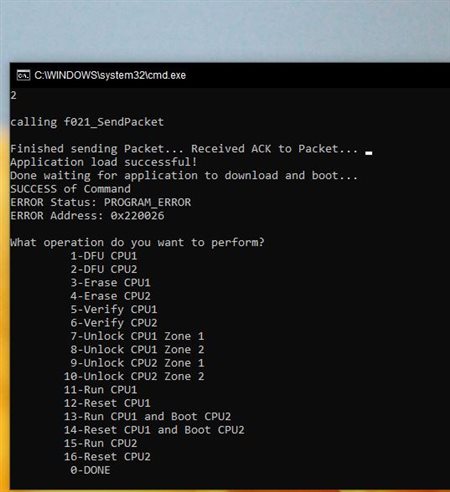
    • ALIGN(8) - after compiling with this change and trying with serial bootloader the result was a different error:

    ERROR Status: PROGRAM_ERROR

    ERROR Address: 0x220026

    • Compiler version 22.6 cannot be used because the program compiles OK and not running correctly


    I don't understand why there is a different error after changing to ALIGN(8) and why the address is of EMIF1_CS2 which we don't have ?!

  • Zvi,

    Success of command is a good, it means that the operation was successful. The error of PROGRAM_ERROR indicates that the application file has sections not mapped to flash memory. The error address is 0x220026, which is odd. Now that you are using ALIGN(8), can you try to look at your application linker cmd file to see if any section is mapped incorrectly? There is a memory map for the device as well that shows the range of memory available.

    Thanks,

    Charles

  • Hello Charles,

    I think it is time to look together at the linker command file - because there is nothing in it to suggest that we mapped our memory incorrectly :

    #include "MW_F2837xD_MemoryMap.h"
    #ifdef CLA_BLOCK_INCLUDED
    // Define a size for the CLA scratchpad area that will be used
    // by the CLA compiler for local symbols and temps
    // Also force references to the special symbols that mark the
    // scratchpad are. 
    CLA_SCRATCHPAD_SIZE = 0x100;
    --undef_sym=__cla_scratchpad_end
    --undef_sym=__cla_scratchpad_start
    #endif //CLA_BLOCK_INCLUDED
    MEMORY
    {
    PAGE 0 :
       /* BEGIN is used for the "boot to SARAM" bootloader mode   */
       BEGIN           	: origin = 0x000000, length = 0x000002
       BEGIN_FLASH     	: origin = 0x080000, length = 0x000002
       #ifdef CLA_BLOCK_INCLUDED
            RAMLS_PROG      	: origin = 0x008000, length = 0x001800
            RAMLS_CLA_PROG      : origin = 0x00A800, length = 0x000800
       #else
            #if BOOT_FROM_FLASH
                RAMLS_PROG      	: origin = 0x008000, length = 0x002000
            #else
                RAMLS_PROG      	: origin = 0x008000, length = 0x003000
            #endif //BOOT_FROM_FLASH
       #endif //CLA_BLOCK_INCLUDED
       
       #ifdef CPU1       
            #if (CPU1_RAMGS_PROG_LENGTH > 0)
                RAMGS_PROG          : origin = CPU1_RAMGS_PROG_START, length = CPU1_RAMGS_PROG_LENGTH
            #endif //(CPU1_RAMGS_PROG_LENGTH > 0)
       #else
            #if (CPU2_RAMGS_PROG_LENGTH > 0)
                RAMGS_PROG          : origin = CPU2_RAMGS_PROG_START, length = CPU2_RAMGS_PROG_LENGTH
           #endif //(CPU2_RAMGS_PROG_LENGTH > 0)
       #endif //CPU1
    
       RESET           	: origin = 0x3FFFC0, length = 0x000002
       /* Flash sectors */
       #if defined(F28376D) || defined(F28374D)
            FLASHA_N           : origin = 0x080002, length = 0x01FFFE	/* on-chip Flash */ 
       #else
            FLASHA_N           : origin = 0x080002, length = 0x03FFFE	/* on-chip Flash */ 
       #endif //defined(F28376D) || defined(F28374D)
    
    PAGE 1 :
       #ifdef CPU1
           BOOT_RSVD           : origin = 0x000002, length = 0x000120     /* Part of M0, BOOT rom will use this for stack */
       #else
           BOOT_RSVD           : origin = 0x000002, length = 0x00007E     /* Part of M0, BOOT rom will use this for stack */
       #endif //CPU1
    
       #ifdef CPU1
           RAMM0M1           	: origin = 0x000122, length = 0x0006DE
       #else
           RAMM0M1           	: origin = 0x000080, length = 0x000780
       #endif //CPU1
    
       RAMD0D1           	: origin = 0x00B000, length = 0x001000
    
       #ifdef CLA_BLOCK_INCLUDED
            RAMLS_CLA_DATA      : origin = 0x009800, length = 0x001000
       #else
            #if BOOT_FROM_FLASH
                RAMLS_DATA          : origin = 0x00A000, length = 0x001000
            #endif //BOOT_FROM_FLASH
       #endif //CLA_BLOCK_INCLUDED
    
    #ifdef CPU1       
            RAMGS_DATA       : origin = CPU1_RAMGS_DATA_START, length = CPU1_RAMGS_DATA_LENGTH
    #else
            RAMGS_DATA       : origin = CPU2_RAMGS_DATA_START, length = CPU2_RAMGS_DATA_LENGTH
    #endif //CPU1
    
       RAMGS_IPCBuffCPU1   : origin = RAMGS_IPC_CPU1_START, length = RAMGS_IPC_CPU1_LENGTH
       RAMGS_IPCBuffCPU2   : origin = RAMGS_IPC_CPU2_START, length = RAMGS_IPC_CPU2_LENGTH 
    
       CLA1_MSGRAMLOW      : origin = 0x001480, length = 0x000080
       CLA1_MSGRAMHIGH     : origin = 0x001500, length = 0x000080
    
       CPU2TOCPU1RAM       : origin = 0x03F800, length = 0x000400
       CPU1TOCPU2RAM       : origin = 0x03FC00, length = 0x000400
    
    #ifdef EMIF1_CS0_INCLUDED
       EMIF1_CS0_MEMORY    : origin = 0x80000000, length = 0x10000000
    #endif //EMIF1_CS0_INCLUDED
    #ifdef EMIF1_CS2_INCLUDED
       EMIF1_CS2_MEMORY    : origin = 0x00100000, length = 0x00200000
    #endif //EMIF1_CS2_INCLUDED
    #ifdef EMIF1_CS3_INCLUDED
       EMIF1_CS3_MEMORY    : origin = 0x00300000, length = 0x00080000
    #endif //EMIF1_CS3_INCLUDED
    #ifdef EMIF1_CS4_INCLUDED
       EMIF1_CS4_MEMORY    : origin = 0x00380000, length = 0x00060000
    #endif //EMIF1_CS4_INCLUDED
    #ifdef EMIF2_CS0_INCLUDED
       EMIF2_CS0_MEMORY    : origin = 0x90000000, length = 0x10000000
    #endif //EMIF2_CS0_INCLUDED
    #ifdef EMIF2_CS2_INCLUDED
       EMIF2_CS2_MEMORY    : origin = 0x00002000, length = 0x00001000
    #endif //EMIF2_CS2_INCLUDED
    
    }
    
    SECTIONS
    {
    #if BOOT_FROM_FLASH
       /* Allocate program areas: */
       .cinit              : > FLASHA_N      PAGE = 0, ALIGN(8)
       .pinit              : > FLASHA_N,     PAGE = 0, ALIGN(8)
       .text               : > FLASHA_N      PAGE = 0, ALIGN(8)
       codestart           : > BEGIN_FLASH       PAGE = 0, ALIGN(8)
       ramfuncs            : LOAD = FLASHA_N,
                             RUN = RAMLS_PROG,
                             LOAD_START(_RamfuncsLoadStart),
                             LOAD_SIZE(_RamfuncsLoadSize),
                             LOAD_END(_RamfuncsLoadEnd),
                             RUN_START(_RamfuncsRunStart),
                             RUN_SIZE(_RamfuncsRunSize),
                             RUN_END(_RamfuncsRunEnd),
                             PAGE = 0, ALIGN(8)
       /* Initalized sections go in Flash */
       .econst             : > FLASHA_N      PAGE = 0, ALIGN(8)
       .switch             : > FLASHA_N      PAGE = 0, ALIGN(8)
       /* Allocate IQmath areas: */
       IQmath			: > FLASHA_N, PAGE = 0, ALIGN(8)            /* Math Code */
       IQmathTables		: > FLASHA_N, PAGE = 0, ALIGN(8)
       
       #ifdef CLA_BLOCK_INCLUDED
           /* CLA specific sections */
           Cla1Prog         : LOAD = FLASHA_N,
                              RUN = RAMLS_CLA_PROG,
                              LOAD_START(_Cla1funcsLoadStart),
                              LOAD_END(_Cla1funcsLoadEnd),
                              RUN_START(_Cla1funcsRunStart),
                              LOAD_SIZE(_Cla1funcsLoadSize),
                              PAGE = 0, ALIGN(8)
           .ebss            : > RAMGS_DATA ,    PAGE = 1
       #else
           .ebss            : >> RAMGS_DATA | RAMLS_DATA,    PAGE = 1 
       #endif //CLA_BLOCK_INCLUDED
       
    #else
       codestart        : > BEGIN,     PAGE = 0
       ramfuncs         : > RAMLS_PROG      PAGE = 0
       .cinit           : > RAMLS_PROG,   PAGE = 0
       .pinit           : > RAMLS_PROG,     PAGE = 0
       .switch          : > RAMLS_PROG,     PAGE = 0
       .econst          : > RAMLS_PROG,    PAGE = 0
       /* Allocate IQ math areas: */
       IQmath			: > RAMLS_PROG,     PAGE = 0            /* Math Code */
       IQmathTables		: > RAMLS_PROG, PAGE = 0
    
       #ifdef CLA_BLOCK_INCLUDED
           /* CLA specific sections */
           Cla1Prog         : > RAMLS_CLA_PROG, PAGE=0
           .text            : >> RAMLS_PROG | RAMGS_PROG,   PAGE = 0
       #else
           .text            : > RAMLS_PROG,   PAGE = 0
       #endif //CLA_BLOCK_INCLUDED
    
       .ebss            : > RAMGS_DATA ,    PAGE = 1
     #endif //BOOT_FROM_FLASH
    
       .stack           : > RAMM0M1,     PAGE = 1
       .reset           : > RESET,     PAGE = 0, TYPE = DSECT /* not used, */
       .esysmem         : > RAMD0D1,    PAGE = 1
       .cio             : > RAMLS_PROG, PAGE = 0
    
       #if defined(EMIF1_CS0_INCLUDED) && defined(EMIF2_CS0_INCLUDED)
          .farbss          : > EMIF1_CS0_MEMORY | EMIF2_CS0_MEMORY,      PAGE = 1
          .farconst        : > EMIF1_CS0_MEMORY | EMIF2_CS0_MEMORY,      PAGE = 1
       #elif !defined(EMIF1_CS0_INCLUDED) && defined(EMIF2_CS0_INCLUDED)
          .farbss          : > EMIF2_CS0_MEMORY,      PAGE = 1
          .farconst        : > EMIF2_CS0_MEMORY,      PAGE = 1
       #elif defined(EMIF1_CS0_INCLUDED) && !defined(EMIF2_CS0_INCLUDED)
          .farbss          : > EMIF1_CS0_MEMORY,      PAGE = 1
          .farconst        : > EMIF1_CS0_MEMORY,      PAGE = 1
       #else
          //No EMIF memory sections
       #endif //defined(EMIF1_CS0_INCLUDED) && defined(EMIF2_CS0_INCLUDED)
    
       #ifdef EMIF1_CS0_INCLUDED
          Em1Cs0           : > EMIF1_CS0_MEMORY,      PAGE = 1
       #endif //EMIF1_CS0_INCLUDED
       #ifdef EMIF2_CS0_INCLUDED
           Em2Cs0          : > EMIF2_CS0_MEMORY,      PAGE = 1
       #endif //EMIF2_CS0_INCLUDED
       #ifdef EMIF1_CS2_INCLUDED
           Em1Cs2          : > EMIF1_CS2_MEMORY,      PAGE = 1
       #endif //EMIF1_CS2_INCLUDED
       #ifdef EMIF1_CS3_INCLUDED
           Em1Cs3          : > EMIF1_CS3_MEMORY,      PAGE = 1
       #endif //EMIF1_CS3_INCLUDED
       #ifdef EMIF1_CS4_INCLUDED
           Em1Cs4          : > EMIF1_CS4_MEMORY,      PAGE = 1
       #endif //EMIF1_CS4_INCLUDED
       #ifdef MW_EMIF2_CS2_INCLUDED
           Em2Cs2          : > EMIF2_CS2_MEMORY,      PAGE = 1
       #endif //MW_EMIF2_CS2_INCLUDED
        
       #ifdef CLA_BLOCK_INCLUDED
           /* CLA C compiler sections */
           //
           // Must be allocated to memory the CLA has write access to
           //
           Cla1DataRam0		: > RAMLS_CLA_DATA, PAGE=1
    
           Cla1ToCpuMsgRAM  : > CLA1_MSGRAMLOW,   PAGE = 1
           CpuToCla1MsgRAM  : > CLA1_MSGRAMHIGH,  PAGE = 1
           CLAscratch       :
                             { *.obj(CLAscratch)
                             . += CLA_SCRATCHPAD_SIZE;
                             *.obj(CLAscratch_end) } >  RAMLS_CLA_DATA,  PAGE = 1
    
           .scratchpad      : > RAMLS_CLA_DATA,       PAGE = 1
           .bss_cla		    : > RAMLS_CLA_DATA,       PAGE = 1
           .const_cla	    :  LOAD = FLASHA_N,
                               RUN = RAMLS_CLA_DATA,
                               RUN_START(_Cla1ConstRunStart),
                               LOAD_START(_Cla1ConstLoadStart),
                               LOAD_SIZE(_Cla1ConstLoadSize),
                               PAGE = 1
       #endif //CLA_BLOCK_INCLUDED
    
       #ifdef CPU1  
           /* The following section definitions are required when using the IPC API Drivers */ 
            GROUP : > CPU1TOCPU2RAM, PAGE = 1 
            {
                PUTBUFFER 
                PUTWRITEIDX 
                GETREADIDX 
                WRITEFLAG1CPU1
    	    WRITEFLAG2CPU1
                READFLAG1CPU1
                READFLAG2CPU1
            }
            GROUP : > CPU2TOCPU1RAM, PAGE = 1
            {
                GETBUFFER :    TYPE = DSECT
                GETWRITEIDX :  TYPE = DSECT
                PUTREADIDX :   TYPE = DSECT
                WRITEFLAG1CPU2: TYPE = DSECT
                WRITEFLAG2CPU2: TYPE = DSECT
                READFLAG1CPU2:  TYPE = DSECT
                READFLAG2CPU2:  TYPE = DSECT
            }
    
       #else
           /* The following section definitions are required when using the IPC API Drivers */ 
            GROUP : > CPU2TOCPU1RAM, PAGE = 1 
            {
                PUTBUFFER 
                PUTWRITEIDX 
                GETREADIDX 
                WRITEFLAG1CPU2
                WRITEFLAG2CPU2
                READFLAG1CPU2			
                READFLAG2CPU2			
            }
            GROUP : > CPU1TOCPU2RAM, PAGE = 1
            {
                GETBUFFER :    TYPE = DSECT
                GETWRITEIDX :  TYPE = DSECT
                PUTREADIDX :   TYPE = DSECT
                WRITEFLAG1CPU1: TYPE = DSECT
                WRITEFLAG2CPU1: TYPE = DSECT
                READFLAG1CPU1 : TYPE = DSECT
                READFLAG2CPU1 : TYPE = DSECT
            }
       #endif //CPU1
            GROUP : > RAMGS_IPCBuffCPU1, PAGE = 1 
            {
                CPU1TOCPU2GSRAM
            }
            GROUP : > RAMGS_IPCBuffCPU2, PAGE = 1 
            {
                CPU2TOCPU1GSRAM
            }
    }
    
    /*
    //===========================================================================
    // End of file.
    //===========================================================================
    */
    

    #ifndef MW_F2837xD_MemoryMap_h_
    #define MW_F2837xD_MemoryMap_h_
    
    /* Below defines are used to allocate global shared memory in linker 
     * command file and for assign memory region to specific CPU. 
     * When you need to update global shared memory map, update through 
     * this file instead of linker command file. 
     * Copyright 2021 The MathWorks, Inc.*/
    
    #if (BOOT_FROM_FLASH == 0) && defined(CLA_BLOCK_INCLUDED)
        #if defined(F28376D) || defined(F28374D)
            #define CPU1_RAMGS_PROG_START       0x011000
            #define CPU1_RAMGS_PROG_LENGTH      0x002000
            #define CPU2_RAMGS_PROG_START       0x016000
            #define CPU2_RAMGS_PROG_LENGTH      0x002000
    
            #define CPU1_RAMGS_DATA_START       0x00E000
            #define CPU1_RAMGS_DATA_LENGTH      0x003000
            #define CPU2_RAMGS_DATA_START       0x013000
            #define CPU2_RAMGS_DATA_LENGTH      0x003000
        #else
            #define CPU1_RAMGS_PROG_START       0x013000
            #define CPU1_RAMGS_PROG_LENGTH      0x002000
            #define CPU2_RAMGS_PROG_START       0x01A000
            #define CPU2_RAMGS_PROG_LENGTH      0x002000
    
            #define CPU1_RAMGS_DATA_START       0x00E000
            #define CPU1_RAMGS_DATA_LENGTH      0x005000
            #define CPU2_RAMGS_DATA_START       0x015000
            #define CPU2_RAMGS_DATA_LENGTH      0x005000
        #endif
    #else
        #define CPU1_RAMGS_PROG_START       0x013000
        #define CPU1_RAMGS_PROG_LENGTH      0x000000
        #define CPU2_RAMGS_PROG_START       0x01A000
        #define CPU2_RAMGS_PROG_LENGTH      0x000000
        #if defined(F28376D) || defined(F28374D)
            #define CPU1_RAMGS_DATA_START       0x00E000
            #define CPU1_RAMGS_DATA_LENGTH      0x005000
            #define CPU2_RAMGS_DATA_START       0x013000
            #define CPU2_RAMGS_DATA_LENGTH      0x005000
        #else
            #define CPU1_RAMGS_DATA_START       0x00E000
            #define CPU1_RAMGS_DATA_LENGTH      0x007000
            #define CPU2_RAMGS_DATA_START       0x015000
            #define CPU2_RAMGS_DATA_LENGTH      0x007000
        #endif
    #endif
    #define RAMGS_IPC_CPU1_START       0x0C000
    #define RAMGS_IPC_CPU1_LENGTH      0x001000
    #define RAMGS_IPC_CPU2_START       0x0D000
    #define RAMGS_IPC_CPU2_LENGTH      0x001000
    #endif


  • Hi Zvi,

    After looking at the cmd files, I see that you've used the entirety of Flash sectors A to N for your flash use, however as noted per the errata advisory in the example linker cmd file, FLASHN_RSVD must be protected (origin = 0x0BFFF0, length = 0x000010) to avoid "Memory Prefetching: Beyond Valid Memory". Is it possible to avoid programming this section for your application, try to change sections used?

    Let me know about this.

    Charles 

  • Hello

    Please send me this errata

  • Zvi,

    Here is a link to the errata for the TMS320F2837xD. The advisory on the prefetching can be found on page 32, it can also be found in the example files (2837xD_FLASH_lnk_cpu1.cmd in the device's LED example where it discusses FLASHN_RSVD).

    Thanks,

    Charles

  • Thanks, I am using F28379D and this errata is not for this device

    And why is it that Core1 is flashed ok but not Core2 ?

  • Zvi,

    Will need a bit more time to go over the files presented, I've done a check on the memory ranges, and they seem fine. As far as the errata is concerned, will need to consult with others on this. Will get back to you as soon as possible.

    Thanks,

    Charles

  • Hi Zvi,

    Testing the linker cmd files, will try to reproduce the issue with debug. This is likely a programming issue.

    To note, the errata does apply to the F28379D device as well. Will see about having the app note updated.

    Thanks and regards,

    Charles

  • Hi Charles,

    Please feel free to update me if any progress was made regarding the Core2 serial programming.

    Zvi.

  • Hi Zvi,

    In order to make progress, can you send the .out file here or in the messages? I will see if it affects my device and what can be done.

    Thanks,

    Charles

  • Hello Charles,

    I cannot send you our company IP.

    Please try to debug it with a different out file

  • Hi Zvi,

    Understandable. I'll try to debug it with a different .out file and get back to you within the next day. 

    Charles

  • Hi Zvi,

    Charles asked me to take a look at this post.

    Quick question: I noticed below in your linker cmd file.  Could you check your map file to see what is assigned at address 0x220026 that you reported?  

    #if defined(EMIF1_CS0_INCLUDED) && defined(EMIF2_CS0_INCLUDED)
    .farbss : > EMIF1_CS0_MEMORY | EMIF2_CS0_MEMORY, PAGE = 1
    .farconst : > EMIF1_CS0_MEMORY | EMIF2_CS0_MEMORY, PAGE = 1
    #elif !defined(EMIF1_CS0_INCLUDED) && defined(EMIF2_CS0_INCLUDED)
    .farbss : > EMIF2_CS0_MEMORY, PAGE = 1
    .farconst : > EMIF2_CS0_MEMORY, PAGE = 1
    #elif defined(EMIF1_CS0_INCLUDED) && !defined(EMIF2_CS0_INCLUDED)
    .farbss : > EMIF1_CS0_MEMORY, PAGE = 1
    .farconst : > EMIF1_CS0_MEMORY, PAGE = 1
    #else
    //No EMIF memory sections
    #endif //defined(EMIF1_CS0_INCLUDED) && defined(EMIF2_CS0_INCLUDED)

    May be some initialized content is mapped there and hence flash kernel is trying to program it (which will fail since it is not flash address).

    Thanks and regards,
    Vamsi

  • Hello Vamsi,

        I just looked at the map file and there are no sections: .farbss nor .farconst  .

        We use same linker cmd file for core 1 and there are no issues while programming it ..

    Best regards, Zvi.

  • Hi Zvi,

    I am currently not able to replicate the issue. Would you be available to have a call over it soon so that we can diagnose it together?

    Thanks,

    Charles