This thread has been locked.

If you have a related question, please click the "Ask a related question" button in the top right corner. The newly created question will be automatically linked to this question.

TMS320F280025C: How to view data in putty using LIN in SCI mode with DMA

Part Number: TMS320F280025C
Other Parts Discussed in Thread: C2000WARE

Hi team,

I am very new to TMS320F280025c microcontroller. In my project I wanted to use LIN communication in SCI mode with DMA and wanted to view the data bytes in putty terminal.

The program I found from the example code of "C2000Ware_4_02_00_00\driverlib\f28002x\examples\lin\lin_ex3_sci_dma.c "

I found that GPIO_22 and GPIO_23 pins are used for LIN_tx and LIN_rx respectively. So, I configure those pins and disable the internal loopback mode. For the transmission, I only sent two bytes of char data and did some modifications. In oscilloscope, I observed a single pulse is being triggered via GPIO_22 pin after a DMA transmission request but didn't find any data bits or other pulses. 

The modified code, I am attaching herewith. Your help would relief me out of the burden. Please help me out.

//#############################################################################
 //
 // FILE:   lin_ex3_sci_dma.c
 //
 // TITLE:  LIN SCI MODE Internal Loopback with DMA
 //
 //! \addtogroup driver_example_list
 //! <h1> LIN SCI MODE Internal Loopback with DMA </h1>
 //!
 //! This example configures the LIN module in SCI mode for internal loopback
 //! with the use of the DMA. The LIN module performs as SCI with a set
 //! character and frame length in multi-buffer mode. When the transmit buffers
 //! in the LINTD0 and LINTD1 registers have enough space, the DMA will transfer
 //! data from global variable sData into those transmit registers. Once the
 //! received buffers in the LINRD0 and LINRD1 registers contain data,the DMA
 //! will transfer the data into the global variable rdata.
 //!
 //! When all data has been placed into rData, a check of the validity of the
 //! data will be performed in one of the DMA channels' ISRs.
 //!
 //! \b External \b Connections \n
 //!  - None
 //!
 //! \b Watch \b Variables \n
 //!  - \b sData - Data to send
 //!  - \b rData - Received data
 //!
 //
 //#############################################################################
 //
 //
 // $Copyright:
 // Copyright (C) 2022 Texas Instruments Incorporated - http://www.ti.com/
 //
 // Redistribution and use in source and binary forms, with or without
 // modification, are permitted provided that the following conditions
 // are met:
 //
 //   Redistributions of source code must retain the above copyright
 //   notice, this list of conditions and the following disclaimer.
 //
 //   Redistributions in binary form must reproduce the above copyright
 //   notice, this list of conditions and the following disclaimer in the
 //   documentation and/or other materials provided with the
 //   distribution.
 //
 //   Neither the name of Texas Instruments Incorporated nor the names of
 //   its contributors may be used to endorse or promote products derived
 //   from this software without specific prior written permission.
 //
 // THIS SOFTWARE IS PROVIDED BY THE COPYRIGHT HOLDERS AND CONTRIBUTORS
 // "AS IS" AND ANY EXPRESS OR IMPLIED WARRANTIES, INCLUDING, BUT NOT
 // LIMITED TO, THE IMPLIED WARRANTIES OF MERCHANTABILITY AND FITNESS FOR
 // A PARTICULAR PURPOSE ARE DISCLAIMED. IN NO EVENT SHALL THE COPYRIGHT
 // OWNER OR CONTRIBUTORS BE LIABLE FOR ANY DIRECT, INDIRECT, INCIDENTAL,
 // SPECIAL, EXEMPLARY, OR CONSEQUENTIAL DAMAGES (INCLUDING, BUT NOT
 // LIMITED TO, PROCUREMENT OF SUBSTITUTE GOODS OR SERVICES; LOSS OF USE,
 // DATA, OR PROFITS; OR BUSINESS INTERRUPTION) HOWEVER CAUSED AND ON ANY
 // THEORY OF LIABILITY, WHETHER IN CONTRACT, STRICT LIABILITY, OR TORT
 // (INCLUDING NEGLIGENCE OR OTHERWISE) ARISING IN ANY WAY OUT OF THE USE
 // OF THIS SOFTWARE, EVEN IF ADVISED OF THE POSSIBILITY OF SUCH DAMAGE.
 // $
 //#############################################################################

 //
 // Included Files
 //
 #include "driverlib.h"
 #include "device.h"

 //
 // Defines
 //
//Modified
 // #define BURST       4
// #define TRANSFER    32
// #define CHAR_LENGTH     8
// #define FRAME_LENGTH    8

#define BURST       1
#define TRANSFER    1
#define CHAR_LENGTH     8
#define FRAME_LENGTH    1

 //
 // Configure the Baud Rate to 115.207kHz
 //
 uint32_t PRESCALER=0x000001a;
 uint16_t DIVIDER=0x0002;

 //
 // Globals
 //
 //Modified
  uint16_t sData[2] = {'a', 'b'};
  uint16_t rData[2];
// unsigned char *sData;
// unsigned char *rData;

 //Place buffers in GSRAM
 #pragma DATA_SECTION(sData, "ramgs0");
 #pragma DATA_SECTION(rData, "ramgs0");

 volatile uint16_t done = 0;         // Flag to set when all data transfered

 //
 // Function Prototypes
 //
 void initDMA(void);
 void configureSCIMode(void);
 __interrupt void dmaCh5ISR(void);
 __interrupt void dmaCh6ISR(void);


 //
 // Main
 //
 void main(void)
 {
     //
     // Initialize device clock and peripherals
     //
     Device_init();

     //
     // Initialize GPIO
     //
     Device_initGPIO();

     // Pin config for LIN tx and LIN rx
     GPIO_setPinConfig(DEVICE_GPIO_CFG_LINTXA);
     GPIO_setPinConfig(DEVICE_GPIO_CFG_LINRXA);
     // GPIO_23 is used as LINTXA
     GPIO_setDirectionMode(23, GPIO_DIR_MODE_IN);
     GPIO_setPadConfig(23, GPIO_PIN_TYPE_PULLUP);
     GPIO_setQualificationMode(23, GPIO_QUAL_ASYNC);
     // GPIO_23 is used as LINRXA
     GPIO_setDirectionMode(22, GPIO_DIR_MODE_OUT);
     GPIO_setPadConfig(22, GPIO_PIN_TYPE_STD);
     GPIO_setQualificationMode(22, GPIO_QUAL_ASYNC);


     //
     // Initialize PIE and clear PIE registers. Disables CPU interrupts.
     //
     Interrupt_initModule();

     //
     // Initialize the PIE vector table with pointers to the shell Interrupt
     // Service Routines (ISR).
     //
     Interrupt_initVectorTable();
     EINT;
     ERTM;

     //
     // Interrupts that are used in this example are re-mapped to
     // ISR functions found within this file.
     // This registers the interrupt handler in PIE vector table.
     //
     Interrupt_register(INT_DMA_CH5, &dmaCh5ISR);
     Interrupt_register(INT_DMA_CH6, &dmaCh6ISR);

     //
     // Enable the DMA interrupt signals
     //
     Interrupt_enable(INT_DMA_CH5);
     Interrupt_enable(INT_DMA_CH6);

     //
     // Initialize the DMA
     //
     initDMA();

     //
     //Initialize the LIN Module
     //
     LIN_initModule(LINA_BASE);

     //
     // Configure the LIN module to operate in SCI mode
     //
     configureSCIMode();

     //
     // Initialize the data buffers
     //
//Modified
//     for(i = 0; i < 128; i++)
//     {
//        sData[i]= i;
//        rData[i]= 0;
//     }

     //
     // Wait for the SCI receiver to be idle
     //
     while(!LIN_isSCIReceiverIdle(LINA_BASE));

     //
     // Wait until space is available in the transmit buffer.
     //
     while(!LIN_isSCISpaceAvailable(LINA_BASE)){}
     //
     //Initiate transfer through a CPU write
     //
     LIN_sendData(LINA_BASE,(unsigned int*)0xFFFF);

     //
     // Start the DMA receive channel
     //
     DMA_startChannel(DMA_CH6_BASE);

     //
     //Start the DMA transmit channel
     //
     DMA_startChannel(DMA_CH5_BASE);

     //Write one data byte when Tx buffer is ready
     LIN_writeSCICharBlocking(LINA_BASE, sData[1]);
     //
     //Wait until the DMA transfer is complete
     //
//     while(!done);


     //
     //When the DMA transfer is complete the program will stop here
     //
     ESTOP0;

 }

 //
 // Function to configure LIN in SCI Mode
 //
 void
 configureSCIMode(void)
 {
     //
     // Enter LIN reset state to perform configurations
     //
     LIN_enterSoftwareReset(LINA_BASE);

     //
     // Switch LIN into SCI mode
     //
     LIN_enableSCIMode(LINA_BASE);

     //
     // Set the SCI communication mode to idle line
     //
     LIN_setSCICommMode(LINA_BASE, LIN_COMM_SCI_IDLELINE);

     //
     // Set SCI to transmit one stop bit
     //
     LIN_setSCIStopBits(LINA_BASE,LIN_SCI_STOP_ONE);

     //
     // Disable parity check
     //
     LIN_disableSCIParity(LINA_BASE);

//Modified
     //
     // Enable multi-buffer mode
     //
//     LIN_enableMultibufferMode(LINA_BASE);

     //
     // Module set to complete operations when halted by debugger
     //
     LIN_setDebugSuspendMode(LINA_BASE, LIN_DEBUG_COMPLETE);

     //
     // Set character length as 8-bits
     //
     LIN_setSCICharLength(LINA_BASE, CHAR_LENGTH);

     //
     // Set to 1 character in response field
     //
     LIN_setSCIFrameLength(LINA_BASE, FRAME_LENGTH);

     //
     // Set the Baud Rate
     //
     LIN_setBaudRatePrescaler(LINA_BASE, PRESCALER, DIVIDER);

//Modified
     //
     // Enable Internal Loopback mode
     //
//     LIN_enableIntLoopback(LINA_BASE);
//     LIN_disableIntLoopback(LINA_BASE);
     //
     //Enable the DMA for transmission
     //
     LIN_enableSCIInterrupt(LINA_BASE, LIN_SCI_INT_TX_DMA);

     //
     //Enable the DMA to receive
     //
     LIN_enableSCIInterrupt(LINA_BASE, LIN_SCI_INT_RX_DMA);


     // Exit LIN reset state
     //
     LIN_exitSoftwareReset(LINA_BASE);
 }

 //
 // DMA setup for both TX and RX channels.
 //
 void initDMA()
 {
     //
     // Initialize DMA
     //
     DMA_initController();

     //
     // Configure DMA Ch5 for TX. When there is enough space in the buffers found in
     // the LINTD0 and LINTD1 registers, data will be transferred from the sdata buffer
     // to the LIN's transmit registers. The destination address is configured to start
     // in the most significant part of the LINTD1 register (TD4/TD5 transmit buffers)and
     // move two address's down with every burst until it fills up the least significant
     // part of the LINTD0 register (TD2/ TD3 transmit buffers).After every transfer of
     // 4 bursts the destination address is brought back to the address of the TD4/TD5
     // buffers contained in the LINTD1 register.
     //

//Modified
//     DMA_configAddresses(DMA_CH5_BASE, (uint16_t *)(LINA_BASE + LIN_O_TD1+2), sData);
//     DMA_configBurst(DMA_CH5_BASE, BURST, 1, -2);
//     DMA_configTransfer(DMA_CH5_BASE, TRANSFER, 1, 6);
//     DMA_configMode(DMA_CH5_BASE, DMA_TRIGGER_LINATX, DMA_CFG_ONESHOT_DISABLE |
//                    DMA_CFG_CONTINUOUS_DISABLE | DMA_CFG_SIZE_16BIT);


     DMA_configAddresses(DMA_CH5_BASE, (uint16_t *)(LINA_BASE + LIN_O_SCITD), sData);
     DMA_configBurst(DMA_CH5_BASE, BURST, 0, 0);
     DMA_configTransfer(DMA_CH5_BASE, TRANSFER, 0, 0);
     DMA_configMode(DMA_CH5_BASE, DMA_TRIGGER_LINATX, DMA_CFG_ONESHOT_DISABLE |
                    DMA_CFG_CONTINUOUS_DISABLE | DMA_CFG_SIZE_16BIT);

     //
     // Configure DMA Ch5 interrupts
     //
     DMA_setInterruptMode(DMA_CH5_BASE, DMA_INT_AT_END);
     DMA_enableInterrupt(DMA_CH5_BASE);
     DMA_enableTrigger(DMA_CH5_BASE);

     //
     // Configure DMA Ch6 for RX. When the buffers found in the LINRD0 and LINRD1
     // registers are full, data will be transferred to the rdata buffer. The source
     // address is configured to start in the most significant part of the LINRD1
     // register (RD4/RD5 receive buffers) and move two address's down with every
     // burst until it transfers the least significant part of the LINTD0 register
     // (RD2/ RD3 receive buffers).After every transfer of 4 bursts the source
     // address is brought back to the address of the RD4/RD5 buffers contained in
     // the LINRD1 register.
     //

//Modified
//     DMA_configAddresses(DMA_CH6_BASE, rData,(uint16_t *)(LINA_BASE + LIN_O_RD1+2));
//     DMA_configBurst(DMA_CH6_BASE, BURST, -2, 1);
//     DMA_configTransfer(DMA_CH6_BASE, TRANSFER, 6, 1);
//     DMA_configMode(DMA_CH6_BASE, DMA_TRIGGER_LINARX, DMA_CFG_ONESHOT_DISABLE |
//                    DMA_CFG_CONTINUOUS_DISABLE | DMA_CFG_SIZE_16BIT);

     DMA_configAddresses(DMA_CH6_BASE, rData,(uint16_t *)(LIN_O_SCIRD));
     DMA_configBurst(DMA_CH6_BASE, BURST, 0, 0);
     DMA_configTransfer(DMA_CH6_BASE, TRANSFER, 0, 0);
     DMA_configMode(DMA_CH6_BASE, DMA_TRIGGER_LINARX, DMA_CFG_ONESHOT_DISABLE |
                    DMA_CFG_CONTINUOUS_DISABLE | DMA_CFG_SIZE_16BIT);

     //
     // Configure DMA Ch6 interrupts
     //
     DMA_setInterruptMode(DMA_CH6_BASE, DMA_INT_AT_END);
     DMA_enableInterrupt(DMA_CH6_BASE);
     DMA_enableTrigger(DMA_CH6_BASE);
 }

 //
 // DMA Channel 5 ISR
 //
 __interrupt void dmaCh5ISR(void)
 {
     DMA_stopChannel(DMA_CH5_BASE);
     Interrupt_clearACKGroup(INTERRUPT_ACK_GROUP7);
     return;
//     done = 1;
 }

 //
 // DMA Channel 6 ISR
 //
  __interrupt void dmaCh6ISR(void)
 {
     uint16_t i;
     DMA_stopChannel(DMA_CH6_BASE);
     Interrupt_clearACKGroup(INTERRUPT_ACK_GROUP7);

//Modified
 //    //
 //    //Check for data integrity
 //    //
 //    for(i=0; i<128; i++)
 //    {
 //        if(rData[i] !=i)
 //        {
 //           //Something went wrong, rdata doesn't contain expected data.
 //           ESTOP0;
 //        }
 //    }

//     done = 1;
     return;
 }

  • Hi Masud,

    Thanks for your question (and for formatting the code in a code block, much appreciated!).


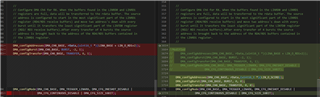
    I think part of the issue is because of the writeSCICharBlocking is conflicing with the previous "LIN_sendData" call:

    (Left is original example, right is the code provided)

    It looks like the LIN_sendData is probably still sending data when you do another LIN_writeSciCharBlocking in the middle of it. Because the buffer is set to only 1 byte, there's likely to be conflict there.

    To be sure of the issue though, could you provide the values of all the error registers in the LIN register set?

    Regards,

    Vince

  • Hi Vince,

    Thank you very much for your instant reply.

    If I use to send more than one byte in continuous manner using LIN_writeSciCharBlocking, then also not coming any results. 

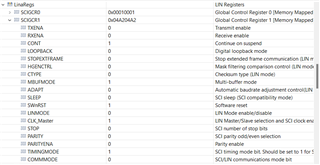
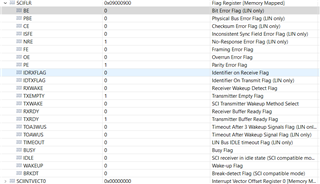
    I am attaching the value of global control register and flag register in LINA. please go through it.

    Thank you once again for your help.

    Warm Regards,

    Masud

  • Hi Masud,


    Thanks for providing the registers, that helps a lot.

    So it looks like two things are happening, both of which are potential debug paths:

    1. The TXENA and RXENA bits are not set (therefore no data transmission or reception will occur).

    For this one, let's use the following two functions somwhere in your initialization code, before the data is transferred to the shift register (before the writeChar function):

    LIN_enableDataTransmitter

    LIN_enableDataReceiver


    This will enable the TXENA and RXENA bits, see diagram below:


    2. The SCIFLR.PE bit is set, so it looks like at some point before the screenshots, a parity error occurred. Let's fix #1 first, then we can see about this issue.


    Regards,

    Vince

  • Dear Vince,

    Thank you for the important information.

    Your valuable reply helped me to transmit the data bytes from memory to terminal via DMA. You deserve ton of thanks.

    Now only i am facing issue with receiving data bytes.

    As per your suggestion, I put LIN_enableDataTransmitter, LIN_enableDataReceiver functions in the configureSCIMode. I wanted to understand, if we use LIN_writeSciCharArray function with DMA doesn't it means the CPU transfer the data instead of DMA. If it is, then I should not include writeChar or readChar function because as per my understanding, when a DMA request is occurred, the transmission between memory and buffer register automatically updated.

    To understand the concept, I modified the code little bit and also attached herewith please go through it. 

    I saw that the SCIRD register gets updated based on the received character from terminal but not updated in rData variable. Each time SCIRD registers receives data byte it triggers the DMA request then why the variable not gets updated?

    The code is below:

       //#############################################################################
        //
        // FILE:   lin_ex3_sci_dma.c
        //
        // TITLE:  LIN SCI MODE Internal Loopback with DMA
        //
        //! \addtogroup driver_example_list
        //! <h1> LIN SCI MODE Internal Loopback with DMA </h1>
        //!
        //! This example configures the LIN module in SCI mode for internal loopback
        //! with the use of the DMA. The LIN module performs as SCI with a set
        //! character and frame length in multi-buffer mode. When the transmit buffers
        //! in the LINTD0 and LINTD1 registers have enough space, the DMA will transfer
        //! data from global variable sData into those transmit registers. Once the
        //! received buffers in the LINRD0 and LINRD1 registers contain data,the DMA
        //! will transfer the data into the global variable rdata.
        //!
        //! When all data has been placed into rData, a check of the validity of the
        //! data will be performed in one of the DMA channels' ISRs.
        //!
        //! \b External \b Connections \n
        //!  - None
        //!
        //! \b Watch \b Variables \n
        //!  - \b sData - Data to send
        //!  - \b rData - Received data
        //!
        //
        //#############################################################################
        //
        //
        // $Copyright:
        // Copyright (C) 2022 Texas Instruments Incorporated - http://www.ti.com/
        //
        // Redistribution and use in source and binary forms, with or without
        // modification, are permitted provided that the following conditions
        // are met:
        //
        //   Redistributions of source code must retain the above copyright
        //   notice, this list of conditions and the following disclaimer.
        //
        //   Redistributions in binary form must reproduce the above copyright
        //   notice, this list of conditions and the following disclaimer in the
        //   documentation and/or other materials provided with the
        //   distribution.
        //
        //   Neither the name of Texas Instruments Incorporated nor the names of
        //   its contributors may be used to endorse or promote products derived
        //   from this software without specific prior written permission.
        //
        // THIS SOFTWARE IS PROVIDED BY THE COPYRIGHT HOLDERS AND CONTRIBUTORS
        // "AS IS" AND ANY EXPRESS OR IMPLIED WARRANTIES, INCLUDING, BUT NOT
        // LIMITED TO, THE IMPLIED WARRANTIES OF MERCHANTABILITY AND FITNESS FOR
        // A PARTICULAR PURPOSE ARE DISCLAIMED. IN NO EVENT SHALL THE COPYRIGHT
        // OWNER OR CONTRIBUTORS BE LIABLE FOR ANY DIRECT, INDIRECT, INCIDENTAL,
        // SPECIAL, EXEMPLARY, OR CONSEQUENTIAL DAMAGES (INCLUDING, BUT NOT
        // LIMITED TO, PROCUREMENT OF SUBSTITUTE GOODS OR SERVICES; LOSS OF USE,
        // DATA, OR PROFITS; OR BUSINESS INTERRUPTION) HOWEVER CAUSED AND ON ANY
        // THEORY OF LIABILITY, WHETHER IN CONTRACT, STRICT LIABILITY, OR TORT
        // (INCLUDING NEGLIGENCE OR OTHERWISE) ARISING IN ANY WAY OUT OF THE USE
        // OF THIS SOFTWARE, EVEN IF ADVISED OF THE POSSIBILITY OF SUCH DAMAGE.
        // $
        //#############################################################################
    
        //
        // Included Files
        //
        #include "driverlib.h"
        #include "device.h"
    
        //
        // Defines
        //
       //Modified
        // #define BURST       4
       // #define TRANSFER    32
       // #define CHAR_LENGTH     8
       // #define FRAME_LENGTH    8
    
       #define BURST       1
       #define TRANSFER    6
       #define CHAR_LENGTH     8
       #define FRAME_LENGTH    1
    
        //
        // Configure the Baud Rate to 115.207kHz
        //
        uint32_t PRESCALER=0x000001a;
        uint16_t DIVIDER=0x0002;
    
        //
        // Globals
        //
        //Modified
         uint16_t sData[6] = {'a', 'b', 'c','d','e', 'f'};
         uint16_t rData[4];
       // unsigned char *sData;
       // unsigned char *rData;
    
        //Place buffers in GSRAM
        #pragma DATA_SECTION(sData, "ramgs0");
        #pragma DATA_SECTION(rData, "ramgs0");
    
    //    volatile uint16_t done = 0;         // Flag to set when all data transfered
    
        //
        // Function Prototypes
        //
        void initDMA(void);
        void configureSCIMode(void);
        __interrupt void dmaCh5ISR(void);
        __interrupt void dmaCh6ISR(void);
    
    
        //
        // Main
        //
        void main(void)
        {
            //
            // Initialize device clock and peripherals
            //
            Device_init();
    
            //
            // Initialize GPIO
            //
            Device_initGPIO();
    
            // Pin config for LIN tx and LIN rx
            GPIO_setPinConfig(DEVICE_GPIO_CFG_LINTXA);
            GPIO_setPinConfig(DEVICE_GPIO_CFG_LINRXA);
            // GPIO_23 is used as LINTXA
            GPIO_setDirectionMode(23, GPIO_DIR_MODE_IN);
            GPIO_setPadConfig(23, GPIO_PIN_TYPE_PULLUP);
            GPIO_setQualificationMode(23, GPIO_QUAL_ASYNC);
            // GPIO_23 is used as LINRXA
            GPIO_setDirectionMode(22, GPIO_DIR_MODE_OUT);
            GPIO_setPadConfig(22, GPIO_PIN_TYPE_STD);
            GPIO_setQualificationMode(22, GPIO_QUAL_ASYNC);
    
    
            //
            // Initialize PIE and clear PIE registers. Disables CPU interrupts.
            //
            Interrupt_initModule();
    
            //
            // Initialize the PIE vector table with pointers to the shell Interrupt
            // Service Routines (ISR).
            //
            Interrupt_initVectorTable();
            EINT;
            ERTM;
    
            //
            // Interrupts that are used in this example are re-mapped to
            // ISR functions found within this file.
            // This registers the interrupt handler in PIE vector table.
            //
            Interrupt_register(INT_DMA_CH5, &dmaCh5ISR);
            Interrupt_register(INT_DMA_CH6, &dmaCh6ISR);
    
            //
            // Enable the DMA interrupt signals
            //
            Interrupt_enable(INT_DMA_CH5);
            Interrupt_enable(INT_DMA_CH6);
    
            //
            // Initialize the DMA
            //
            initDMA();
    
            //
            //Initialize the LIN Module
            //
            LIN_initModule(LINA_BASE);
    
            //
            // Configure the LIN module to operate in SCI mode
            //
            configureSCIMode();
    
            //
            // Initialize the data buffers
            //
       //Modified
       //     for(i = 0; i < 128; i++)
       //     {
       //        sData[i]= i;
       //        rData[i]= 0;
       //     }
    
            //
            // Wait for the SCI receiver to be idle
            //
            while(!LIN_isSCIReceiverIdle(LINA_BASE));
    
            //
            // Wait until space is available in the transmit buffer.
            //
            while(!LIN_isSCISpaceAvailable(LINA_BASE)){}
            //
            //Initiate transfer through a CPU write
            //
            LIN_sendData(LINA_BASE,(unsigned int*)0xFFFF);
    
            //
            // Start the DMA receive channel
            //
            DMA_startChannel(DMA_CH6_BASE);
    
            //
            //Start the DMA transmit channel
            //
            DMA_startChannel(DMA_CH5_BASE);
    
            //Write one data byte when Tx buffer is ready
    //        LIN_writeSCICharBlocking(LINA_BASE, sData[1]);
            //
            //Wait until the DMA transfer is complete
            //
    //        while(!done);
    //        for(;;);
    
            //
            //When the DMA transfer is complete the program will stop here
            //
    //        ESTOP0;
    
        }
    
        //
        // Function to configure LIN in SCI Mode
        //
        void
        configureSCIMode(void)
        {
            //
            // Enter LIN reset state to perform configurations
            //
            LIN_enterSoftwareReset(LINA_BASE);
    
            //
            // Switch LIN into SCI mode
            //
            LIN_enableSCIMode(LINA_BASE);
    
            //
            // Set the SCI communication mode to idle line
            //
            LIN_setSCICommMode(LINA_BASE, LIN_COMM_SCI_IDLELINE);
    
            //
            // Set SCI to transmit one stop bit
            //
            LIN_setSCIStopBits(LINA_BASE,LIN_SCI_STOP_ONE);
    
            //
            // Disable parity check
            //
            LIN_disableSCIParity(LINA_BASE);
    
       //Modified
            //
            // Enable multi-buffer mode
            //
       //     LIN_enableMultibufferMode(LINA_BASE);
            LIN_disableMultibufferMode(LINA_BASE);
    
            //
            // Module set to complete operations when halted by debugger
            //
            LIN_setDebugSuspendMode(LINA_BASE, LIN_DEBUG_COMPLETE);
    
            //
            // Set character length as 8-bits
            //
            LIN_setSCICharLength(LINA_BASE, CHAR_LENGTH);
    
            //
            // Set to 1 character in response field
            //
            LIN_setSCIFrameLength(LINA_BASE, FRAME_LENGTH);
    
            //
            // Set the Baud Rate
            //
            LIN_setBaudRatePrescaler(LINA_BASE, PRESCALER, DIVIDER);
    
       //Modified
            //
            // Enable Internal Loopback mode
            //
       //     LIN_enableIntLoopback(LINA_BASE);
       //     LIN_disableIntLoopback(LINA_BASE);
    
            LIN_enableDataTransmitter(LINA_BASE);
            LIN_enableDataReceiver(LINA_BASE);
            //
            //Enable the DMA for transmission
            //
            LIN_enableSCIInterrupt(LINA_BASE, LIN_SCI_INT_TX_DMA);
    
            //
            //Enable the DMA to receive
            //
            LIN_enableSCIInterrupt(LINA_BASE, LIN_SCI_INT_RX_DMA);
    
    
            // Exit LIN reset state
            //
            LIN_exitSoftwareReset(LINA_BASE);
        }
    
        //
        // DMA setup for both TX and RX channels.
        //
        void initDMA()
        {
            //
            // Initialize DMA
            //
            DMA_initController();
    
            //
            // Configure DMA Ch5 for TX. When there is enough space in the buffers found in
            // the LINTD0 and LINTD1 registers, data will be transferred from the sdata buffer
            // to the LIN's transmit registers. The destination address is configured to start
            // in the most significant part of the LINTD1 register (TD4/TD5 transmit buffers)and
            // move two address's down with every burst until it fills up the least significant
            // part of the LINTD0 register (TD2/ TD3 transmit buffers).After every transfer of
            // 4 bursts the destination address is brought back to the address of the TD4/TD5
            // buffers contained in the LINTD1 register.
            //
    
       //Modified
    //        DMA_configAddresses(DMA_CH5_BASE, (uint16_t *)(LINA_BASE + LIN_O_TD1+2), sData);
    //        DMA_configBurst(DMA_CH5_BASE, BURST, 1, -2);
    //        DMA_configTransfer(DMA_CH5_BASE, TRANSFER, 1, 6);
    //        DMA_configMode(DMA_CH5_BASE, DMA_TRIGGER_LINATX, DMA_CFG_ONESHOT_DISABLE |
    //                       DMA_CFG_CONTINUOUS_DISABLE | DMA_CFG_SIZE_16BIT);
    
    //
            DMA_configAddresses(DMA_CH5_BASE, (uint16_t *)(LINA_BASE + LIN_O_SCITD), sData);
            DMA_configBurst(DMA_CH5_BASE, BURST, 4, 0);
            DMA_configTransfer(DMA_CH5_BASE, TRANSFER, 1, 0);
            DMA_configMode(DMA_CH5_BASE, DMA_TRIGGER_LINATX, DMA_CFG_ONESHOT_DISABLE |
                           DMA_CFG_CONTINUOUS_DISABLE | DMA_CFG_SIZE_16BIT);
    
            //
            // Configure DMA Ch5 interrupts
            //
            DMA_setInterruptMode(DMA_CH5_BASE, DMA_INT_AT_END);
            DMA_enableInterrupt(DMA_CH5_BASE);
            DMA_enableTrigger(DMA_CH5_BASE);
    
            //
            // Configure DMA Ch6 for RX. When the buffers found in the LINRD0 and LINRD1
            // registers are full, data will be transferred to the rdata buffer. The source
            // address is configured to start in the most significant part of the LINRD1
            // register (RD4/RD5 receive buffers) and move two address's down with every
            // burst until it transfers the least significant part of the LINTD0 register
            // (RD2/ RD3 receive buffers).After every transfer of 4 bursts the source
            // address is brought back to the address of the RD4/RD5 buffers contained in
            // the LINRD1 register.
            //
    
       //Modified
       //     DMA_configAddresses(DMA_CH6_BASE, rData,(uint16_t *)(LINA_BASE + LIN_O_RD1+2));
       //     DMA_configBurst(DMA_CH6_BASE, BURST, -2, 1);
       //     DMA_configTransfer(DMA_CH6_BASE, TRANSFER, 6, 1);
       //     DMA_configMode(DMA_CH6_BASE, DMA_TRIGGER_LINARX, DMA_CFG_ONESHOT_DISABLE |
       //                    DMA_CFG_CONTINUOUS_DISABLE | DMA_CFG_SIZE_16BIT);
    
            DMA_configAddresses(DMA_CH6_BASE, rData,(uint16_t *)(LIN_O_SCIRD));
            DMA_configBurst(DMA_CH6_BASE, BURST, 0, 4);
            DMA_configTransfer(DMA_CH6_BASE, TRANSFER, 0, 1);
            DMA_configMode(DMA_CH6_BASE, DMA_TRIGGER_LINARX, DMA_CFG_ONESHOT_DISABLE |
                           DMA_CFG_CONTINUOUS_DISABLE | DMA_CFG_SIZE_16BIT);
    
            //
            // Configure DMA Ch6 interrupts
            //
            DMA_setInterruptMode(DMA_CH6_BASE, DMA_INT_AT_END);
            DMA_enableInterrupt(DMA_CH6_BASE);
            DMA_enableTrigger(DMA_CH6_BASE);
        }
    
        //
        // DMA Channel 5 ISR
        //
        __interrupt void dmaCh5ISR(void)
        {
            DMA_stopChannel(DMA_CH5_BASE);
            Interrupt_clearACKGroup(INTERRUPT_ACK_GROUP7);
            return;
    //        done = 1;
        }
    
        //
        // DMA Channel 6 ISR
        //
         __interrupt void dmaCh6ISR(void)
        {
            uint16_t i;
            DMA_stopChannel(DMA_CH6_BASE);
            Interrupt_clearACKGroup(INTERRUPT_ACK_GROUP7);
    
       //Modified
        //    //
        //    //Check for data integrity
        //    //
        //    for(i=0; i<128; i++)
        //    {
        //        if(rData[i] !=i)
        //        {
        //           //Something went wrong, rdata doesn't contain expected data.
        //           ESTOP0;
        //        }
        //    }
    
    //        done = 1;
            return;
        }
    Thank you and warm regards,

    Masud

  • Hi Masud,

    Glad you were able to get the transmitter working. answering the question on the DMA: Please see line that has "LIN_O_SCIRD". This is missing the "LINA_BASE" offset, and so is pointing to the wrong location in memory.

     '

    Please see comparisons above between left=original code, right=provided code.

    Specifically this line is incorrect, and needs to have "LINA_BASE" like the TX :

    DMA_configAddresses(DMA_CH6_BASE, rData,(uint16_t *)(LIN_O_SCIRD));

    Regards,

    Vince

  • Hi Vince,

    I have added LINA_BASE with LIN_O_SCIRD, then also the result is not updating in the rData variable. The data byte is received by the SCIRD buffer register and reflecting in the register section. I have also tried using a single rData variable instead of array and pass the address to the DMA_configAddresses(DMA_CH6_BASE, &rData,(uint16_t *)(LINA_BASE+LIN_O_SCIRD)); I think am very close to it but doing some mistakes that I couldn't figure out.

    Thank you and regards,

    Masud

  • Hi Masud,

    Can you show the updated line that has LINA_BASE and LIN_O_SCIRD? I would like to review that part of the code.


    Regards,

    Vince

  • Hi Vince,

    Sorry for the late reply, facing health issue.

    below is the updated code:

    //#############################################################################
        //
        // FILE:   lin_ex3_sci_dma.c
        //
        // TITLE:  LIN SCI MODE Internal Loopback with DMA
        //
        //! \addtogroup driver_example_list
        //! <h1> LIN SCI MODE Internal Loopback with DMA </h1>
        //!
        //! This example configures the LIN module in SCI mode for internal loopback
        //! with the use of the DMA. The LIN module performs as SCI with a set
        //! character and frame length in multi-buffer mode. When the transmit buffers
        //! in the LINTD0 and LINTD1 registers have enough space, the DMA will transfer
        //! data from global variable sData into those transmit registers. Once the
        //! received buffers in the LINRD0 and LINRD1 registers contain data,the DMA
        //! will transfer the data into the global variable rdata.
        //!
        //! When all data has been placed into rData, a check of the validity of the
        //! data will be performed in one of the DMA channels' ISRs.
        //!
        //! \b External \b Connections \n
        //!  - None
        //!
        //! \b Watch \b Variables \n
        //!  - \b sData - Data to send
        //!  - \b rData - Received data
        //!
        //
        //#############################################################################
        //
        //
        // $Copyright:
        // Copyright (C) 2022 Texas Instruments Incorporated - http://www.ti.com/
        //
        // Redistribution and use in source and binary forms, with or without
        // modification, are permitted provided that the following conditions
        // are met:
        //
        //   Redistributions of source code must retain the above copyright
        //   notice, this list of conditions and the following disclaimer.
        //
        //   Redistributions in binary form must reproduce the above copyright
        //   notice, this list of conditions and the following disclaimer in the
        //   documentation and/or other materials provided with the
        //   distribution.
        //
        //   Neither the name of Texas Instruments Incorporated nor the names of
        //   its contributors may be used to endorse or promote products derived
        //   from this software without specific prior written permission.
        //
        // THIS SOFTWARE IS PROVIDED BY THE COPYRIGHT HOLDERS AND CONTRIBUTORS
        // "AS IS" AND ANY EXPRESS OR IMPLIED WARRANTIES, INCLUDING, BUT NOT
        // LIMITED TO, THE IMPLIED WARRANTIES OF MERCHANTABILITY AND FITNESS FOR
        // A PARTICULAR PURPOSE ARE DISCLAIMED. IN NO EVENT SHALL THE COPYRIGHT
        // OWNER OR CONTRIBUTORS BE LIABLE FOR ANY DIRECT, INDIRECT, INCIDENTAL,
        // SPECIAL, EXEMPLARY, OR CONSEQUENTIAL DAMAGES (INCLUDING, BUT NOT
        // LIMITED TO, PROCUREMENT OF SUBSTITUTE GOODS OR SERVICES; LOSS OF USE,
        // DATA, OR PROFITS; OR BUSINESS INTERRUPTION) HOWEVER CAUSED AND ON ANY
        // THEORY OF LIABILITY, WHETHER IN CONTRACT, STRICT LIABILITY, OR TORT
        // (INCLUDING NEGLIGENCE OR OTHERWISE) ARISING IN ANY WAY OUT OF THE USE
        // OF THIS SOFTWARE, EVEN IF ADVISED OF THE POSSIBILITY OF SUCH DAMAGE.
        // $
        //#############################################################################
    
        //
        // Included Files
        //
        #include "driverlib.h"
        #include "device.h"
    
        //
        // Defines
        //
       //Modified
        // #define BURST       4
       // #define TRANSFER    32
       // #define CHAR_LENGTH     8
       // #define FRAME_LENGTH    8
    
       #define BURST       1
       #define TRANSFER    6
       #define CHAR_LENGTH     8
       #define FRAME_LENGTH    1
    
        //
        // Configure the Baud Rate to 115.207kHz
        //
        uint32_t PRESCALER=0x000001a;
        uint16_t DIVIDER=0x0002;
    
        //
        // Globals
        //
        //Modified
         uint16_t sData[6] = {'a', 'b', 'c','d','e', 'f'};
         uint16_t rData[4];
       // unsigned char *sData;
    //     uint16_t *rData;
    //     uint16_t rData;
         uint16_t i;
        //Place buffers in GSRAM
        #pragma DATA_SECTION(sData, "ramgs0");
        #pragma DATA_SECTION(rData, "ramgs0");
    
    //    volatile uint16_t done = 0;         // Flag to set when all data transfered
    
        //
        // Function Prototypes
        //
        void initDMA(void);
        void configureSCIMode(void);
        __interrupt void dmaCh5ISR(void);
        __interrupt void dmaCh6ISR(void);
    
    
        //
        // Main
        //
        void main(void)
        {
            //
            // Initialize device clock and peripherals
            //
            Device_init();
    
            //
            // Initialize GPIO
            //
            Device_initGPIO();
    
            // Pin config for LIN tx and LIN rx
            GPIO_setPinConfig(DEVICE_GPIO_CFG_LINTXA);
            GPIO_setPinConfig(DEVICE_GPIO_CFG_LINRXA);
            // GPIO_23 is used as LINTXA
            GPIO_setDirectionMode(29, GPIO_DIR_MODE_IN);
            GPIO_setPadConfig(29, GPIO_PIN_TYPE_PULLUP);
            GPIO_setQualificationMode(29, GPIO_QUAL_ASYNC);
            // GPIO_23 is used as LINRXA
            GPIO_setDirectionMode(28, GPIO_DIR_MODE_OUT);
            GPIO_setPadConfig(28, GPIO_PIN_TYPE_STD);
            GPIO_setQualificationMode(28, GPIO_QUAL_ASYNC);
    
    
            //
            // Initialize PIE and clear PIE registers. Disables CPU interrupts.
            //
            Interrupt_initModule();
    
            //
            // Initialize the PIE vector table with pointers to the shell Interrupt
            // Service Routines (ISR).
            //
            Interrupt_initVectorTable();
            EINT;
            ERTM;
    
            //
            // Interrupts that are used in this example are re-mapped to
            // ISR functions found within this file.
            // This registers the interrupt handler in PIE vector table.
            //
            Interrupt_register(INT_DMA_CH5, &dmaCh5ISR);
            Interrupt_register(INT_DMA_CH6, &dmaCh6ISR);
    
            //
            // Enable the DMA interrupt signals
            //
            Interrupt_enable(INT_DMA_CH5);
            Interrupt_enable(INT_DMA_CH6);
    
            //
            // Initialize the DMA
            //
            initDMA();
    
            //
            //Initialize the LIN Module
            //
            LIN_initModule(LINA_BASE);
    
            //
            // Configure the LIN module to operate in SCI mode
            //
            configureSCIMode();
    
            //
            // Initialize the data buffers
            //
       //Modified
       //     for(i = 0; i < 128; i++)
       //     {
       //        sData[i]= i;
       //        rData[i]= 0;
       //     }
    
            //
            // Wait for the SCI receiver to be idle
            //
            while(!LIN_isSCIReceiverIdle(LINA_BASE));
    
            //
            // Wait until space is available in the transmit buffer.
            //
            while(!LIN_isSCISpaceAvailable(LINA_BASE)){}
            //
            //Initiate transfer through a CPU write
            //
            LIN_sendData(LINA_BASE,(unsigned int*)0xFFFF);
    
            //
            // Start the DMA receive channel
            //
            DMA_startChannel(DMA_CH6_BASE);
    
            //
            //Start the DMA transmit channel
            //
    //        DMA_startChannel(DMA_CH5_BASE);
    
    
            DMA_startChannel(DMA_CH5_BASE);
    
            //Write one data byte when Tx buffer is ready
    //        LIN_writeSCICharBlocking(LINA_BASE, sData[1]);
            //
            //Wait until the DMA transfer is complete
            //
    //        while(!done);
    //        for(;;);
    
            //
            //When the DMA transfer is complete the program will stop here
            //
    //        ESTOP0;
    
        }
    
        //
        // Function to configure LIN in SCI Mode
        //
        void
        configureSCIMode(void)
        {
            //
            // Enter LIN reset state to perform configurations
            //
            LIN_enterSoftwareReset(LINA_BASE);
    
            //
            // Switch LIN into SCI mode
            //
            LIN_enableSCIMode(LINA_BASE);
    
            //
            // Set the SCI communication mode to idle line
            //
            LIN_setSCICommMode(LINA_BASE, LIN_COMM_SCI_IDLELINE);
    
            //
            // Set SCI to transmit one stop bit
            //
            LIN_setSCIStopBits(LINA_BASE,LIN_SCI_STOP_ONE);
    
            //
            // Disable parity check
            //
            LIN_disableSCIParity(LINA_BASE);
    
       //Modified
            //
            // Enable multi-buffer mode
            //
       //     LIN_enableMultibufferMode(LINA_BASE);
            LIN_disableMultibufferMode(LINA_BASE);
    
            //
            // Module set to complete operations when halted by debugger
            //
            LIN_setDebugSuspendMode(LINA_BASE, LIN_DEBUG_COMPLETE);
    
            //
            // Set character length as 8-bits
            //
            LIN_setSCICharLength(LINA_BASE, CHAR_LENGTH);
    
            //
            // Set to 1 character in response field
            //
            LIN_setSCIFrameLength(LINA_BASE, FRAME_LENGTH);
    
            //
            // Set the Baud Rate
            //
            LIN_setBaudRatePrescaler(LINA_BASE, PRESCALER, DIVIDER);
    
       //Modified
            //
            // Enable Internal Loopback mode
            //
       //     LIN_enableIntLoopback(LINA_BASE);
       //     LIN_disableIntLoopback(LINA_BASE);
    
            LIN_enableDataTransmitter(LINA_BASE);
            LIN_enableDataReceiver(LINA_BASE);
            //
            //Enable the DMA for transmission
            //
            LIN_enableSCIInterrupt(LINA_BASE, LIN_SCI_INT_TX_DMA);
    
            //
            //Enable the DMA to receive
            //
            LIN_enableSCIInterrupt(LINA_BASE, LIN_SCI_INT_RX_DMA);
    
    
            // Exit LIN reset state
            //
            LIN_exitSoftwareReset(LINA_BASE);
        }
    
        //
        // DMA setup for both TX and RX channels.
        //
        void initDMA()
        {
            //
            // Initialize DMA
            //
            DMA_initController();
    
            //
            // Configure DMA Ch5 for TX. When there is enough space in the buffers found in
            // the LINTD0 and LINTD1 registers, data will be transferred from the sdata buffer
            // to the LIN's transmit registers. The destination address is configured to start
            // in the most significant part of the LINTD1 register (TD4/TD5 transmit buffers)and
            // move two address's down with every burst until it fills up the least significant
            // part of the LINTD0 register (TD2/ TD3 transmit buffers).After every transfer of
            // 4 bursts the destination address is brought back to the address of the TD4/TD5
            // buffers contained in the LINTD1 register.
            //
    
       //Modified
    //        DMA_configAddresses(DMA_CH5_BASE, (uint16_t *)(LINA_BASE + LIN_O_TD1+2), sData);
    //        DMA_configBurst(DMA_CH5_BASE, BURST, 1, -2);
    //        DMA_configTransfer(DMA_CH5_BASE, TRANSFER, 1, 6);
    //        DMA_configMode(DMA_CH5_BASE, DMA_TRIGGER_LINATX, DMA_CFG_ONESHOT_DISABLE |
    //                       DMA_CFG_CONTINUOUS_DISABLE | DMA_CFG_SIZE_16BIT);
    
    //
            DMA_configAddresses(DMA_CH5_BASE, (uint16_t *)(LINA_BASE + LIN_O_SCITD), sData);
            DMA_configBurst(DMA_CH5_BASE, BURST, 4, 0);
            DMA_configTransfer(DMA_CH5_BASE, TRANSFER, 1, 0);
            DMA_configMode(DMA_CH5_BASE, DMA_TRIGGER_LINATX, DMA_CFG_ONESHOT_DISABLE |
                           DMA_CFG_CONTINUOUS_DISABLE | DMA_CFG_SIZE_16BIT);
    
            //
            // Configure DMA Ch5 interrupts
            //
            DMA_setInterruptMode(DMA_CH5_BASE, DMA_INT_AT_END);
            DMA_enableInterrupt(DMA_CH5_BASE);
            DMA_enableTrigger(DMA_CH5_BASE);
    
            //
            // Configure DMA Ch6 for RX. When the buffers found in the LINRD0 and LINRD1
            // registers are full, data will be transferred to the rdata buffer. The source
            // address is configured to start in the most significant part of the LINRD1
            // register (RD4/RD5 receive buffers) and move two address's down with every
            // burst until it transfers the least significant part of the LINTD0 register
            // (RD2/ RD3 receive buffers).After every transfer of 4 bursts the source
            // address is brought back to the address of the RD4/RD5 buffers contained in
            // the LINRD1 register.
            //
    
       //Modified
       //     DMA_configAddresses(DMA_CH6_BASE, rData,(uint16_t *)(LINA_BASE + LIN_O_RD1+2));
       //     DMA_configBurst(DMA_CH6_BASE, BURST, -2, 1);
       //     DMA_configTransfer(DMA_CH6_BASE, TRANSFER, 6, 1);
       //     DMA_configMode(DMA_CH6_BASE, DMA_TRIGGER_LINARX, DMA_CFG_ONESHOT_DISABLE |
       //                    DMA_CFG_CONTINUOUS_DISABLE | DMA_CFG_SIZE_16BIT);
    
            DMA_configAddresses(DMA_CH6_BASE, rData,(uint16_t *)(LINA_BASE + LIN_O_SCIRD));
            DMA_configBurst(DMA_CH6_BASE, BURST, 0, 4);
            DMA_configTransfer(DMA_CH6_BASE, TRANSFER, 0, 1);
            DMA_configMode(DMA_CH6_BASE, DMA_TRIGGER_LINARX, DMA_CFG_ONESHOT_DISABLE |
                           DMA_CFG_CONTINUOUS_DISABLE | DMA_CFG_SIZE_16BIT);
    
            //
            // Configure DMA Ch6 interrupts
            //
            DMA_setInterruptMode(DMA_CH6_BASE, DMA_INT_AT_END);
            DMA_enableInterrupt(DMA_CH6_BASE);
            DMA_enableTrigger(DMA_CH6_BASE);
        }
    
        //
        // DMA Channel 5 ISR
        //
        __interrupt void dmaCh5ISR(void)
        {
            DMA_stopChannel(DMA_CH5_BASE);
            Interrupt_clearACKGroup(INTERRUPT_ACK_GROUP7);
            return;
    //        done = 1;
        }
    
        //
        // DMA Channel 6 ISR
        //
         __interrupt void dmaCh6ISR(void)
        {
            uint16_t i;
            DMA_stopChannel(DMA_CH6_BASE);
            Interrupt_clearACKGroup(INTERRUPT_ACK_GROUP7);
    
       //Modified
        //    //
        //    //Check for data integrity
        //    //
        //    for(i=0; i<128; i++)
        //    {
        //        if(rData[i] !=i)
        //        {
        //           //Something went wrong, rdata doesn't contain expected data.
        //           ESTOP0;
        //        }
        //    }
    
    //        done = 1;
            return;
        }
    

    I checked the code but didnt find any issue, if the SCIRD address is not correct then how the data is received by SCIRD buffer register?

    But in the rData doesn't receive anything.

    Thank you for your consideration.

    warm regards,

  • Hi Masud,

    It looks like your main code does not have a while loop at the end to keep the program running. Is it possible that the program is just ending before the RX can receive?

    Either way, I would recommend you put a "while(1);" at the end of your main loop.

    Regards,

    Vince