This thread has been locked.

If you have a related question, please click the "Ask a related question" button in the top right corner. The newly created question will be automatically linked to this question.

TMS320F28376D: extending EMxOE STROBE period

Part Number: TMS320F28376D

Hi team,


My customer would like to control chip-select’s EMxOE Timing (STROBE) by external signal. In this case, we can apply external signal to EMxWAIT pin, correct?

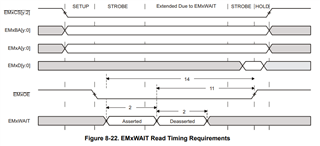
Also, when extending EMxOE STROBE period by WAIT signal, should assert timing of WAIT be in the range of EMxOE STROBE? If WAIT signal asserted not in the range of EMxOE STROBE period, how the device would operate?
 

Best regards,

Kurumi

  • Hi,

    My customer would like to control chip-select’s EMxOE Timing (STROBE) by external signal. In this case, we can apply external signal to EMxWAIT pin, correct?

    Correct.

    Also, when extending EMxOE STROBE period by WAIT signal, should assert timing of WAIT be in the range of EMxOE STROBE? If WAIT signal asserted not in the range of EMxOE STROBE period, how the device would operate?

    Yes, it need to follow the timing requirement given in the diagram. If not then WAIT will be ignored and access will be completed with whatever data available on the bus.

    Regards,

    Vivek Singh

  • Hi Vivek,


    So, extended wait mode should be ON (EW=1) to use WAIT signal. And the datasheet shows below parameter for EMxOE active low width.

     Q1: I believe RST*E represents strobe period. And if WAIT is not asserted during this period, then EMxOE will transition to High. Is my understanding correct?

    Q2: If WAIT-pin is asserted during strobe period (RST*E), then EMxOE active low time will be extended until WAIT-pin is de-asserted. And the extended time is max EWC*16*E. Is my understanding correct?

    Q3: If WAIT-pin is not de-asserted by the end of max extend (EWC*16*E) time, then EMxOE will transition to High after the (EWC*16*E) time. Is my understanding correct?


    Best regards,

    Kurumi

  • Yes, all the points you mentioned are correct.

    Regards,

    Vivek Singh

  • Understood, thank you again for your support.

    Best regards,

    Kurumi
