This thread has been locked.

If you have a related question, please click the "Ask a related question" button in the top right corner. The newly created question will be automatically linked to this question.

TMS320F280039: I2C Timing Requirements data in datasheet

Part Number: TMS320F280039

Hi Champs,

There are some questions on I2C time data.

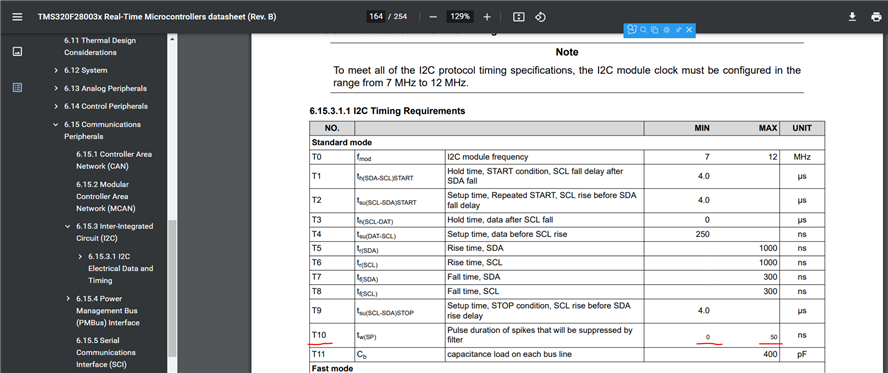
1.I read F280039 datasheet online and found the data I marked(T10) seems incomplete. I tried to read in another browser, and tried to download the file and read, but I read the same thing. What should the data here be? 
https://www.ti.com/lit/ds/symlink/tms320f280039.pdf?ts=1683803067979&ref_url=https%253A%252F%252Fwww.ti.com.cn%252Fproduct%252Fcn%252FTMS320F280039

2. T10 is used to filter out spikes, so how much voltage can be filter? And where is the filter?

3. There is no tw(SP) in F28069 datasheet, does it mean F28069 does not have this filter?

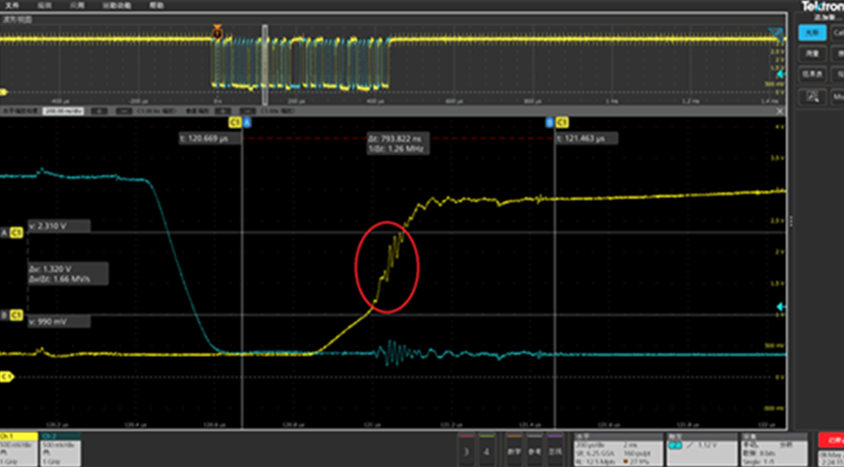
4. Also in the same table, T5 maximum value is 1000ns, if in the rise time the voltage has dropped as below picture, is there any risk?
Could you please help me on this? Thanks!

Regards,

Julia

  • 2. T10 is used to filter out spikes, so how much voltage can be filter? And where is the filter?

    Any glitches less than 50ns will gobbled. Any signals which is read as one or a zero by mcu but is less than 50ns width will be filtered by spike filter.

    3. There is no tw(SP) in F28069 datasheet, does it mean F28069 does not have this filter?

    This 50ns glitch filter is I2C specification requirement. So, it is available in F28069 I2C as well. In older device datasheets we didn't explicitly mention this.

    . Also in the same table, T5 maximum value is 1000ns, if in the rise time the voltage has dropped as below picture, is there any risk

    It looks like some sort of ringing noise and has the potential to cause problem if the width of these pulses exceed 50ns. I recommend to use series resistors, stronger pull-up and do impedance matching to get these problems resolved.

    Regards,

    Manoj