This thread has been locked.

If you have a related question, please click the "Ask a related question" button in the top right corner. The newly created question will be automatically linked to this question.

TMS320F28069: TMS320F28069 float instruction Cycle

Part Number: TMS320F28069

Please consult a comparison question between 28069 floating-point and integer operations:

My CCS version is 12.1. When running float and int operations in the interrupt function [the interrupt function is loaded in RAM], I found that the multiplication of two floats is 5 Instruction cycle, as attachment.

Why is the multiplication of two floats 5 Instruction cycle?
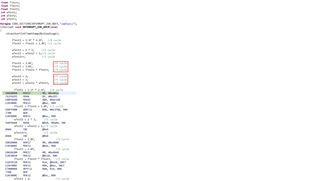
  • Thanks for providing the disassembly. You can see the disassembly shows why this takes 5 cycles. 2 moves, then the multiply which is a 2p cycle instruction - this means it takes 2 cycles, but the 2nd cycle can be filled with a non-conflicting instruction, if available. In this case, the compiler isn't able to fill anything there. Then the final move.

    3 moves + 1 multiply (2 cycles) = 5 cycles

    What optimization level was used?

    Thanks,

    Sira