This thread has been locked.

If you have a related question, please click the "Ask a related question" button in the top right corner. The newly created question will be automatically linked to this question.

TMS320F28377D: TI GPIO Driver unit test

Part Number: TMS320F28377D


Dear TI,

I have created a driver inspired by the TI driver and now wish to conduct testing on it.

I would greatly appreciate it if you could provide me with information on how TI tests the GPIOs and muxing for dual-core CPUs.

Thank you in advance,

S.Tarik

  • Hello Tarik,

    I would greatly appreciate it if you could provide me with information on how TI tests the GPIOs

    I have contacted the design experts who test the GPIOs and I will get back to you once they have a response.

    muxing for dual-core CPUs.

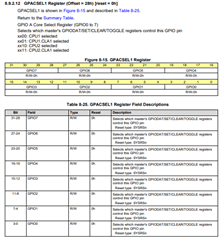
    To configure the GPIOs for CPU1, configure it how you normally would (configure the GPyGMUXn and GPyMUXn, the direction, and the pull-up resistor if needed). For CPU2 you do the same thing, but once you configure everything you need to change the GPIO controller to be the secondary CPU (this is done through the GPyCSELn register).

    Best regards,

    Omer Amir

  • Hello Tarik,

    I asked some of the people involving validation of our devices, and you should be able to test your driver by doing a simple GPIO toggle and reading the pin with an oscilloscope. There is not anything extraneous used in testing.

    Best regards,

    Omer Amir

  • Hello Omer,

    Yes, I did that for a low level test,

    The thing is this test is not sufficient since it does not test all the possible mixing with peripheral,

    I want to implement a software test on all the GPIOs and for each GPIO test all the possible mixing GPIO

    S.Tarik

  • Hello Tarik,

    The thing is this test is not sufficient since it does not test all the possible mixing with peripheral,

    I want to implement a software test on all the GPIOs and for each GPIO test all the possible mixing GPIO

    You will have to implement a program to do this yourself, as TI does not have an example or test that does this that we provide customers. You can create a loop to iterate through all sequences of the GPyGMUXn and GPyMUXn configurations for each GPIO (either using bitfields or driverlib), but this is only really best used for a ControlCARD since a LaunchPAD will not have all pins broken out on the board.

    Best regards,

    Omer Amir