This thread has been locked.

If you have a related question, please click the "Ask a related question" button in the top right corner. The newly created question will be automatically linked to this question.

TMS320F28075: ADC error calibration

Part Number: TMS320F28075

Dear Champs,

I am asking this for our customers.

in the datasheet,

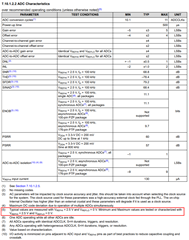
7.10.1.2.2 ADC characteristics

  1. Which ADC error could be calibrated, which one could not be calibrated?
  2. Which one error parameter of the ADC characteristics table  is for single end ADC, which one is for differential ADC?
  3. What does "Channel to channel gain/offset error" and "ADC to ADC gain/offset error" mean?
  4. Some test result did not show the "test condition" in the ADC characteristics table. What is the test condition of the Gain error, offset error, channel to channel gain/offset error, INL/DNL?
  5. The result of the ADC characteristics table were base on what temperature and sampling rate test condition?
  6. what sampling rate was suggested?
  7. What is the temperature drift error for the F28075 ADC?

Best Regards,

Daniel

  • Hello Daniel,

    Which ADC error could be calibrated, which one could not be calibrated?

    If you're talking about calibrating the ADC, there are functions in OTP for copying the trim values into the respective ADC registers. If you're talking about doing a re-calibration to replace the trim values in the registers, I don't believe this device has any such feature built-in. You can see the screenshot below for what's available in the reference manual.

    Which one error parameter of the ADC characteristics table  is for single end ADC, which one is for differential ADC?

    There is no differential ADC for this device (the F2837xS/D variants do have a differential ADC). This will be fixed in the next revision of the reference manual for this device where the registers are not marked as reserved.

    What does "Channel to channel gain/offset error" and "ADC to ADC gain/offset error" mean?

    You can refer to my second response on this post: https://e2e.ti.com/f/1/t/1186725.

    Some test result did not show the "test condition" in the ADC characteristics table. What is the test condition of the Gain error, offset error, channel to channel gain/offset error, INL/DNL?

    You can refer to the below screenshot, which I believe highlights the only testing conditions. If the customer has tried this and is still not able to get similar results, let me know and I can inquire further as to their setup:

    The result of the ADC characteristics table were base on what temperature and sampling rate test condition?

    I believe this data was captured based on a range of testing at different temperatures with the maximum sampling rate, but I will double-check with another expert.

    what sampling rate was suggested?

    The sampling rate suggested depends on the control loop of the customer's application; faster sampling rate means the ADC data will need to be computed faster, which may take up bandwidth from other processes. This is a decision the customer should make based on their needs, but the sampling rate can reach 3.1 MSPS given that there are no user-based requirements.

    What is the temperature drift error for the F28075 ADC?

    I will need to ask about this and get back to you.

    Best regards,

    Omer Amir

  • Hello Daniel,

    The result of the ADC characteristics table were base on what temperature and sampling rate test condition?

    The characterization for the min/max's were tested within the operational range of the device (i.e. from low temp to high temp) so that the characterization data provided can be expected for those conditions.

    What is the temperature drift error for the F28075 ADC?

    The drift error is included for the offset/gain error min/max values. Note that for external reference, it is assumed that the reference is ideal.

    Best regards,

    Omer Amir

  • If you're talking about calibrating the ADC, there are functions in OTP for copying the trim values into the respective ADC registers. If you're talking about doing a re-calibration to replace the trim values in the registers, I don't believe this device has any such feature built-in. You can see the screenshot below for what's available in the reference manual.

    as you mention the F28075 could not doing a re-calibration to replace the trim value in the registers.

    does it mean customer could not improve the ADC accuracy by any method? or do you mean the trim value of the calibrated at factory could not be changed?

    Assuming the customer has already called factory OTP trim by Device_cal() in the initialization, the customer wants to know if they can calibrate them further.

    For general gain/offset error, we know the user can use a software based calibration like our app note "TMS320280x and TMS3202801x ADC Calibration" (https://www.ti.com/lit/an/spraad8a/spraad8a.pdf?ts=1673934390939&ref_url=https%253A%252F%252Fwww.ti.com%252Fproduct%252FTMS320F2808)

    could you help to double confirm whether customer could use this software method on this Application note to calibrate F28075 ADC?

    Regards,

    Daniel 

  • Hello Daniel,

    does it mean customer could not improve the ADC accuracy by any method? or do you mean the trim value of the calibrated at factory could not be changed?

    The trim values stored in registers (loaded from OTP) I believe can be overwritten with whatever the customer wants, it's just that upon booting these factory values are what are automatically loaded.

    could you help to double confirm whether customer could use this software method on this Application note to calibrate F28075 ADC?

    The software/equations used in the application report should be applicable from what I can see, but keep in mind that the hardware/ADC concepts described in this chapter relating to the ADC itself are most likely not applicable to the F2807x ADC. Per the Peripherals Reference Guide, these two devices have fundamentally different ADCs. As long as the customer knows this, they should be able to use the same software method to calibrate the ADC. Let me know if they have any issues.

    Best regards,

    Omer Amir

  • Hello Daniel,

    The trim values stored in registers (loaded from OTP) I believe can be overwritten with whatever the customer wants, it's just that upon booting these factory values are what are automatically loaded.

    As a note, on this device there are post-processing blocks (PPB) for each ADC which can be used to offset the ADC input value in hardware. The customer can use this if the trims provided in OTP are not sufficient.

    Best regards,

    Omer Amir