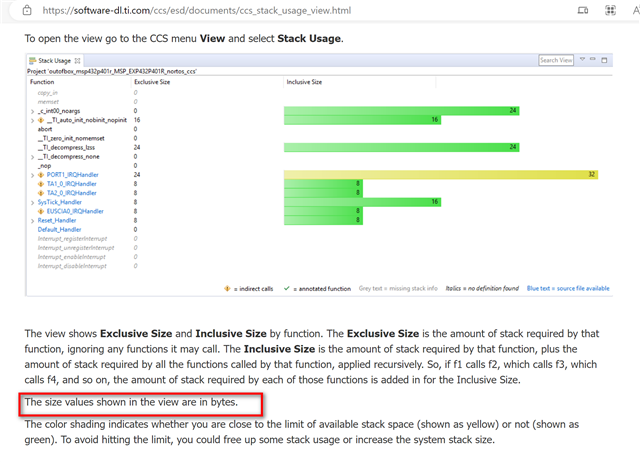
Does TI have the document of stack usage?
What is the calculation logic of exclusive and inclusive size ?

This thread has been locked.
If you have a related question, please click the "Ask a related question" button in the top right corner. The newly created question will be automatically linked to this question.
Does TI have the document of stack usage?
What is the calculation logic of exclusive and inclusive size ?

Hello,
You can refer to the Stack Usage View in CCS reference:
Best regards,
Omer Amir
I use below example to verify the size value.
When stackoverflow happens, the functionCallCount is 249.
__TI_STACK_END is 0x7F8
Cmd file:
RAMM1 : origin = 0x000400, length = 0x0003F8 /* on-chip RAM block M1 */


It seems there no way to change the format in which the data is presented in the Stack Usage view, I was unable to make any edits from what I saw and there are no directions online provided by TI on how to do this. This may just be something you have to keep in mind (i.e. divide the value by 2 to know how many words are needed for the stack).
On C2000, I believe a char = byte = 16 bits?
As far as they way it's stored, yes. Even if a variable is only 8-bits, it is stored at a 16-bit location because addresses are word-addressable. Although this may be confusing to a user, because not all devices are word-addressable.
A byte is always 8 bits, but the way it's stored on C2000 devices is at a 16-bit location. C2000 uses word-addressable memory, not byte-addressable.
The question here is whether the Stack Usage view is showing number of memory locations being used or number of bytes being used, since for our devices these are distinct.
A byte is always 8 bits,
I've always been confused about this with C2000. I always referred to this document:
"A byte is defined as the unit of data capable of holding a single character on any given machine. Hence, if the term "byte" is used on C2000 it refers to 16 bits. In summary: TMS320C28x bytes and words are equivalent (16 bits)."
I agree, that documentation is confusing; I think more in terms of what the customer is asking is an 8-bit memory location like a traditional byte. I'm not sure who manages that html page, but that should be changed.
Ok, it is indeed confusing. When searching E2E, i see varying points of view on this, even amongst TI'ers.
In any case, back to the original topic I found a related discussion for additional clarification.