Other Parts Discussed in Thread: ADS8686S
Good morning,
I am implementing a parallel communication using EMIF of my TMS320F28388D in Docking Card, with an external ADC ADS8686S of 16 bits that has a parallel bus in order to writing its registers, reading the conversions, etc...
It's interesting because I don't use the Address Bus, it's an asynchronous communication, and the direction of the register of the ADC I would like to write is directly in the Data Bus.
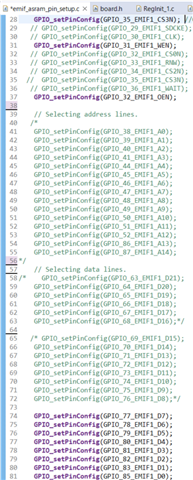
Due to the configuration of the DockingCard, it's not possible to use a 16bit data bus communication because the D9 of the EMIF1 doesn't have an external pin in the docking card, so I have to use data bits from D0-D7. The ADC has a Byte Parallel Interface communication available (Parallel communication of 8 bits) so there would be possible.
What I found odd is the following issue: As I'm using the EMIF interface to communicate with the ADC, this 16.bit ADC has the following time-schematic for a Byte Parallel Communication
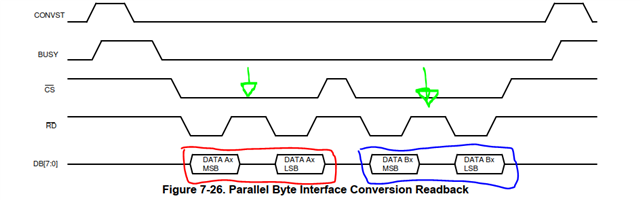
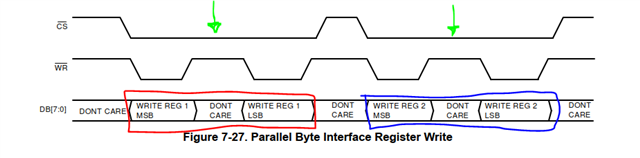
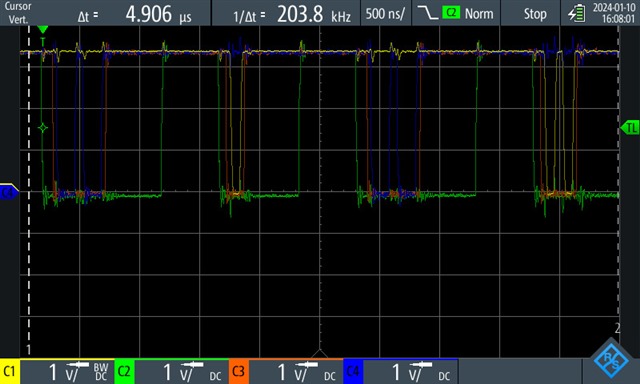
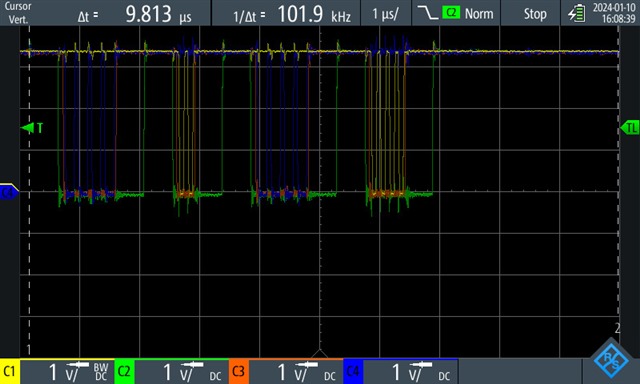
As you can see in the first picture, when using a 8 bit parallel communication, because the ADC is 16 bit, I have to read two times the ADC to read the whole conversion (it appears 4 read because it's a dual ADC and have 2 channels that are sampled simulataneously). The same with writing a register in the ADC, I have to write two times 8 bits to make a 16 bit frame.
The difficulty is that in this time-schematics is that the Chip Select between same readings or writings remains low. I goes up and then goes low in the first picture when I want to read the conversion of the another channel.
When I read the operation of the EMIF interface it has 3 phases, Setup, Strobe and Hold. At the end of the Hold period the CS goes up (inactive).
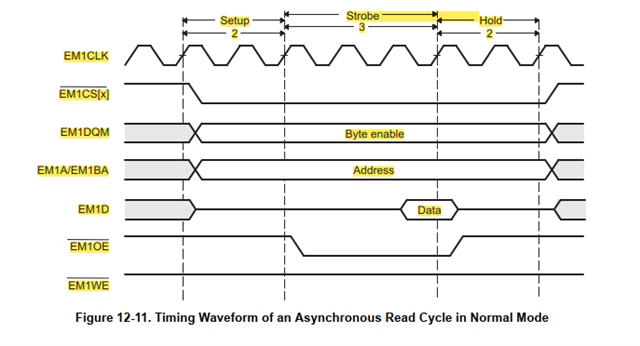
It says the following thing in orange:
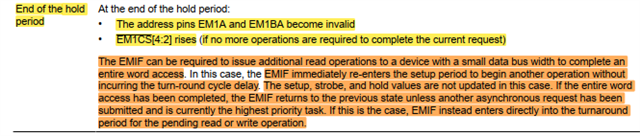
However, what I would need is that the Chip Select remains low after a first 8 bit reading before it reads another 8 bit reading to read the whole 16 bit frame of the adc. The same with the writing of the EMIF and the ADC. I would like to know if there is an option to after the Strobe period or hold period (OE is high-inactive) maintain the CS low-active and put the OE in low-active to do a dual reading without putting up the CS between the two readings.
I expect you could understand what I would like to know. I would be very grateful if you could help me.
Thank you in advance, have a nice day.
Pedro