This thread has been locked.

If you have a related question, please click the "Ask a related question" button in the top right corner. The newly created question will be automatically linked to this question.

TMS320F28379D: Flash API and watchdog

Part Number: TMS320F28379D


I've modified the flash_programming_dcsm_cpu example (see attached) to have an additional Fapi_issueProgrammingCommand() call, then ServiceDog(), then another Fapi_issueProgrammingCommand().

    BufAddr[0] = 0x2;
    BufAddr[1] = 0x2;
    BufAddr[2] = 0x2;
    BufAddr[3] = 0x2;
    BufAddr[4] = 0x2;
    BufAddr[5] = 0x2;
    BufAddr[6] = 0x2;
    BufAddr[7] = 0x2;

    oReturnCheck = Fapi_issueProgrammingCommand((Uint32 *)0x82000,
                                                BufAddr,
                                                8,
                                                0,
                                                0,
                                                Fapi_DataOnly);

    if(oReturnCheck != Fapi_Status_Success)
    {
        Example_Error(oReturnCheck);
    }

    /* pet the watchdog */
    ServiceDog();


    BufAddr[0] = 0x3;
    BufAddr[1] = 0x3;
    BufAddr[2] = 0x3;
    BufAddr[3] = 0x3;
    BufAddr[4] = 0x3;
    BufAddr[5] = 0x3;
    BufAddr[6] = 0x3;
    BufAddr[7] = 0x3;

    oReturnCheck = Fapi_issueProgrammingCommand((Uint32 *)0x82000,
                                                BufAddr,
                                                8,
                                                0,
                                                0,
                                                Fapi_DataOnly);

    if(oReturnCheck != Fapi_Status_Success)
    {
        Example_Error(oReturnCheck);
    }

By stepping thru the debugger and examining the Memory Browser I can see that the first Fapi_issueProgrammingCommand() (line 457) updates the specified locations in memory.

But the 2nd Fapi_issueProgrammingCommand() (line 482) also returns "Fapi_Status_Success" but the memory locations still contain the values from line 457.
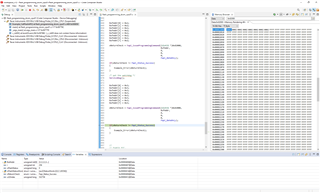
What API call do I need to make after servicing the watchdog?  I tried re-initializing the API with "Fapi_initializeAPI()", but this didn't help.

Thank you

//###########################################################################
//
// FILE:   flash_programming_dcsm_cpu01.c
//
// TITLE:  Flash Programming with DCSM.
//
//! \addtogroup cpu01_example_list
//! <h1> Flash Programming with DCSM </h1>
//!
//! This example programs secure memory
//!
//
//###########################################################################
//
// $Release Date:  $
// $Copyright:
// Copyright (C) 2013-2023 Texas Instruments Incorporated - http://www.ti.com/
//
// Redistribution and use in source and binary forms, with or without 
// modification, are permitted provided that the following conditions 
// are met:
// 
//   Redistributions of source code must retain the above copyright 
//   notice, this list of conditions and the following disclaimer.
// 
//   Redistributions in binary form must reproduce the above copyright
//   notice, this list of conditions and the following disclaimer in the 
//   documentation and/or other materials provided with the   
//   distribution.
// 
//   Neither the name of Texas Instruments Incorporated nor the names of
//   its contributors may be used to endorse or promote products derived
//   from this software without specific prior written permission.
// 
// THIS SOFTWARE IS PROVIDED BY THE COPYRIGHT HOLDERS AND CONTRIBUTORS 
// "AS IS" AND ANY EXPRESS OR IMPLIED WARRANTIES, INCLUDING, BUT NOT 
// LIMITED TO, THE IMPLIED WARRANTIES OF MERCHANTABILITY AND FITNESS FOR
// A PARTICULAR PURPOSE ARE DISCLAIMED. IN NO EVENT SHALL THE COPYRIGHT 
// OWNER OR CONTRIBUTORS BE LIABLE FOR ANY DIRECT, INDIRECT, INCIDENTAL, 
// SPECIAL, EXEMPLARY, OR CONSEQUENTIAL DAMAGES (INCLUDING, BUT NOT 
// LIMITED TO, PROCUREMENT OF SUBSTITUTE GOODS OR SERVICES; LOSS OF USE,
// DATA, OR PROFITS; OR BUSINESS INTERRUPTION) HOWEVER CAUSED AND ON ANY
// THEORY OF LIABILITY, WHETHER IN CONTRACT, STRICT LIABILITY, OR TORT 
// (INCLUDING NEGLIGENCE OR OTHERWISE) ARISING IN ANY WAY OUT OF THE USE 
// OF THIS SOFTWARE, EVEN IF ADVISED OF THE POSSIBILITY OF SUCH DAMAGE.
// $
//###########################################################################

#include "F28x_Project.h"
#include <string.h>
#include "flash_programming_dcsm_c28.h"
#include "F021_F2837xD_C28x.h"

//
// Defines
//
#define  WORDS_IN_FLASH_BUFFER    0xFF

#ifdef __TI_COMPILER_VERSION__
    #if __TI_COMPILER_VERSION__ >= 15009000
        #define ramFuncSection ".TI.ramfunc"
    #else
        #define ramFuncSection "ramfuncs"
    #endif
#endif

//
// Globals
//
#pragma DATA_SECTION(Buffer,"BufferDataSection");
uint16   Buffer[WORDS_IN_FLASH_BUFFER + 1];
uint32   *Buffer32 = (uint32 *)Buffer;

//
// Function Prototypes
//
void Example_Error(Fapi_StatusType status);
void Example_Done(void);
void Example_CallFlashAPI(void);

//
// Main
//
void main(void)
{
    //
    // Initialize System Control. Enable Peripheral Clocks.
    //
    InitSysCtrl();

    //
    // Disable CPU interrupts.
    //
    DINT;

    //
    // Initialize PIE control registers to default state.
    //
    InitPieCtrl();

    //
    // Disable CPU interrupts and clear all CPU interrupt flags.
    //
    IER = 0x0000;
    IFR = 0x0000;

    //
    // Initialize PIE vector table with pointers to the default
    // Interrupt Service Routines (ISR).
    //
    InitPieVectTable();

    //
    // Call the Flash API functions for this example.
    //
    Example_CallFlashAPI();
}

//
// Example_CallFlashAPI - This function will interface to the flash API.
//                        Flash API functions used in this function are
//                        executed from RAM.
//
#pragma CODE_SECTION(Example_CallFlashAPI, ramFuncSection);
void Example_CallFlashAPI(void)
{
    uint32 u32Index = 0UL;
    uint16 i = 0U;
    Fapi_StatusType oReturnCheck;
    volatile Fapi_FlashStatusType oFlashStatus;
    Fapi_FlashStatusWordType oFlashStatusWord;
    Uint16 BufAddr[8];

    //
    // Grab flash semaphore for Zone1 to enable access to flash registers.
    //
    EALLOW;
    DcsmCommonRegs.FLSEM.all = 0xA501;
    EDIS;

    //
    // Call flash initialization to setup flash waitstates.
    // This function must reside in RAM.
    //
    InitFlash();

    //
    // Disable ECC.
    //
    EALLOW;
    Flash0EccRegs.ECC_ENABLE.bit.ENABLE = 0x0;

    //
    // This function is required to initialize the Flash API based on system
    // frequency before any other Flash API operation can be performed.
    //
    oReturnCheck = Fapi_initializeAPI(F021_CPU0_BASE_ADDRESS, 120);

    if(oReturnCheck != Fapi_Status_Success)
    {
        //
        // Check Flash API documentation for possible errors.
        //
        Example_Error(oReturnCheck);
    }

    //
    // Fapi_setActiveFlashBank function sets the flash bank and FMC for further
    // flash operations to be performed on the bank.
    //
    oReturnCheck = Fapi_setActiveFlashBank(Fapi_FlashBank0);

    if(oReturnCheck != Fapi_Status_Success)
    {
        //
        // Check Flash API documentation for possible errors.
        //
        Example_Error(oReturnCheck);
    }

    //
    // Erase Sector C.
    //
    oReturnCheck = Fapi_issueAsyncCommandWithAddress(Fapi_EraseSector,
                   (uint32 *)Bzero_SectorC_start);

    //
    // Wait until FSM is done with erase sector operation.
    //
    while (Fapi_checkFsmForReady() != Fapi_Status_FsmReady)
    {
    }

    //
    // Verify that Sector C is erased. The erase step itself does verification
    // as it goes. This verify is a second verification that can be done.
    //
    oReturnCheck = Fapi_doBlankCheck((uint32 *)Bzero_SectorC_start,
                   Bzero_16KSector_u32length,
                   &oFlashStatusWord);

    if(oReturnCheck != Fapi_Status_Success)
    {
        //
        // Check Flash API documentation for possible errors.
        // If erase command fails, use Fapi_getFsmStatus() function to get the
        // FMSTAT register contents to see if any of the EV bit, ESUSP bit,
        // CSTAT bit or VOLTSTAT bit is set. Refer to API documentation for
        // more details.
        //
        Example_Error(oReturnCheck);
    }

    //
    // Erase Sector B.
    //
    oReturnCheck = Fapi_issueAsyncCommandWithAddress(Fapi_EraseSector,
                   (uint32 *)Bzero_SectorB_start);

    //
    // Wait until FSM is done with erase sector operation.
    //
    while (Fapi_checkFsmForReady() != Fapi_Status_FsmReady)
    {
    }

    //
    // Verify that Sector B is erased. The erase step itself does verification
    // as it goes. This verify is a second verification that can be done.
    //
    oReturnCheck = Fapi_doBlankCheck((uint32 *)Bzero_SectorB_start,
                   Bzero_16KSector_u32length,
                   &oFlashStatusWord);

    if(oReturnCheck != Fapi_Status_Success)
    {
        //
        // Check Flash API documentation for possible errors.
        // If erase command fails, use Fapi_getFsmStatus() function to get the
        // FMSTAT register contents to see if any of the EV bit, ESUSP bit,
        // CSTAT bit or VOLTSTAT bit is set. Refer to API documentation for
        // more details.
        //
        Example_Error(oReturnCheck);
    }

    //
    // A data buffer of max 8 words can be supplied to the program function.
    // Each word is programmed until the whole buffer is programmed or a
    // problem is found. However, to program a buffer that has more than 8
    // words, program function can be called in a loop to program 8 words for
    // each loop iteration until the whole buffer is programmed.
    //
    // For example, program 0xFF bytes in flash Sector C along with auto-
    // generated ECC.
    //

    //
    // For example fill a buffer with data to program into the flash.
    //
    for(i=0;i<=WORDS_IN_FLASH_BUFFER;i++)
    {
        Buffer[i] = i;
    }

    //
    // Program buffer into Sector C with ECC.
    //
    for(i=0, u32Index = Bzero_SectorC_start;
       (u32Index < (Bzero_SectorC_start + WORDS_IN_FLASH_BUFFER))
       && (oReturnCheck == Fapi_Status_Success); i+= 8, u32Index+= 8)
    {
        oReturnCheck = Fapi_issueProgrammingCommand((uint32 *)u32Index,Buffer+i,
                       8,
                       0,
                       0,
                       Fapi_AutoEccGeneration);

        //
        // Wait until FSM is done with program operation.
        //
        while(Fapi_checkFsmForReady() == Fapi_Status_FsmBusy)
        {
        }

        if(oReturnCheck != Fapi_Status_Success)
        {
            //
            // Check Flash API documentation for possible errors.
            //
            Example_Error(oReturnCheck);
        }

        //
        // Read FMSTAT register contents to know the status of FSM after
        // program command for any debug.
        //
        oFlashStatus = Fapi_getFsmStatus();

        //
        // Verify the values programmed. The program step itself does
        // verification as it goes. This verify is a second verification that
        // can be done.
        //
        oReturnCheck = Fapi_doVerify((uint32 *)u32Index,
                       4,
                       Buffer32+(i/2),
                       &oFlashStatusWord);

        if(oReturnCheck != Fapi_Status_Success)
        {
            //
            // Check Flash API documentation for possible errors.
            //
            Example_Error(oReturnCheck);
        }
    }

    //
    // Program buffer into Sector B with out ECC.
    // Disable ECC so that an error is not generated when reading flash contents
    // without ECC programmed.
    //
    Flash0EccRegs.ECC_ENABLE.bit.ENABLE = 0x0;

    for(i=0, u32Index = Bzero_SectorB_start;
       (u32Index < (Bzero_SectorB_start + WORDS_IN_FLASH_BUFFER))
       && (oReturnCheck == Fapi_Status_Success); i+= 8, u32Index+= 8)
    {
        oReturnCheck = Fapi_issueProgrammingCommand((uint32 *)u32Index,
                       Buffer+i,
                       8,
                       0,
                       0,
                       Fapi_DataOnly);

        //
        // Wait until FSM is done with program operation.
        //
        while(Fapi_checkFsmForReady() == Fapi_Status_FsmBusy)
        {
        }

        if(oReturnCheck != Fapi_Status_Success)
        {
            //
            // Check Flash API documentation for possible errors.
            //
            Example_Error(oReturnCheck);
        }

        //
        // Read FMSTAT register contents to know the status of FSM
        // after program command for any debug.
        //
        oFlashStatus = Fapi_getFsmStatus();

        //
        // Verify the values programmed. The program step itself does
        // verification as it goes. This verify is a second verification that
        // can be done.
        //
        oReturnCheck = Fapi_doVerify((uint32 *)u32Index,
                       4,
                       Buffer32+(i/2),
                       &oFlashStatusWord);

        if(oReturnCheck != Fapi_Status_Success)
        {
            //
            // Check Flash API documentation for possible errors.
            //
            Example_Error(oReturnCheck);
        }
    }

    //
    // Erase the sectors that we have programmed above.
    // Erase Sector C.
    //
    oReturnCheck = Fapi_issueAsyncCommandWithAddress(Fapi_EraseSector,
                   (uint32 *)Bzero_SectorC_start);

    //
    // Wait until FSM is done with erase sector operation.
    //
    while (Fapi_checkFsmForReady() != Fapi_Status_FsmReady)
    {
    }

    //
    // Verify that Sector C is erased. The erase step itself does verification
    // as it goes. This verify is a second verification that can be done.
    //
    oReturnCheck = Fapi_doBlankCheck((uint32 *)Bzero_SectorC_start,
                   Bzero_16KSector_u32length,
                   &oFlashStatusWord);

    if(oReturnCheck != Fapi_Status_Success)
    {
        //
        // Check Flash API documentation for possible errors.
        // If erase command fails, use Fapi_getFsmStatus() function to get the
        // FMSTAT register contents to see if any of the EV bit, ESUSP bit,
        // CSTAT bit or VOLTSTAT bit is set. Refer to API documentation for
        // more details.
        //
        Example_Error(oReturnCheck);
    }

    //
    // Erase Sector B.
    //
    oReturnCheck = Fapi_issueAsyncCommandWithAddress(Fapi_EraseSector,
                   (uint32 *)Bzero_SectorB_start);

    //
    // Wait until FSM is done with erase sector operation.
    //
    while (Fapi_checkFsmForReady() != Fapi_Status_FsmReady)
    {
    }

    //
    // Verify that Sector B is erased. The erase step itself does verification
    // as it goes. This verify is a second verification that can be done.
    //
    oReturnCheck = Fapi_doBlankCheck((uint32 *)Bzero_SectorB_start,
                   Bzero_16KSector_u32length,
                   &oFlashStatusWord);

    if(oReturnCheck != Fapi_Status_Success)
    {
        //
        // Check Flash API documentation for possible errors.
        // If erase command fails, use Fapi_getFsmStatus() function to get the
        // FMSTAT register contents to see if any of the EV bit, ESUSP bit,
        // CSTAT bit or VOLTSTAT bit is set. Refer to API documentation for
        // more details.
        //
        Example_Error(oReturnCheck);
    }


    BufAddr[0] = 0x2;
    BufAddr[1] = 0x2;
    BufAddr[2] = 0x2;
    BufAddr[3] = 0x2;
    BufAddr[4] = 0x2;
    BufAddr[5] = 0x2;
    BufAddr[6] = 0x2;
    BufAddr[7] = 0x2;

    oReturnCheck = Fapi_issueProgrammingCommand((Uint32 *)0x82000,
                                                BufAddr,
                                                8,
                                                0,
                                                0,
                                                Fapi_DataOnly);

    if(oReturnCheck != Fapi_Status_Success)
    {
        Example_Error(oReturnCheck);
    }

    /* pet the watchdog */
    ServiceDog();


    BufAddr[0] = 0x3;
    BufAddr[1] = 0x3;
    BufAddr[2] = 0x3;
    BufAddr[3] = 0x3;
    BufAddr[4] = 0x3;
    BufAddr[5] = 0x3;
    BufAddr[6] = 0x3;
    BufAddr[7] = 0x3;

    oReturnCheck = Fapi_issueProgrammingCommand((Uint32 *)0x82000,
                                                BufAddr,
                                                8,
                                                0,
                                                0,
                                                Fapi_DataOnly);

    if(oReturnCheck != Fapi_Status_Success)
    {
        Example_Error(oReturnCheck);
    }


    //
    // Enable ECC.
    //
    Flash0EccRegs.ECC_ENABLE.bit.ENABLE = 0xA;

    //
    // Release flash semaphore.
    //
    DcsmCommonRegs.FLSEM.all = 0xA500;

    EDIS;

    //
    // Example is done here.
    //
    Example_Done();
}

//
// Example_Error - For this example, if an error is found just stop here
//
#pragma CODE_SECTION(Example_Error,ramFuncSection);
void Example_Error(Fapi_StatusType status)
{
    //
    // Error code will be in the status parameter.
    // ESTOP0.
    //
    __asm("    ESTOP0");
}

//
// Example_Done - For this example, once we are done just stop here
//
#pragma CODE_SECTION(Example_Error,ramFuncSection);
void Example_Done(void)
{
    //
    // ESTOP0.
    //
    __asm("    ESTOP0");

    for(;;)
    {
    }
}

//
// End of file
//

  • Hi Diane,

    You might be missing EALLOW; after the watchdog service.  Please check.

    Thanks and regards,
    Vamsi

  • Vamsi,

    I added EALLOW after ServiceDog(), but I got the same results:

        oReturnCheck = Fapi_issueProgrammingCommand((Uint32 *)0x82000,
                                                    BufAddr,
                                                    8,
                                                    0,
                                                    0,
                                                    Fapi_DataOnly);
    
        if(oReturnCheck != Fapi_Status_Success)
        {
            Example_Error(oReturnCheck);
        }
    
        /* pet the watchdog */
        ServiceDog();
        EALLOW;
    
    
        BufAddr[0] = 0x3;
        BufAddr[1] = 0x3;
        BufAddr[2] = 0x3;
        BufAddr[3] = 0x3;
        BufAddr[4] = 0x3;
        BufAddr[5] = 0x3;
        BufAddr[6] = 0x3;
        BufAddr[7] = 0x3;
    
        oReturnCheck = Fapi_issueProgrammingCommand((Uint32 *)0x82000,
                                                    BufAddr,
                                                    8,
                                                    0,
                                                    0,
                                                    Fapi_DataOnly);
    
        if(oReturnCheck != Fapi_Status_Success)
        {
            Example_Error(oReturnCheck);
        }

    Thank you,

    Diane

    //###########################################################################
    //
    // FILE:   flash_programming_dcsm_cpu01.c
    //
    // TITLE:  Flash Programming with DCSM.
    //
    //! \addtogroup cpu01_example_list
    //! <h1> Flash Programming with DCSM </h1>
    //!
    //! This example programs secure memory
    //!
    //
    //###########################################################################
    //
    // $Release Date:  $
    // $Copyright:
    // Copyright (C) 2013-2023 Texas Instruments Incorporated - http://www.ti.com/
    //
    // Redistribution and use in source and binary forms, with or without 
    // modification, are permitted provided that the following conditions 
    // are met:
    // 
    //   Redistributions of source code must retain the above copyright 
    //   notice, this list of conditions and the following disclaimer.
    // 
    //   Redistributions in binary form must reproduce the above copyright
    //   notice, this list of conditions and the following disclaimer in the 
    //   documentation and/or other materials provided with the   
    //   distribution.
    // 
    //   Neither the name of Texas Instruments Incorporated nor the names of
    //   its contributors may be used to endorse or promote products derived
    //   from this software without specific prior written permission.
    // 
    // THIS SOFTWARE IS PROVIDED BY THE COPYRIGHT HOLDERS AND CONTRIBUTORS 
    // "AS IS" AND ANY EXPRESS OR IMPLIED WARRANTIES, INCLUDING, BUT NOT 
    // LIMITED TO, THE IMPLIED WARRANTIES OF MERCHANTABILITY AND FITNESS FOR
    // A PARTICULAR PURPOSE ARE DISCLAIMED. IN NO EVENT SHALL THE COPYRIGHT 
    // OWNER OR CONTRIBUTORS BE LIABLE FOR ANY DIRECT, INDIRECT, INCIDENTAL, 
    // SPECIAL, EXEMPLARY, OR CONSEQUENTIAL DAMAGES (INCLUDING, BUT NOT 
    // LIMITED TO, PROCUREMENT OF SUBSTITUTE GOODS OR SERVICES; LOSS OF USE,
    // DATA, OR PROFITS; OR BUSINESS INTERRUPTION) HOWEVER CAUSED AND ON ANY
    // THEORY OF LIABILITY, WHETHER IN CONTRACT, STRICT LIABILITY, OR TORT 
    // (INCLUDING NEGLIGENCE OR OTHERWISE) ARISING IN ANY WAY OUT OF THE USE 
    // OF THIS SOFTWARE, EVEN IF ADVISED OF THE POSSIBILITY OF SUCH DAMAGE.
    // $
    //###########################################################################
    
    #include "F28x_Project.h"
    #include <string.h>
    #include "flash_programming_dcsm_c28.h"
    #include "F021_F2837xD_C28x.h"
    
    //
    // Defines
    //
    #define  WORDS_IN_FLASH_BUFFER    0xFF
    
    #ifdef __TI_COMPILER_VERSION__
        #if __TI_COMPILER_VERSION__ >= 15009000
            #define ramFuncSection ".TI.ramfunc"
        #else
            #define ramFuncSection "ramfuncs"
        #endif
    #endif
    
    //
    // Globals
    //
    #pragma DATA_SECTION(Buffer,"BufferDataSection");
    uint16   Buffer[WORDS_IN_FLASH_BUFFER + 1];
    uint32   *Buffer32 = (uint32 *)Buffer;
    
    //
    // Function Prototypes
    //
    void Example_Error(Fapi_StatusType status);
    void Example_Done(void);
    void Example_CallFlashAPI(void);
    
    //
    // Main
    //
    void main(void)
    {
        //
        // Initialize System Control. Enable Peripheral Clocks.
        //
        InitSysCtrl();
    
        //
        // Disable CPU interrupts.
        //
        DINT;
    
        //
        // Initialize PIE control registers to default state.
        //
        InitPieCtrl();
    
        //
        // Disable CPU interrupts and clear all CPU interrupt flags.
        //
        IER = 0x0000;
        IFR = 0x0000;
    
        //
        // Initialize PIE vector table with pointers to the default
        // Interrupt Service Routines (ISR).
        //
        InitPieVectTable();
    
        //
        // Call the Flash API functions for this example.
        //
        Example_CallFlashAPI();
    }
    
    //
    // Example_CallFlashAPI - This function will interface to the flash API.
    //                        Flash API functions used in this function are
    //                        executed from RAM.
    //
    #pragma CODE_SECTION(Example_CallFlashAPI, ramFuncSection);
    void Example_CallFlashAPI(void)
    {
        uint32 u32Index = 0UL;
        uint16 i = 0U;
        Fapi_StatusType oReturnCheck;
        volatile Fapi_FlashStatusType oFlashStatus;
        Fapi_FlashStatusWordType oFlashStatusWord;
        Uint16 BufAddr[8];
    
        //
        // Grab flash semaphore for Zone1 to enable access to flash registers.
        //
        EALLOW;
        DcsmCommonRegs.FLSEM.all = 0xA501;
        EDIS;
    
        //
        // Call flash initialization to setup flash waitstates.
        // This function must reside in RAM.
        //
        InitFlash();
    
        //
        // Disable ECC.
        //
        EALLOW;
        Flash0EccRegs.ECC_ENABLE.bit.ENABLE = 0x0;
    
        //
        // This function is required to initialize the Flash API based on system
        // frequency before any other Flash API operation can be performed.
        //
        oReturnCheck = Fapi_initializeAPI(F021_CPU0_BASE_ADDRESS, 120);
    
        if(oReturnCheck != Fapi_Status_Success)
        {
            //
            // Check Flash API documentation for possible errors.
            //
            Example_Error(oReturnCheck);
        }
    
        //
        // Fapi_setActiveFlashBank function sets the flash bank and FMC for further
        // flash operations to be performed on the bank.
        //
        oReturnCheck = Fapi_setActiveFlashBank(Fapi_FlashBank0);
    
        if(oReturnCheck != Fapi_Status_Success)
        {
            //
            // Check Flash API documentation for possible errors.
            //
            Example_Error(oReturnCheck);
        }
    
        //
        // Erase Sector C.
        //
        oReturnCheck = Fapi_issueAsyncCommandWithAddress(Fapi_EraseSector,
                       (uint32 *)Bzero_SectorC_start);
    
        //
        // Wait until FSM is done with erase sector operation.
        //
        while (Fapi_checkFsmForReady() != Fapi_Status_FsmReady)
        {
        }
    
        //
        // Verify that Sector C is erased. The erase step itself does verification
        // as it goes. This verify is a second verification that can be done.
        //
        oReturnCheck = Fapi_doBlankCheck((uint32 *)Bzero_SectorC_start,
                       Bzero_16KSector_u32length,
                       &oFlashStatusWord);
    
        if(oReturnCheck != Fapi_Status_Success)
        {
            //
            // Check Flash API documentation for possible errors.
            // If erase command fails, use Fapi_getFsmStatus() function to get the
            // FMSTAT register contents to see if any of the EV bit, ESUSP bit,
            // CSTAT bit or VOLTSTAT bit is set. Refer to API documentation for
            // more details.
            //
            Example_Error(oReturnCheck);
        }
    
        //
        // Erase Sector B.
        //
        oReturnCheck = Fapi_issueAsyncCommandWithAddress(Fapi_EraseSector,
                       (uint32 *)Bzero_SectorB_start);
    
        //
        // Wait until FSM is done with erase sector operation.
        //
        while (Fapi_checkFsmForReady() != Fapi_Status_FsmReady)
        {
        }
    
        //
        // Verify that Sector B is erased. The erase step itself does verification
        // as it goes. This verify is a second verification that can be done.
        //
        oReturnCheck = Fapi_doBlankCheck((uint32 *)Bzero_SectorB_start,
                       Bzero_16KSector_u32length,
                       &oFlashStatusWord);
    
        if(oReturnCheck != Fapi_Status_Success)
        {
            //
            // Check Flash API documentation for possible errors.
            // If erase command fails, use Fapi_getFsmStatus() function to get the
            // FMSTAT register contents to see if any of the EV bit, ESUSP bit,
            // CSTAT bit or VOLTSTAT bit is set. Refer to API documentation for
            // more details.
            //
            Example_Error(oReturnCheck);
        }
    
        //
        // A data buffer of max 8 words can be supplied to the program function.
        // Each word is programmed until the whole buffer is programmed or a
        // problem is found. However, to program a buffer that has more than 8
        // words, program function can be called in a loop to program 8 words for
        // each loop iteration until the whole buffer is programmed.
        //
        // For example, program 0xFF bytes in flash Sector C along with auto-
        // generated ECC.
        //
    
        //
        // For example fill a buffer with data to program into the flash.
        //
        for(i=0;i<=WORDS_IN_FLASH_BUFFER;i++)
        {
            Buffer[i] = i;
        }
    
        //
        // Program buffer into Sector C with ECC.
        //
        for(i=0, u32Index = Bzero_SectorC_start;
           (u32Index < (Bzero_SectorC_start + WORDS_IN_FLASH_BUFFER))
           && (oReturnCheck == Fapi_Status_Success); i+= 8, u32Index+= 8)
        {
            oReturnCheck = Fapi_issueProgrammingCommand((uint32 *)u32Index,Buffer+i,
                           8,
                           0,
                           0,
                           Fapi_AutoEccGeneration);
    
            //
            // Wait until FSM is done with program operation.
            //
            while(Fapi_checkFsmForReady() == Fapi_Status_FsmBusy)
            {
            }
    
            if(oReturnCheck != Fapi_Status_Success)
            {
                //
                // Check Flash API documentation for possible errors.
                //
                Example_Error(oReturnCheck);
            }
    
            //
            // Read FMSTAT register contents to know the status of FSM after
            // program command for any debug.
            //
            oFlashStatus = Fapi_getFsmStatus();
    
            //
            // Verify the values programmed. The program step itself does
            // verification as it goes. This verify is a second verification that
            // can be done.
            //
            oReturnCheck = Fapi_doVerify((uint32 *)u32Index,
                           4,
                           Buffer32+(i/2),
                           &oFlashStatusWord);
    
            if(oReturnCheck != Fapi_Status_Success)
            {
                //
                // Check Flash API documentation for possible errors.
                //
                Example_Error(oReturnCheck);
            }
        }
    
        //
        // Program buffer into Sector B with out ECC.
        // Disable ECC so that an error is not generated when reading flash contents
        // without ECC programmed.
        //
        Flash0EccRegs.ECC_ENABLE.bit.ENABLE = 0x0;
    
        for(i=0, u32Index = Bzero_SectorB_start;
           (u32Index < (Bzero_SectorB_start + WORDS_IN_FLASH_BUFFER))
           && (oReturnCheck == Fapi_Status_Success); i+= 8, u32Index+= 8)
        {
            oReturnCheck = Fapi_issueProgrammingCommand((uint32 *)u32Index,
                           Buffer+i,
                           8,
                           0,
                           0,
                           Fapi_DataOnly);
    
            //
            // Wait until FSM is done with program operation.
            //
            while(Fapi_checkFsmForReady() == Fapi_Status_FsmBusy)
            {
            }
    
            if(oReturnCheck != Fapi_Status_Success)
            {
                //
                // Check Flash API documentation for possible errors.
                //
                Example_Error(oReturnCheck);
            }
    
            //
            // Read FMSTAT register contents to know the status of FSM
            // after program command for any debug.
            //
            oFlashStatus = Fapi_getFsmStatus();
    
            //
            // Verify the values programmed. The program step itself does
            // verification as it goes. This verify is a second verification that
            // can be done.
            //
            oReturnCheck = Fapi_doVerify((uint32 *)u32Index,
                           4,
                           Buffer32+(i/2),
                           &oFlashStatusWord);
    
            if(oReturnCheck != Fapi_Status_Success)
            {
                //
                // Check Flash API documentation for possible errors.
                //
                Example_Error(oReturnCheck);
            }
        }
    
        //
        // Erase the sectors that we have programmed above.
        // Erase Sector C.
        //
        oReturnCheck = Fapi_issueAsyncCommandWithAddress(Fapi_EraseSector,
                       (uint32 *)Bzero_SectorC_start);
    
        //
        // Wait until FSM is done with erase sector operation.
        //
        while (Fapi_checkFsmForReady() != Fapi_Status_FsmReady)
        {
        }
    
        //
        // Verify that Sector C is erased. The erase step itself does verification
        // as it goes. This verify is a second verification that can be done.
        //
        oReturnCheck = Fapi_doBlankCheck((uint32 *)Bzero_SectorC_start,
                       Bzero_16KSector_u32length,
                       &oFlashStatusWord);
    
        if(oReturnCheck != Fapi_Status_Success)
        {
            //
            // Check Flash API documentation for possible errors.
            // If erase command fails, use Fapi_getFsmStatus() function to get the
            // FMSTAT register contents to see if any of the EV bit, ESUSP bit,
            // CSTAT bit or VOLTSTAT bit is set. Refer to API documentation for
            // more details.
            //
            Example_Error(oReturnCheck);
        }
    
        //
        // Erase Sector B.
        //
        oReturnCheck = Fapi_issueAsyncCommandWithAddress(Fapi_EraseSector,
                       (uint32 *)Bzero_SectorB_start);
    
        //
        // Wait until FSM is done with erase sector operation.
        //
        while (Fapi_checkFsmForReady() != Fapi_Status_FsmReady)
        {
        }
    
        //
        // Verify that Sector B is erased. The erase step itself does verification
        // as it goes. This verify is a second verification that can be done.
        //
        oReturnCheck = Fapi_doBlankCheck((uint32 *)Bzero_SectorB_start,
                       Bzero_16KSector_u32length,
                       &oFlashStatusWord);
    
        if(oReturnCheck != Fapi_Status_Success)
        {
            //
            // Check Flash API documentation for possible errors.
            // If erase command fails, use Fapi_getFsmStatus() function to get the
            // FMSTAT register contents to see if any of the EV bit, ESUSP bit,
            // CSTAT bit or VOLTSTAT bit is set. Refer to API documentation for
            // more details.
            //
            Example_Error(oReturnCheck);
        }


        BufAddr[0] = 0x2;
        BufAddr[1] = 0x2;
        BufAddr[2] = 0x2;
        BufAddr[3] = 0x2;
        BufAddr[4] = 0x2;
        BufAddr[5] = 0x2;
        BufAddr[6] = 0x2;
        BufAddr[7] = 0x2;
    
        oReturnCheck = Fapi_issueProgrammingCommand((Uint32 *)0x82000,
                                                    BufAddr,
                                                    8,
                                                    0,
                                                    0,
                                                    Fapi_DataOnly);
    
        if(oReturnCheck != Fapi_Status_Success)
        {
            Example_Error(oReturnCheck);
        }
    
        /* pet the watchdog */
        ServiceDog();
        EALLOW;
    
    
        BufAddr[0] = 0x3;
        BufAddr[1] = 0x3;
        BufAddr[2] = 0x3;
        BufAddr[3] = 0x3;
        BufAddr[4] = 0x3;
        BufAddr[5] = 0x3;
        BufAddr[6] = 0x3;
        BufAddr[7] = 0x3;
    
        oReturnCheck = Fapi_issueProgrammingCommand((Uint32 *)0x82000,
                                                    BufAddr,
                                                    8,
                                                    0,
                                                    0,
                                                    Fapi_DataOnly);
    
        if(oReturnCheck != Fapi_Status_Success)
        {
            Example_Error(oReturnCheck);
        }


        //
        // Enable ECC.
        //
        Flash0EccRegs.ECC_ENABLE.bit.ENABLE = 0xA;
    
        //
        // Release flash semaphore.
        //
        DcsmCommonRegs.FLSEM.all = 0xA500;
    
        EDIS;
    
        //
        // Example is done here.
        //
        Example_Done();
    }
    
    //
    // Example_Error - For this example, if an error is found just stop here
    //
    #pragma CODE_SECTION(Example_Error,ramFuncSection);
    void Example_Error(Fapi_StatusType status)
    {
        //
        // Error code will be in the status parameter.
        // ESTOP0.
        //
        __asm("    ESTOP0");
    }
    
    //
    // Example_Done - For this example, once we are done just stop here
    //
    #pragma CODE_SECTION(Example_Error,ramFuncSection);
    void Example_Done(void)
    {
        //
        // ESTOP0.
        //
        __asm("    ESTOP0");
    
        for(;;)
        {
        }
    }
    
    //
    // End of file
    //
    

  • Diane,

    I don't see below wait loop after the program command in your code.  This loop ensures that the given command is complete before proceeding to the next command.


    // Wait until FSM is done with program operation.
    //
    while(Fapi_checkFsmForReady() == Fapi_Status_FsmBusy)
    {
    }

    Thanks and regards,
    Vamsi

  • Vamsi, thank for your help with this.

    I added the suggested while loops, but I still get the same behavior (I'm manually stepping thru the debugger, so I'm guessing by chance that was slow enough to allow the program steps to complete):

        BufAddr[0] = 0x2;
        BufAddr[1] = 0x2;
        BufAddr[2] = 0x2;
        BufAddr[3] = 0x2;
        BufAddr[4] = 0x2;
        BufAddr[5] = 0x2;
        BufAddr[6] = 0x2;
        BufAddr[7] = 0x2;
    
        oReturnCheck = Fapi_issueProgrammingCommand((Uint32 *)0x82000,
                                                    BufAddr,
                                                    8,
                                                    0,
                                                    0,
                                                    Fapi_DataOnly);
    
        //
        // Wait until FSM is done with erase sector operation.
        //
        while (Fapi_checkFsmForReady() != Fapi_Status_FsmReady)
        {
        }
    
        if(oReturnCheck != Fapi_Status_Success)
        {
            Example_Error(oReturnCheck);
        }
    
        /* pet the watchdog */
        ServiceDog();
        EALLOW;
    
    
        BufAddr[0] = 0x3;
        BufAddr[1] = 0x3;
        BufAddr[2] = 0x3;
        BufAddr[3] = 0x3;
        BufAddr[4] = 0x3;
        BufAddr[5] = 0x3;
        BufAddr[6] = 0x3;
        BufAddr[7] = 0x3;
    
        oReturnCheck = Fapi_issueProgrammingCommand((Uint32 *)0x82000,
                                                    BufAddr,
                                                    8,
                                                    0,
                                                    0,
                                                    Fapi_DataOnly);
    
        //
        // Wait until FSM is done with erase sector operation.
        //
        while (Fapi_checkFsmForReady() != Fapi_Status_FsmReady)
        {
        }
    
        if(oReturnCheck != Fapi_Status_Success)
        {
            Example_Error(oReturnCheck);
        }

    //###########################################################################
    //
    // FILE:   flash_programming_dcsm_cpu01.c
    //
    // TITLE:  Flash Programming with DCSM.
    //
    //! \addtogroup cpu01_example_list
    //! <h1> Flash Programming with DCSM </h1>
    //!
    //! This example programs secure memory
    //!
    //
    //###########################################################################
    //
    // $Release Date:  $
    // $Copyright:
    // Copyright (C) 2013-2023 Texas Instruments Incorporated - http://www.ti.com/
    //
    // Redistribution and use in source and binary forms, with or without 
    // modification, are permitted provided that the following conditions 
    // are met:
    // 
    //   Redistributions of source code must retain the above copyright 
    //   notice, this list of conditions and the following disclaimer.
    // 
    //   Redistributions in binary form must reproduce the above copyright
    //   notice, this list of conditions and the following disclaimer in the 
    //   documentation and/or other materials provided with the   
    //   distribution.
    // 
    //   Neither the name of Texas Instruments Incorporated nor the names of
    //   its contributors may be used to endorse or promote products derived
    //   from this software without specific prior written permission.
    // 
    // THIS SOFTWARE IS PROVIDED BY THE COPYRIGHT HOLDERS AND CONTRIBUTORS 
    // "AS IS" AND ANY EXPRESS OR IMPLIED WARRANTIES, INCLUDING, BUT NOT 
    // LIMITED TO, THE IMPLIED WARRANTIES OF MERCHANTABILITY AND FITNESS FOR
    // A PARTICULAR PURPOSE ARE DISCLAIMED. IN NO EVENT SHALL THE COPYRIGHT 
    // OWNER OR CONTRIBUTORS BE LIABLE FOR ANY DIRECT, INDIRECT, INCIDENTAL, 
    // SPECIAL, EXEMPLARY, OR CONSEQUENTIAL DAMAGES (INCLUDING, BUT NOT 
    // LIMITED TO, PROCUREMENT OF SUBSTITUTE GOODS OR SERVICES; LOSS OF USE,
    // DATA, OR PROFITS; OR BUSINESS INTERRUPTION) HOWEVER CAUSED AND ON ANY
    // THEORY OF LIABILITY, WHETHER IN CONTRACT, STRICT LIABILITY, OR TORT 
    // (INCLUDING NEGLIGENCE OR OTHERWISE) ARISING IN ANY WAY OUT OF THE USE 
    // OF THIS SOFTWARE, EVEN IF ADVISED OF THE POSSIBILITY OF SUCH DAMAGE.
    // $
    //###########################################################################
    
    #include "F28x_Project.h"
    #include <string.h>
    #include "flash_programming_dcsm_c28.h"
    #include "F021_F2837xD_C28x.h"
    
    //
    // Defines
    //
    #define  WORDS_IN_FLASH_BUFFER    0xFF
    
    #ifdef __TI_COMPILER_VERSION__
        #if __TI_COMPILER_VERSION__ >= 15009000
            #define ramFuncSection ".TI.ramfunc"
        #else
            #define ramFuncSection "ramfuncs"
        #endif
    #endif
    
    //
    // Globals
    //
    #pragma DATA_SECTION(Buffer,"BufferDataSection");
    uint16   Buffer[WORDS_IN_FLASH_BUFFER + 1];
    uint32   *Buffer32 = (uint32 *)Buffer;
    
    //
    // Function Prototypes
    //
    void Example_Error(Fapi_StatusType status);
    void Example_Done(void);
    void Example_CallFlashAPI(void);
    
    //
    // Main
    //
    void main(void)
    {
        //
        // Initialize System Control. Enable Peripheral Clocks.
        //
        InitSysCtrl();
    
        //
        // Disable CPU interrupts.
        //
        DINT;
    
        //
        // Initialize PIE control registers to default state.
        //
        InitPieCtrl();
    
        //
        // Disable CPU interrupts and clear all CPU interrupt flags.
        //
        IER = 0x0000;
        IFR = 0x0000;
    
        //
        // Initialize PIE vector table with pointers to the default
        // Interrupt Service Routines (ISR).
        //
        InitPieVectTable();
    
        //
        // Call the Flash API functions for this example.
        //
        Example_CallFlashAPI();
    }
    
    //
    // Example_CallFlashAPI - This function will interface to the flash API.
    //                        Flash API functions used in this function are
    //                        executed from RAM.
    //
    #pragma CODE_SECTION(Example_CallFlashAPI, ramFuncSection);
    void Example_CallFlashAPI(void)
    {
        uint32 u32Index = 0UL;
        uint16 i = 0U;
        Fapi_StatusType oReturnCheck;
        volatile Fapi_FlashStatusType oFlashStatus;
        Fapi_FlashStatusWordType oFlashStatusWord;
        Uint16 BufAddr[8];
    
        //
        // Grab flash semaphore for Zone1 to enable access to flash registers.
        //
        EALLOW;
        DcsmCommonRegs.FLSEM.all = 0xA501;
        EDIS;
    
        //
        // Call flash initialization to setup flash waitstates.
        // This function must reside in RAM.
        //
        InitFlash();
    
        //
        // Disable ECC.
        //
        EALLOW;
        Flash0EccRegs.ECC_ENABLE.bit.ENABLE = 0x0;
    
        //
        // This function is required to initialize the Flash API based on system
        // frequency before any other Flash API operation can be performed.
        //
        oReturnCheck = Fapi_initializeAPI(F021_CPU0_BASE_ADDRESS, 120);
    
        if(oReturnCheck != Fapi_Status_Success)
        {
            //
            // Check Flash API documentation for possible errors.
            //
            Example_Error(oReturnCheck);
        }
    
        //
        // Fapi_setActiveFlashBank function sets the flash bank and FMC for further
        // flash operations to be performed on the bank.
        //
        oReturnCheck = Fapi_setActiveFlashBank(Fapi_FlashBank0);
    
        if(oReturnCheck != Fapi_Status_Success)
        {
            //
            // Check Flash API documentation for possible errors.
            //
            Example_Error(oReturnCheck);
        }
    
        //
        // Erase Sector C.
        //
        oReturnCheck = Fapi_issueAsyncCommandWithAddress(Fapi_EraseSector,
                       (uint32 *)Bzero_SectorC_start);
    
        //
        // Wait until FSM is done with erase sector operation.
        //
        while (Fapi_checkFsmForReady() != Fapi_Status_FsmReady)
        {
        }
    
        //
        // Verify that Sector C is erased. The erase step itself does verification
        // as it goes. This verify is a second verification that can be done.
        //
        oReturnCheck = Fapi_doBlankCheck((uint32 *)Bzero_SectorC_start,
                       Bzero_16KSector_u32length,
                       &oFlashStatusWord);
    
        if(oReturnCheck != Fapi_Status_Success)
        {
            //
            // Check Flash API documentation for possible errors.
            // If erase command fails, use Fapi_getFsmStatus() function to get the
            // FMSTAT register contents to see if any of the EV bit, ESUSP bit,
            // CSTAT bit or VOLTSTAT bit is set. Refer to API documentation for
            // more details.
            //
            Example_Error(oReturnCheck);
        }
    
        //
        // Erase Sector B.
        //
        oReturnCheck = Fapi_issueAsyncCommandWithAddress(Fapi_EraseSector,
                       (uint32 *)Bzero_SectorB_start);
    
        //
        // Wait until FSM is done with erase sector operation.
        //
        while (Fapi_checkFsmForReady() != Fapi_Status_FsmReady)
        {
        }
    
        //
        // Verify that Sector B is erased. The erase step itself does verification
        // as it goes. This verify is a second verification that can be done.
        //
        oReturnCheck = Fapi_doBlankCheck((uint32 *)Bzero_SectorB_start,
                       Bzero_16KSector_u32length,
                       &oFlashStatusWord);
    
        if(oReturnCheck != Fapi_Status_Success)
        {
            //
            // Check Flash API documentation for possible errors.
            // If erase command fails, use Fapi_getFsmStatus() function to get the
            // FMSTAT register contents to see if any of the EV bit, ESUSP bit,
            // CSTAT bit or VOLTSTAT bit is set. Refer to API documentation for
            // more details.
            //
            Example_Error(oReturnCheck);
        }
    
        //
        // A data buffer of max 8 words can be supplied to the program function.
        // Each word is programmed until the whole buffer is programmed or a
        // problem is found. However, to program a buffer that has more than 8
        // words, program function can be called in a loop to program 8 words for
        // each loop iteration until the whole buffer is programmed.
        //
        // For example, program 0xFF bytes in flash Sector C along with auto-
        // generated ECC.
        //
    
        //
        // For example fill a buffer with data to program into the flash.
        //
        for(i=0;i<=WORDS_IN_FLASH_BUFFER;i++)
        {
            Buffer[i] = i;
        }
    
        //
        // Program buffer into Sector C with ECC.
        //
        for(i=0, u32Index = Bzero_SectorC_start;
           (u32Index < (Bzero_SectorC_start + WORDS_IN_FLASH_BUFFER))
           && (oReturnCheck == Fapi_Status_Success); i+= 8, u32Index+= 8)
        {
            oReturnCheck = Fapi_issueProgrammingCommand((uint32 *)u32Index,Buffer+i,
                           8,
                           0,
                           0,
                           Fapi_AutoEccGeneration);
    
            //
            // Wait until FSM is done with program operation.
            //
            while(Fapi_checkFsmForReady() == Fapi_Status_FsmBusy)
            {
            }
    
            if(oReturnCheck != Fapi_Status_Success)
            {
                //
                // Check Flash API documentation for possible errors.
                //
                Example_Error(oReturnCheck);
            }
    
            //
            // Read FMSTAT register contents to know the status of FSM after
            // program command for any debug.
            //
            oFlashStatus = Fapi_getFsmStatus();
    
            //
            // Verify the values programmed. The program step itself does
            // verification as it goes. This verify is a second verification that
            // can be done.
            //
            oReturnCheck = Fapi_doVerify((uint32 *)u32Index,
                           4,
                           Buffer32+(i/2),
                           &oFlashStatusWord);
    
            if(oReturnCheck != Fapi_Status_Success)
            {
                //
                // Check Flash API documentation for possible errors.
                //
                Example_Error(oReturnCheck);
            }
        }
    
        //
        // Program buffer into Sector B with out ECC.
        // Disable ECC so that an error is not generated when reading flash contents
        // without ECC programmed.
        //
        Flash0EccRegs.ECC_ENABLE.bit.ENABLE = 0x0;
    
        for(i=0, u32Index = Bzero_SectorB_start;
           (u32Index < (Bzero_SectorB_start + WORDS_IN_FLASH_BUFFER))
           && (oReturnCheck == Fapi_Status_Success); i+= 8, u32Index+= 8)
        {
            oReturnCheck = Fapi_issueProgrammingCommand((uint32 *)u32Index,
                           Buffer+i,
                           8,
                           0,
                           0,
                           Fapi_DataOnly);
    
            //
            // Wait until FSM is done with program operation.
            //
            while(Fapi_checkFsmForReady() == Fapi_Status_FsmBusy)
            {
            }
    
            if(oReturnCheck != Fapi_Status_Success)
            {
                //
                // Check Flash API documentation for possible errors.
                //
                Example_Error(oReturnCheck);
            }
    
            //
            // Read FMSTAT register contents to know the status of FSM
            // after program command for any debug.
            //
            oFlashStatus = Fapi_getFsmStatus();
    
            //
            // Verify the values programmed. The program step itself does
            // verification as it goes. This verify is a second verification that
            // can be done.
            //
            oReturnCheck = Fapi_doVerify((uint32 *)u32Index,
                           4,
                           Buffer32+(i/2),
                           &oFlashStatusWord);
    
            if(oReturnCheck != Fapi_Status_Success)
            {
                //
                // Check Flash API documentation for possible errors.
                //
                Example_Error(oReturnCheck);
            }
        }
    
        //
        // Erase the sectors that we have programmed above.
        // Erase Sector C.
        //
        oReturnCheck = Fapi_issueAsyncCommandWithAddress(Fapi_EraseSector,
                       (uint32 *)Bzero_SectorC_start);
    
        //
        // Wait until FSM is done with erase sector operation.
        //
        while (Fapi_checkFsmForReady() != Fapi_Status_FsmReady)
        {
        }
    
        //
        // Verify that Sector C is erased. The erase step itself does verification
        // as it goes. This verify is a second verification that can be done.
        //
        oReturnCheck = Fapi_doBlankCheck((uint32 *)Bzero_SectorC_start,
                       Bzero_16KSector_u32length,
                       &oFlashStatusWord);
    
        if(oReturnCheck != Fapi_Status_Success)
        {
            //
            // Check Flash API documentation for possible errors.
            // If erase command fails, use Fapi_getFsmStatus() function to get the
            // FMSTAT register contents to see if any of the EV bit, ESUSP bit,
            // CSTAT bit or VOLTSTAT bit is set. Refer to API documentation for
            // more details.
            //
            Example_Error(oReturnCheck);
        }
    
        //
        // Erase Sector B.
        //
        oReturnCheck = Fapi_issueAsyncCommandWithAddress(Fapi_EraseSector,
                       (uint32 *)Bzero_SectorB_start);
    
        //
        // Wait until FSM is done with erase sector operation.
        //
        while (Fapi_checkFsmForReady() != Fapi_Status_FsmReady)
        {
        }
    
        //
        // Verify that Sector B is erased. The erase step itself does verification
        // as it goes. This verify is a second verification that can be done.
        //
        oReturnCheck = Fapi_doBlankCheck((uint32 *)Bzero_SectorB_start,
                       Bzero_16KSector_u32length,
                       &oFlashStatusWord);
    
        if(oReturnCheck != Fapi_Status_Success)
        {
            //
            // Check Flash API documentation for possible errors.
            // If erase command fails, use Fapi_getFsmStatus() function to get the
            // FMSTAT register contents to see if any of the EV bit, ESUSP bit,
            // CSTAT bit or VOLTSTAT bit is set. Refer to API documentation for
            // more details.
            //
            Example_Error(oReturnCheck);
        }


        BufAddr[0] = 0x2;
        BufAddr[1] = 0x2;
        BufAddr[2] = 0x2;
        BufAddr[3] = 0x2;
        BufAddr[4] = 0x2;
        BufAddr[5] = 0x2;
        BufAddr[6] = 0x2;
        BufAddr[7] = 0x2;
    
        oReturnCheck = Fapi_issueProgrammingCommand((Uint32 *)0x82000,
                                                    BufAddr,
                                                    8,
                                                    0,
                                                    0,
                                                    Fapi_DataOnly);
    
        //
        // Wait until FSM is done with erase sector operation.
        //
        while (Fapi_checkFsmForReady() != Fapi_Status_FsmReady)
        {
        }
    
        if(oReturnCheck != Fapi_Status_Success)
        {
            Example_Error(oReturnCheck);
        }
    
        /* pet the watchdog */
        ServiceDog();
        EALLOW;
    
    
        BufAddr[0] = 0x3;
        BufAddr[1] = 0x3;
        BufAddr[2] = 0x3;
        BufAddr[3] = 0x3;
        BufAddr[4] = 0x3;
        BufAddr[5] = 0x3;
        BufAddr[6] = 0x3;
        BufAddr[7] = 0x3;
    
        oReturnCheck = Fapi_issueProgrammingCommand((Uint32 *)0x82000,
                                                    BufAddr,
                                                    8,
                                                    0,
                                                    0,
                                                    Fapi_DataOnly);
    
        //
        // Wait until FSM is done with erase sector operation.
        //
        while (Fapi_checkFsmForReady() != Fapi_Status_FsmReady)
        {
        }
    
        if(oReturnCheck != Fapi_Status_Success)
        {
            Example_Error(oReturnCheck);
        }


        //
        // Enable ECC.
        //
        Flash0EccRegs.ECC_ENABLE.bit.ENABLE = 0xA;
    
        //
        // Release flash semaphore.
        //
        DcsmCommonRegs.FLSEM.all = 0xA500;
    
        EDIS;
    
        //
        // Example is done here.
        //
        Example_Done();
    }
    
    //
    // Example_Error - For this example, if an error is found just stop here
    //
    #pragma CODE_SECTION(Example_Error,ramFuncSection);
    void Example_Error(Fapi_StatusType status)
    {
        //
        // Error code will be in the status parameter.
        // ESTOP0.
        //
        __asm("    ESTOP0");
    }
    
    //
    // Example_Done - For this example, once we are done just stop here
    //
    #pragma CODE_SECTION(Example_Error,ramFuncSection);
    void Example_Done(void)
    {
        //
        // ESTOP0.
        //
        __asm("    ESTOP0");
    
        for(;;)
        {
        }
    }
    
    //
    // End of file
    //
    

    Thank you,

    Diane

  • I don't think it's the watchdog that's causing the problem.

    If I make 2 sequential program commands to the same address, the 2nd set of values aren't stored:

        BufAddr[0] = 0x2;
        BufAddr[1] = 0x2;
        BufAddr[2] = 0x2;
        BufAddr[3] = 0x2;
        BufAddr[4] = 0x2;
        BufAddr[5] = 0x2;
        BufAddr[6] = 0x2;
        BufAddr[7] = 0x2;
    
        oReturnCheck = Fapi_issueProgrammingCommand((Uint32 *)0x82000,
                                                    BufAddr,
                                                    8,
                                                    0,
                                                    0,
                                                    Fapi_DataOnly);
    
        //
        // Wait until FSM is done with erase sector operation.
        //
        while (Fapi_checkFsmForReady() != Fapi_Status_FsmReady)
        {
        }
    
        if(oReturnCheck != Fapi_Status_Success)
        {
            Example_Error(oReturnCheck);
        }
    
    //    /* pet the watchdog */
    //    ServiceDog();
    //    EALLOW;
    
    
        BufAddr[0] = 0x3;
        BufAddr[1] = 0x3;
        BufAddr[2] = 0x3;
        BufAddr[3] = 0x3;
        BufAddr[4] = 0x3;
        BufAddr[5] = 0x3;
        BufAddr[6] = 0x3;
        BufAddr[7] = 0x3;
    
        oReturnCheck = Fapi_issueProgrammingCommand((Uint32 *)0x82000,
                                                    BufAddr,
                                                    8,
                                                    0,
                                                    0,
                                                    Fapi_DataOnly);
    
        //
        // Wait until FSM is done with erase sector operation.
        //
        while (Fapi_checkFsmForReady() != Fapi_Status_FsmReady)
        {
        }
    
        if(oReturnCheck != Fapi_Status_Success)
        {
            Example_Error(oReturnCheck);
        }

  • Hi Diane,

    0x2 --> 0x3 involves a bit change from 0 to 1.

    Using a program command, you can not change a 0 to 1.

    You need to issue erase command to change a bit from 0 to 1.

    Thanks and regards,

    Vamsi

  • Vamsi,

    I was trying to provide a simplified example of what I was doing, my writes are changing address and values every time.

    You were right, the problem was the missing EALLOW after the watchdog call.

    Thank you for your help. 

    Diane