


Part Number: TMS320F28386D
Hi All
I am configuring Ethernet on my custom board (TMS320F28386D) using example code cm_common_config_c28x.c and ethernet_ex1_basic_tx_rx_loopback.c and its not working .
The problem is that I don't know whether my configuration is right or wrong because i am new in
Ethernet. so please check my code and schematic that where i am stuck
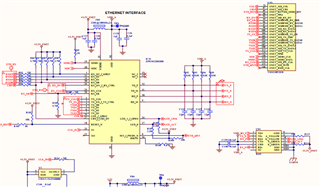
below is my schematic and code
 void main(void)
{
//
// Initialize device clock and peripherals
//
Device_init();
//
// Boot CM core
//
#ifdef _FLASH
Device_bootCM(BOOTMODE_BOOT_TO_FLASH_SECTOR0);
#else
Device_bootCM(BOOTMODE_BOOT_TO_S0RAM);
#endif
//
// Disable pin locks and enable internal pull-ups.
//
Device_initGPIO();
#ifdef ETHERNET
//
// Set up EnetCLK to use SYSPLL as the clock source and set the
// clock divider to 2.
//
// This way we ensure that the PTP clock is 100 MHz. Note that this value
// is not automatically/dynamically known to the CM core and hence it needs
// to be made available to the CM side code beforehand.
SysCtl_setEnetClk(SYSCTL_ENETCLKOUT_DIV_2, SYSCTL_SOURCE_SYSPLL);
//
// Configure the GPIOs for ETHERNET.
//
//
// / 1 PIN
GPIO_setPinConfig(GPIO_35_ENET_MII_COL);
// 2ND PIN
GPIO_setPinConfig(GPIO_40_ENET_MII_CRS);
// 3RD PIN
// GPIO_setPinConfig( GPIO_41_ENET_REVMII_MDIO_RST);
GPIO_setDirectionMode(41, GPIO_DIR_MODE_OUT);
GPIO_setPadConfig(41, GPIO_PIN_TYPE_PULLUP);
GPIO_writePin(41,1);
// 4TH PIN
GPIO_setPinConfig(GPIO_50_ENET_MII_RX_DV );
// 5TH PIN
GPIO_setPinConfig(GPIO_51_ENET_MII_RX_ERR );
// 6TH PIN
GPIO_setPinConfig(GPIO_52_ENET_MII_RX_DATA0 );
// 7TH PIN
GPIO_setPinConfig(GPIO_53_ENET_MII_RX_DATA1);
// 8TH PIN
GPIO_setPinConfig(GPIO_54_ENET_MII_RX_DATA2);
// 9TH PIN
GPIO_setPinConfig(GPIO_55_ENET_MII_RX_DATA3);
// 10TH PIN
GPIO_setPinConfig(GPIO_56_ENET_MII_TX_EN);
// 11TH PIN
GPIO_setPinConfig( GPIO_59_ENET_MII_TX_DATA0 );
// 12TH PIN
GPIO_setPinConfig(GPIO_60_ENET_MII_TX_DATA1 );
// 13TH PIN
GPIO_setPinConfig(GPIO_61_ENET_MII_TX_DATA2 );
// 14TH PIN
GPIO_setPinConfig(GPIO_62_ENET_MII_TX_DATA3 );
// 15TH PIN
GPIO_setPinConfig(GPIO_44_ESC_TX1_CLK );
// 16TH PIN
GPIO_setPinConfig(GPIO_42_ENET_MDIO_CLK );
// 17TH PIN
GPIO_setPinConfig(GPIO_43_ENET_MDIO_DATA );
// 18TH PIN
GPIO_setPinConfig(GPIO_67_ENET_MII_RX_CLK );
// 19TH PIN
// GPIO_setPinConfig( GPIO_68_ENET_MII_INTR);
GPIO_setDirectionMode(68, GPIO_DIR_MODE_OUT);
GPIO_setPadConfig(68, GPIO_PIN_TYPE_PULLUP);
GPIO_writePin(68,1);
#endif
#ifdef MCAN
//
// Setting the MCAN Clock.
//
SysCtl_setMCANClk(SYSCTL_MCANCLK_DIV_4);
//
// Configuring the GPIOs for MCAN.
//
GPIO_setPinConfig(DEVICE_GPIO_CFG_MCANRXA);
GPIO_setPinConfig(DEVICE_GPIO_CFG_MCANTXA);
#endif
#ifdef CANA
//
// Configuring the GPIOs for CAN A.
//
GPIO_setPinConfig(DEVICE_GPIO_CFG_CANRXA);
GPIO_setPinConfig(DEVICE_GPIO_CFG_CANTXA);
//
// Allocate Shared Peripheral CAN A to the CM Side.
//
SysCtl_allocateSharedPeripheral(SYSCTL_PALLOCATE_CAN_A,0x1U);
#endif
#ifdef CANB
//
// Configuring the GPIOs for CAN B.
//
GPIO_setPinConfig(DEVICE_GPIO_CFG_CANRXB);
GPIO_setPinConfig(DEVICE_GPIO_CFG_CANTXB);
//
// Allocate Shared Peripheral CAN B to the CM Side.
//
SysCtl_allocateSharedPeripheral(SYSCTL_PALLOCATE_CAN_B,0x1U);
#endif
#ifdef UART
//
// Configure GPIO85 as the UART Rx pin.
//
GPIO_setPinConfig(GPIO_85_UARTA_RX);
GPIO_setDirectionMode(85, GPIO_DIR_MODE_IN);
GPIO_setPadConfig(85, GPIO_PIN_TYPE_STD);
GPIO_setQualificationMode(85, GPIO_QUAL_ASYNC);
//
// Configure GPIO84 as the UART Tx pin.
//
GPIO_setPinConfig(GPIO_84_UARTA_TX);
GPIO_setDirectionMode(84, GPIO_DIR_MODE_OUT);
GPIO_setPadConfig(84, GPIO_PIN_TYPE_STD);
GPIO_setQualificationMode(84, GPIO_QUAL_ASYNC);
#endif
#ifdef USB
#ifdef USE_20MHZ_XTAL
//
// Set up the auxiliary PLL so a 60 MHz output clock is provided to the USB module.
// This fixed frequency is required for all USB operations.
//
SysCtl_setAuxClock(SYSCTL_AUXPLL_OSCSRC_XTAL |
SYSCTL_AUXPLL_IMULT(48) |
SYSCTL_REFDIV(2U) | SYSCTL_ODIV(4U) |
SYSCTL_AUXPLL_DIV_2 |
SYSCTL_AUXPLL_ENABLE |
SYSCTL_DCC_BASE_0);
#else
//
// Set up the auxiliary PLL so a 60 MHz output clock is provided to the USB module.
// This fixed frequency is required for all USB operations.
//
SysCtl_setAuxClock(SYSCTL_AUXPLL_OSCSRC_XTAL |
SYSCTL_AUXPLL_IMULT(48) |
SYSCTL_REFDIV(2U) | SYSCTL_ODIV(5U) |
SYSCTL_AUXPLL_DIV_2 |
SYSCTL_AUXPLL_ENABLE |
SYSCTL_DCC_BASE_0);
#endif
//
// Allocate Shared Peripheral USB to the CM Side.
//
SysCtl_allocateSharedPeripheral(SYSCTL_PALLOCATE_USBA, 1);
GPIO_setPinConfig(GPIO_0_GPIO0);
GPIO_setPadConfig(0, GPIO_PIN_TYPE_STD);
GPIO_setDirectionMode(0, GPIO_DIR_MODE_OUT);
GPIO_setMasterCore(0, GPIO_CORE_CM);
//
// Set the master core of GPIOs to CM.
//
GPIO_setMasterCore(42, GPIO_CORE_CM);
GPIO_setMasterCore(43, GPIO_CORE_CM);
GPIO_setMasterCore(46, GPIO_CORE_CM);
GPIO_setMasterCore(47, GPIO_CORE_CM);
GPIO_setMasterCore(120, GPIO_CORE_CM);
GPIO_setMasterCore(121, GPIO_CORE_CM);
//
// Set the USB DM and DP GPIOs.
//
GPIO_setAnalogMode(42, GPIO_ANALOG_ENABLED);
GPIO_setAnalogMode(43, GPIO_ANALOG_ENABLED);
//
// Set the direction for VBUS and ID.
//
GPIO_setDirectionMode(46, GPIO_DIR_MODE_IN);
GPIO_setDirectionMode(47, GPIO_DIR_MODE_IN);
//
// Configure the Power Fault.
//
GPIO_setMasterCore(120, GPIO_CORE_CM);
GPIO_setDirectionMode(120, GPIO_DIR_MODE_IN);
//
// Configure the External Power Signal Enable.
//
GPIO_setMasterCore(121, GPIO_CORE_CM);
GPIO_setDirectionMode(121, GPIO_DIR_MODE_OUT);
GPIO_writePin(121, 1);
//
// Set the CM Clock to run at 120MHz.
// The CM Clock is a fractional multiple of the AUXPLL Clock (120 Mhz) from
// which the USB Clock (60 MHz) is derived.
//
SysCtl_setCMClk(SYSCTL_CMCLKOUT_DIV_1, SYSCTL_SOURCE_AUXPLL);
#endif
}
void main(void)
{
Ethernet_InitInterfaceConfig initInterfaceConfig;
Ethernet_InitConfig *pInitCfg;
Ethernet_Pkt_Desc pktDesc;
uint32_t i;
Ethernet_Statistics stats;
Ethernet_Handle emac_handle;
//
// Initialize device clock and peripherals
//
CM_init();
//
//Form the unicast Packet in Memory
//
for(i=0;i<PACKET_LENGTH/4;i++)
{
//
//First 6 bytes of the packet are the MAC Destination Address
//Bytes, the Destination and CRC shall be inserted by the hardware
//
if(i == 0)
*((uint32_t *)pData + i) = 0x01020304;
else if(i == 1)
*((uint32_t *)pData + i) = 0xFFFF0506;
else
HWREG((uint32_t *)pData +i) = 0xFFFFFFFF;
}
//
//Select the MII interface of the module
//
initInterfaceConfig.ssbase = EMAC_SS_BASE;
initInterfaceConfig.enet_base = EMAC_BASE;
initInterfaceConfig.phyMode = ETHERNET_SS_PHY_INTF_SEL_MII;
//
//Assign SoC specific functions for Enabling,Disabling interrupts
//and for enabling the Peripheral at system level
//
initInterfaceConfig.ptrPlatformInterruptDisable = &Platform_disableInterrupt;
initInterfaceConfig.ptrPlatformInterruptEnable = &Platform_enableInterrupt;
initInterfaceConfig.ptrPlatformPeripheralEnable = &Platform_enablePeripheral;
initInterfaceConfig.ptrPlatformPeripheralReset = &Platform_resetPeripheral;
//
//Assign the peripheral number at the SoC
//
initInterfaceConfig.peripheralNum = SYSCTL_PERIPH_CLK_ENET;
//
//Assign the default SoC specific interrupt numbers of Ethernet interrupts
//
initInterfaceConfig.interruptNum[0] = INT_EMAC;
initInterfaceConfig.interruptNum[1] = INT_EMAC_TX0;
initInterfaceConfig.interruptNum[2] = INT_EMAC_TX1;
initInterfaceConfig.interruptNum[3] = INT_EMAC_RX0;
initInterfaceConfig.interruptNum[4] = INT_EMAC_RX1;
pInitCfg = Ethernet_initInterface(initInterfaceConfig);
//
// Get an initial configuration of known good parameters
//
Ethernet_getInitConfig(pInitCfg);
//
//Configure the Loopback mode
//
pInitCfg->loopbackMode = ETHERNET_MAC_CONFIGURATION_LM_LOOPBACK_ENABLED;
//
//Assign the callbacks for Getting packet buffer when needed
//Releasing the TxPacketBuffer on Transmit interrupt callbacks
//Receive packet callback on Receive packet completion interrupt
//
pInitCfg->pfcbGetPacket = &Ethernet_getPacketBuffer;
pInitCfg->pfcbFreePacket = &Ethernet_releaseTxPacketBuffer;
pInitCfg->pfcbRxPacket = &Ethernet_receivePacketCallback;
//
//Assign the Buffer to be used by the Low level driver for receiving
//Packets. This should be accessible by the Ethernet DMA
//
pInitCfg->rxBuffer = Ethernet_rxBuffer;
//
//The Application handle is not used by this application
//Hence using a dummy value of 1
//
Ethernet_getHandle((Ethernet_Handle)1,pInitCfg , &emac_handle);
//
//Do global Interrupt Enable
//
(void)Interrupt_enableInProcessor();
//
//Assign default ISRs
//
Interrupt_registerHandler(INT_EMAC_TX0, Ethernet_transmitISR);
Interrupt_registerHandler(INT_EMAC_RX0, Ethernet_receiveISR);
//
//Enable the default interrupt handlers
//
Interrupt_enable(INT_EMAC_TX0);
Interrupt_enable(INT_EMAC_RX0);
//
//Prepare a Packet Descriptor structure to send a packet
//This contains a single buffer packet
//The Source address shall be inserted by the MAC
//Packet CRC is auto computed by the module and appended in the packet
//
pktDesc.bufferLength = PACKET_LENGTH;
pktDesc.dataOffset = 0;
pktDesc.dataBuffer = pData;
pktDesc.nextPacketDesc = 0;
pktDesc.flags = ETHERNET_PKT_FLAG_SOP |ETHERNET_PKT_FLAG_EOP|ETHERNET_PKT_FLAG_SA_INS;
pktDesc.pktChannel = ETHERNET_DMA_CHANNEL_NUM_0;
pktDesc.pktLength = PACKET_LENGTH;
pktDesc.validLength = PACKET_LENGTH;
pktDesc.numPktFrags = 1;
//
//Send the packet prepared
//
Ethernet_sendPacket(emac_handle,&pktDesc);
//
//Delay for the MAC to send the packet on the wire and receive it
//
SysCtl_delay(3000);
//
//Read the statistics of the Module
//
Ethernet_getStatistics(emac_handle, &stats);
//
//Check if a packet has been received
//
if(!stats.rxUnicastPacketsGood)
__asm(" bkpt #0");
}
Thanks

