This thread has been locked.

If you have a related question, please click the "Ask a related question" button in the top right corner. The newly created question will be automatically linked to this question.

Strapping TMS320F2812 boot mode pins


I am designing a prototype board for the F2812 and would
like to keep my options open as to how it boots up. I would
therefore need to install pull-ups/downs and jumpers on the
4 pins that determine this operation:
- GPIOF4/SCITXDA
- GPIOF12/MDXA
- GPIOF3/SPISTEA
- GPIOF2/SPICLK

Ideally, I would like to configure it so if we forget to
install any jumpers, it will boot from flash, and we need to
add only one jumper to boot from SARAM. Then I want the
option of enabling any other mode by installing enough
jumpers.

I don't expect to use the McBSP, but I will be using the
SPI, so any pin that will become an output after boot is
finished cannot be tied directly to a voltage source.

I can't find any TI literature that helps specify this
beyond the Ioh & Iol specs in chapter 6 of the data sheet
(which are symmetrical).

The Spectrum Digital ezDsp board requires us to move jumpers
for each input to mutually exclusive positions, where the
pull-ups are 10k, but the pull-downs are 2.2k.

Does anyone have any better handle on this?
============================================================
Gary Lynch        printf("lynchg%cstacoenergy%ccom", 64, 46)
============================================================

  • Hello!

    Do you want to use one of these four pins later? If you do not you will not need any of these pull up/downs, just the fixed logic input given by the jumper.

    If you need to use these pins: GPIO2,3,4 habe no pull ups, GPIO12 has got one. Hence, you will have to add a pull up/down to gpio2,3,4 (e.g. 10 kOhm). I suggest to connect a 10 kOhm resistor that can be jumpered to GND/VDD to the GPIO2,3,4. GPIO12 has got a pull up (approx. 10 kOhm), hence you will need a smaller resistance for the pull down (e.g. 2.2k).

    Moreover, I would not recommend the F2812 for new designs. The F28335 is better.

    Regards,
    Edwin Krasser

    Jumper
    * VDD
    * ------------/\/\ 10 kOhm /\/\------ GPIO2,3,4
    * GND

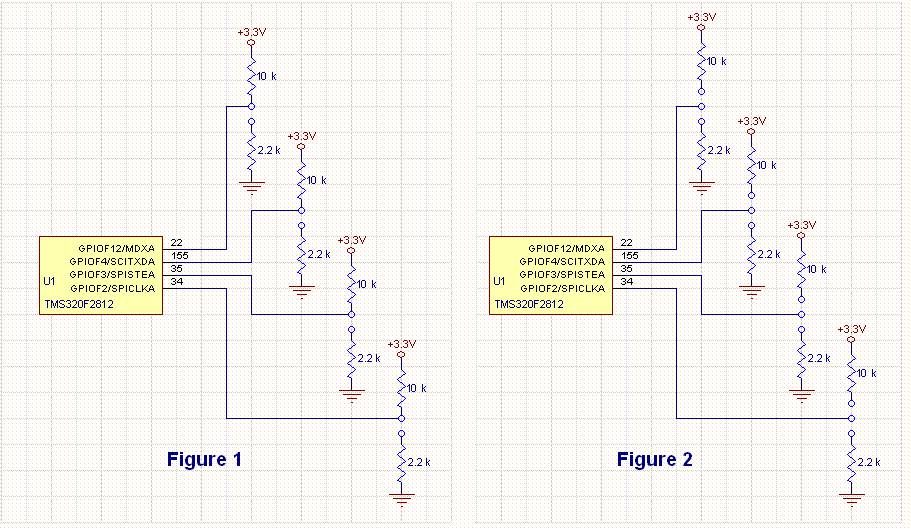
  • What you say would make perfect sense if the folks at
    Spectrum Digital had wired their board the way you describe.
    (See
    http://my.execpc.com/~bookworm/Profession/BootModeHw14.gif,
    figure 1, to verify what I understood is the circuit you
    intended.)

    With jumpers out, inputs will be pulled up to 3.3 V, and
    when a jump is installed, it pulls the pin down to 0.6 V,
    which the micro interprets as a low at boot time.

    I also have to verify the F2812 can pull SPICLKA, & SCITXDA
    pins high with 2.2k pulling it down (it can) after bootup,
    when I am using those pins for my SPI port.

    However, the esDsp board is not laid out that way. It
    resembles the circuit in figure 2 of the link referenced
    above. As such the 2.2k and the 10k resistors cannot be
    attached at the same time, and there is no resistive
    divider.

    I was just asking if I missed something (or did Spectrum
    Digital miss it instead?)

  • Hello!

    It does not really matter which pu/pd-network you use.

    Figure 1: pro: just one jumper, no jumer=high / con: in pull down mode (with jumper) you will not have good 0 V (just 3.3*2.2/(10+2.2)=0.6 V) which is low too and an additional current through both resistors

    Figure 2: pro: you get 3.3 V and 0 V when pull up/down / con: you always have to set a jumper, otherwise your pin will float!

    So, both solutions will work :-). If you want to use the F2812 in your later design, i do not recommend the Spectrum Digital board as perfect reference. Especially the double linear regulator TPS767D301. With this power supply you will waste as much power as the DSP needs in your linear regulator :-(. (e.g. two TPS62000s, using the power good signal of the 3.3 V regulator as enable for the 1.9 V regulator are much better)

    Regards,
    Edwin Krasser