Part Number: TMS320F28379D
Other Parts Discussed in Thread: C2000WARE
Tool/software:
//###########################################################################
/*
* This is a minimum working example which demonstrates usage of the SCI Module
* for the MSP430F28379D
*
* Pinout
*
* I2C : SDA (J1.10 / GPIO104)
* SCL (J1.9 / GPIO105)
* SCIA : GPIO43 / GPIO42 (on board)
* HEARTBEAT : GPIO0 (J4.40)
* ODINT-PIN : GPIO1 (J4.39)
*/
//#############################################################################
//
// Included Files
//
#include <akm.h>
#include "driverlib.h"
#include "device.h"
#define TIMER_PERIOD_US 2000
uint8_t start_meas=0;
//test string for testing the serial comm
const char teststr[]="NNAABBCC\r\n";
uint16_t sendbuf[12];
uint16_t read_buf[8];
uint8_t is_sof=0; //indicates whether the last read sample was a start of frame sample
//circular buffer for storing H field samples
//#define CIRCULAR_BUFFER_SIZE 512
//int16_t bit5buffer[CIRCULAR_BUFFER_SIZE];
struct akm_meas{
int16_t Bx;
int16_t By;
int16_t Bz;
uint16_t status;
};
__interrupt void cpuTimer0ISR(void){
start_meas=1;
Interrupt_clearACKGroup(INTERRUPT_ACK_GROUP1);
}
void serialize_akm(uint16_t* dest, const struct akm_meas* meas){
//first two bytes is 0xFF for a regular sample and 0xAA for a SOF sample
if(is_sof){
dest[0]=0x00AA;
dest[1]=0x00AA;
dest[2]=0x00AA;
}
else{
dest[0]=0x00FF;
dest[1]=0x00FF;
dest[2]=0x00FF;
}
//serialized measurements
dest[3]=0x00FF;// (meas->Bx);
dest[4]= 0x00FF;// (meas->Bx)>>8;
dest[5]=0x00;
dest[6]= 0x00FF;// (meas->By);
dest[7]= 0x00FF;// (meas->By)>>8;
dest[8]=0x00;
dest[9]= 0x00FF;// (meas->Bz);
dest[10]= 0x00FF;// (meas->Bz)>>8;
dest[11]=0x00;
}
void init_i2c(void){
I2C_disableModule(I2CA_BASE);
I2C_initMaster(I2CA_BASE, DEVICE_SYSCLK_FREQ, 200000, I2C_DUTYCYCLE_50);
I2C_setConfig(I2CA_BASE, I2C_MASTER_SEND_MODE);
I2C_setSlaveAddress(I2CA_BASE, 0);
I2C_disableLoopback(I2CA_BASE);
I2C_setBitCount(I2CA_BASE, I2C_BITCOUNT_8);
I2C_setDataCount(I2CA_BASE, 1);
I2C_setAddressMode(I2CA_BASE, I2C_ADDR_MODE_7BITS);
I2C_enableFIFO(I2CA_BASE);
I2C_setFIFOInterruptLevel(I2CA_BASE, I2C_FIFO_TXEMPTY, I2C_FIFO_RXEMPTY);
I2C_setEmulationMode(I2CA_BASE, I2C_EMULATION_FREE_RUN);
I2C_enableModule(I2CA_BASE);
}
void pinmux_init(void){
// GPIO11 -> HEARTBEAT Pinmux
GPIO_setPinConfig(GPIO_0_GPIO0);
GPIO_setDirectionMode(HEARTBEAT_PIN, GPIO_DIR_MODE_OUT);
GPIO_setPadConfig(HEARTBEAT_PIN, GPIO_PIN_TYPE_STD);
GPIO_setMasterCore(HEARTBEAT_PIN, GPIO_CORE_CPU1);
GPIO_setQualificationMode(HEARTBEAT_PIN, GPIO_QUAL_SYNC);
// SDA & SCL lines for I2C
GPIO_setPinConfig(GPIO_105_SCLA);
GPIO_setPadConfig(105, GPIO_PIN_TYPE_PULLUP);
GPIO_setPadConfig(105, GPIO_PIN_TYPE_OD);
GPIO_setQualificationMode(105, GPIO_QUAL_ASYNC);
GPIO_setPinConfig(GPIO_104_SDAA);
GPIO_setPadConfig(104, GPIO_PIN_TYPE_PULLUP);
GPIO_setPadConfig(104, GPIO_PIN_TYPE_OD);
GPIO_setQualificationMode(104, GPIO_QUAL_ASYNC);
// ODINT Pin
GPIO_setDirectionMode(ODINT,GPIO_DIR_MODE_IN);
GPIO_setPinConfig(GPIO_1_GPIO1);
// SCIA
GPIO_setPinConfig(GPIO_43_SCIRXDA);
GPIO_setPinConfig(GPIO_42_SCITXDA);
}
void gpio_init(void){
//HEARTBEAT initialization
GPIO_setDirectionMode(HEARTBEAT_PIN, GPIO_DIR_MODE_OUT);
GPIO_setPadConfig(HEARTBEAT_PIN, GPIO_PIN_TYPE_STD);
GPIO_setMasterCore(HEARTBEAT_PIN, GPIO_CORE_CPU1);
GPIO_setQualificationMode(HEARTBEAT_PIN, GPIO_QUAL_SYNC);
//start of frame SOF GPIO
GPIO_setDirectionMode(SOF_GPIO, GPIO_DIR_MODE_IN);
GPIO_setPadConfig(SOF_GPIO, GPIO_PIN_TYPE_STD);
GPIO_setMasterCore(SOF_GPIO, GPIO_CORE_CPU1);
GPIO_setQualificationMode(SOF_GPIO, GPIO_QUAL_SYNC);
//W2BW_SUPPLY initialization
// GPIO_setDirectionMode(ODINT, GPIO_DIR_MODE_OUT);
// GPIO_setPadConfig(ODINT, GPIO_PIN_TYPE_STD);
// GPIO_setMasterCore(ODINT, GPIO_CORE_CPU1);
// GPIO_setQualificationMode(ODINT, GPIO_QUAL_SYNC);
}
void timer_init(void){
const uint32_t timer_perios_us=TIMER_PERIOD_US;
CPUTimer_setPeriod(CPUTIMER0_BASE,DEVICE_SYSCLK_FREQ/1000000*timer_perios_us);
CPUTimer_setEmulationMode(CPUTIMER0_BASE,
CPUTIMER_EMULATIONMODE_STOPAFTERNEXTDECREMENT);
CPUTimer_setPreScaler(CPUTIMER0_BASE, 0);
CPUTimer_stopTimer(CPUTIMER0_BASE);
CPUTimer_reloadTimerCounter(CPUTIMER0_BASE);
CPUTimer_startTimer(CPUTIMER0_BASE);
//register & enable CPU Timer0 interrupt
Interrupt_register(INT_TIMER0, &cpuTimer0ISR);
CPUTimer_enableInterrupt(CPUTIMER0_BASE);
Interrupt_enable(INT_TIMER0);
}
void sci_comm(void){
//
// Configuration for the SCI Rx pin.
//
GPIO_setMasterCore(DEVICE_GPIO_PIN_SCIRXDA, GPIO_CORE_CPU1);
GPIO_setPinConfig(DEVICE_GPIO_CFG_SCIRXDA);
GPIO_setDirectionMode(DEVICE_GPIO_PIN_SCIRXDA, GPIO_DIR_MODE_IN);
GPIO_setPadConfig(DEVICE_GPIO_PIN_SCIRXDA, GPIO_PIN_TYPE_STD);
GPIO_setQualificationMode(DEVICE_GPIO_PIN_SCIRXDA, GPIO_QUAL_ASYNC);
//
// Configuration for the SCI Tx pin.
//
GPIO_setMasterCore(DEVICE_GPIO_PIN_SCITXDA, GPIO_CORE_CPU1);
GPIO_setPinConfig(DEVICE_GPIO_CFG_SCITXDA);
GPIO_setDirectionMode(DEVICE_GPIO_PIN_SCITXDA, GPIO_DIR_MODE_OUT);
GPIO_setPadConfig(DEVICE_GPIO_PIN_SCITXDA, GPIO_PIN_TYPE_STD);
GPIO_setQualificationMode(DEVICE_GPIO_PIN_SCITXDA, GPIO_QUAL_ASYNC);
//
// Initialize SCIA and its FIFO.
//
SCI_performSoftwareReset(SCIA_BASE);
//
// Configure SCIA for echoback.
//
SCI_setConfig(SCIA_BASE, DEVICE_LSPCLK_FREQ, 250000, (SCI_CONFIG_WLEN_8 |
SCI_CONFIG_STOP_ONE |
SCI_CONFIG_PAR_NONE));
SCI_resetChannels(SCIA_BASE);
SCI_resetRxFIFO(SCIA_BASE);
SCI_resetTxFIFO(SCIA_BASE);
SCI_clearInterruptStatus(SCIA_BASE, SCI_INT_TXFF | SCI_INT_RXFF);
SCI_enableFIFO(SCIA_BASE);
SCI_enableModule(SCIA_BASE);
SCI_performSoftwareReset(SCIA_BASE);
}
uint8_t i2c_write(uint8_t addr,const uint8_t* data,uint8_t count){
//wait until the bus is not busy anymore (e.g. STOP condition has been sent)
while(I2C_getStopConditionStatus(I2CA_BASE))
;
//set the I2C slave address to the write address
I2C_setSlaveAddress(I2CA_BASE,I2C_W2BW_ADDRESS);
//set the number of bytes to be sent
I2C_setDataCount(I2CA_BASE, count);
//push the data to the I2C TX FIFO
uint8_t i=0;
for(i=0; i<count; i++){
I2C_putData(I2CA_BASE,data[i]);
}
//set the I2C mode to master
I2C_setConfig(I2CA_BASE, I2C_MASTER_SEND_MODE);
//send the start condition
I2C_sendStartCondition(I2CA_BASE);
//send the stop condition
I2C_sendStopCondition(I2CA_BASE);
return 0;
}
uint8_t i2c_read(uint8_t addr,uint16_t* data,uint8_t count){
//wait until the bus is not busy anymore (e.g. STOP condition has been sent)
while(I2C_getStopConditionStatus(I2CA_BASE))
;
uint8_t i=0;
//set the I2C slave address to the write address
I2C_setSlaveAddress(I2CA_BASE,I2C_W2BW_ADDRESS);
//set the I2C mode to master & repeat mode (data is read until STOP condition)
I2C_setConfig(I2CA_BASE, I2C_MASTER_RECEIVE_MODE|I2C_REPEAT_MODE);
//send the start condition
I2C_sendStartCondition(I2CA_BASE);
uint8_t bytes_read=0;
while((count-bytes_read)>16){
//wait until 16 bytes have been read
while(I2C_getRxFIFOStatus(I2CA_BASE)!=I2C_FIFO_RX16)
;
//copy the 16 bytes to the data buffer
for(i=0; i<16; i++)
data[bytes_read+i]=I2C_getData(I2CA_BASE);
bytes_read+=16;
}
uint8_t remaining_bytes=count-bytes_read;
//wait for the remaining bytes to be read into the RX FIFO
while(I2C_getRxFIFOStatus(I2CA_BASE)!=remaining_bytes)
;
I2C_RxFIFOLevel level=I2C_getRxFIFOStatus(I2CA_BASE);
//send the stop condition
I2C_sendStopCondition(I2CA_BASE);
//copy the remaining bytes
//retreive the latest bit (e.g. the bit that was received most recently)
//data[remaining_bytes-1]=I2C_getData(I2CA_BASE);
//copy the remaining received bits from the FIFO
for(i=0; i<remaining_bytes; i++)
data[bytes_read+i]=I2C_getData(I2CA_BASE);
return 0;
}
void parse_akm_meas(const uint8_t* bytes,struct akm_meas* meas){
//read the status byte
meas->status=bytes[0];
//parse Bz value
uint16_t Bz=0;
Bz=bytes[1];
Bz=Bz<<8;
Bz=Bz|bytes[2];
//parse By value
uint16_t By=0;
By=bytes[3];
By=By<<8;
By=By|bytes[4];
//parse Bx value
uint16_t Bx=0;
Bx=bytes[5];
Bx=Bx<<8;
Bx=Bx|bytes[6];
//fill in structure
meas->Bx=(int16_t)Bx;
meas->By=(int16_t)By;
meas->Bz=(int16_t)Bz;
}
//definitions for AKM comm
//----CNTL1 register (16bit)
const uint8_t ADDR_CNTL1=0x20;
const uint8_t CNTL1_LOW_DRDY_EVENT_EN=0b00000001;
// upper 8 bits are all zero for this register
//----CNTL2 register (8bit)
const uint8_t ADDR_CNTL2=0x21;
const uint8_t CNTL2_MEASMODE6=0x0C; //500Hz continuous measurement mode
const uint8_t CNTL2_SINGLEMEAS=0x01; //single measurement mode
//----additional addresses
const uint8_t ADDR_STATUS=0x10;
const uint8_t ADDR_STATUS_AND_FIELDS=0x17;
//global variables
struct akm_meas current_meas;
//global memores of last N measurements
#define N_MEM 1024
int16_t Bxmem[N_MEM]={0};
int16_t Bymem[N_MEM]={0};
int16_t Bzmem[N_MEM]={0};
//
// Main
//
void main(void)
{
//
// Initialize device clock and peripherals
//
Device_init();
//
// Disable pin locks and enable internal pullups.
//
Device_initGPIO();
//
// Initialize PIE and clear PIE registers. Disable CPU interrupts.
//
Interrupt_initModule();
//
// Initialize the PIE vector table with pointers to the shell Interrupt
// Service Routines (ISR).
//
Interrupt_initVectorTable();
//init the I2C interface
pinmux_init();
gpio_init();
init_i2c();
//enable / disable the I2C module
I2C_disableModule(I2CA_BASE);
DEVICE_DELAY_US(200000u);
I2C_enableModule(I2CA_BASE);
//enable event on data ready (e.g. odint pulled low when data ready)
const uint8_t WRITE_CONFIG_CNTL1[]={ADDR_CNTL1,CNTL1_LOW_DRDY_EVENT_EN,0x00};
//set measurement mode to MODE6 (e.g. single measurement mode)
const uint8_t WRITE_CONFIG_CNTL2[]={ADDR_CNTL2,CNTL2_SINGLEMEAS};
//write the address to be read to the sensor using I2C write command
const uint8_t WRITE_STATUS_AND_FIELDS_ADDR[]={ADDR_STATUS_AND_FIELDS};
//initialize AKM sensor
i2c_write(0,WRITE_CONFIG_CNTL1,3);
i2c_write(0,WRITE_CONFIG_CNTL2,2);
DEVICE_DELAY_US(2000000u);
/* read status register for debugging purposes, not needed
uint8_t read_buf[6];
//first, write the random address to be read to the sensor using a I2C write transaction
const uint8_t WRITE_RAND_ADDR[]={ADDR_STATUS};
i2c_write(0,WRITE_RAND_ADDR,1);
i2c_read(0,read_buf,1);
*/
//initialize the SCI comm interface to the PC
sci_comm();
//set up timer & enable interrupts
timer_init();
Interrupt_enableMaster();
EINT;
ERTM;
uint16_t loop_counter=0;
for(;;){
if(start_meas){
//toggle the heartbeat pin
GPIO_togglePin(HEARTBEAT_PIN);
//set the mode to single measurement mode via I2C, this triggers a new measurement
i2c_write(0,WRITE_CONFIG_CNTL2,2);
//DEVICE_DELAY_US(100u);
i2c_write(0,WRITE_STATUS_AND_FIELDS_ADDR,1);
//DEVICE_DELAY_US(100u);
//read 7 bytes from the address
// for some reason, with the current `i2c_read` function, we need to read 8 bytes instead of 7. the first byte that is read seems to be random
i2c_read(0,read_buf,7+1);
//check whether the sample read was a start of frame sample
if(GPIO_readPin(SOF_GPIO))
is_sof=1;
else
is_sof=0;
//parse magnetic data from sensor
parse_akm_meas(read_buf+1,¤t_meas);
//serialize last measurement and send over UART
serialize_akm(sendbuf,¤t_meas);
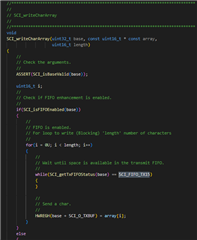
SCI_writeCharArray(SCIA_BASE,sendbuf,sizeof(sendbuf));
start_meas=0;
loop_counter+=1;
}
}
}
//
// End of File
//
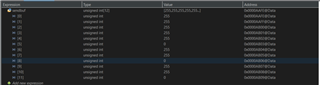
I am using this code to send this very simple debug message but the serial monitor receives it incorrectly