This thread has been locked.

If you have a related question, please click the "Ask a related question" button in the top right corner. The newly created question will be automatically linked to this question.

TMS320F28377D: Minimal data Hold Time required in EMIF Asynchronous Memory Reading Operation

Part Number: TMS320F28377D

Tool/software:

Dear All


        I'am using EMIF of F28337D to exchange data with a FPGA . The EMIF is configued in asynchronous memory mode and the wait mode is disabled.   

In https://www.ti.com/lit/pdf/SPRUHM8  Table 25-21, it says, quote

On the rising edge of the clock that is concurrent with the end of the strobe period:
• EM1OE rises
• The data on the EM1Dx bus is sampled by EMIF.

To my knowledge there should be a minimal data hold time after EM1OE rises, then I found this value in  TMS320F2837xD Dual-Core Real-Time Microcontrollers datasheet (Rev. P) ,.
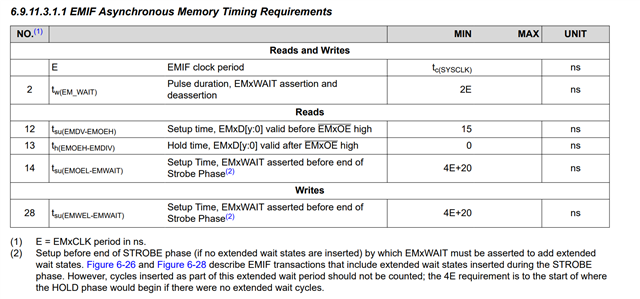
   

No.13 row  in above figure says the hold time can be 0 ns,  which is a bit opposed with my intuition.

Now I'am going to implement a FPGA design to achieve an asynchronous Read/Write mechinism ,  like an asynchronous SRAM,   as a slave device of F28377D.

So, my questions are:

1.   When DSP read data from FPGA, should FPGA keep EMxD signal stable for some non-zero time after EMxOE rises? 

       According to the specification of F28377D, the answer seems to be no. 

      Could anyone help confirm it?

  • Hi Ellis,

    The data on the EMxDx bus is sampled by EMIF on the rising edge of the EMxOE. This hold time is the required duration that the input data must be stable after the rising edge of EM1xOE signal. If data is changing within this hold time window, the input data might not be sampled correctly. 

    When the EMxOE clock goes high, the input data is sampled. However, the transmission of memory device is not stopped immediately after the rising edge of EMxOE because the clock needs to travel to memory device and the gate in memory device also takes time to close. So the minimum of hold time can be zero.

    1.   When DSP read data from FPGA, should FPGA keep EMxD signal stable for some non-zero time after EMxOE rises? 

    You don't have to.