TMS320C28346: TMS320C28346: EPWM7 Frequency Jitter and Phase Shift Synchronization Issues

Part Number: TMS320C28346


Device: TMS320C28346

Device: TMS320C28346

Description of Issues:

I am encountering synchronization issues with the EPWM modules in a configuration where two separate synchronization chains are active.

1. EPWM7 Frequency Jitter (Interaction between Sync Groups)

Configuration:

I have configured two separate synchronization groups:

  • Group A: EPWM1 (Master) $\rightarrow$ EPWM2 $\rightarrow$ EPWM3

  • Group B: EPWM4 (Master) $\rightarrow$ EPWM5 $\rightarrow$ EPWM6 $\rightarrow$ EPWM7

Symptoms:

  • Frequency jitter occurs specifically on EPWM7.

  • The waveform appears stable at 100kHz, but jitter occurs at other frequencies.

  • Key Observation: If I disable the Master mode on EPWM1 (disable sync out), the jitter on EPWM7 disappears.

  • Code Workaround: In the attached code, enabling the logic under //@@@@@@ if enable -> PWM7 ok. resolves the jitter.

Question:

Since EPWM1 and EPWM7 belong to different synchronization chains in my setup, I am unsure why EPWM1 is affecting EPWM7. Can this behavior be reproduced on the TI Evaluation Board (EVM), or does this indicate a specific noise/layout issue on our custom hardware?


2. EPWM7 Phase Shift Failure (in EPWM4-7 Chain)

Configuration:

  • EPWM4 to EPWM7 are synchronized (EPWM4 is Master).

Symptoms:

  • Phase control works for EPWM5 and EPWM6, but fails for EPWM7.

  • When changing the frequency/phase settings for the group (EPWM4–7), the phase shift is not updated for EPWM7.

  • Code Observation: Modifying the variables below the comment @@@@@@ PWM7 phase shift is not applied has no effect.

Question:

I have not been able to find the root cause of why only EPWM7 fails to respond to phase shift changes while the rest of the chain operates correctly.

TEST CODE: 251203_28346 epwm test_June.Shin.zip 

Your advice would be greatly appreciated.

Thank you.

  • Hi June,

    I will take a look at it and will get back to you soon.

    Thanks

    Srikanth

  • Thank you, Srikanth. I look forward to hearing from you.

  • Hi June,

    Apologies for the delay - Srikanth is currently out, so please allow another day for me to take a preliminary look at your issue. Thanks for the patience.

    Best Regards,

    Allison

  • Hi Allison,

    Thanks for letting me know. That is fine, please take your time with the review.

    I look forward to hearing from you.

  • Thanks for the patience, June.

    I unfortunately will also be out of office tomorrow, but I will follow up on this first thing Monday.

    Best Regards,

    Allison

  • Hi June,

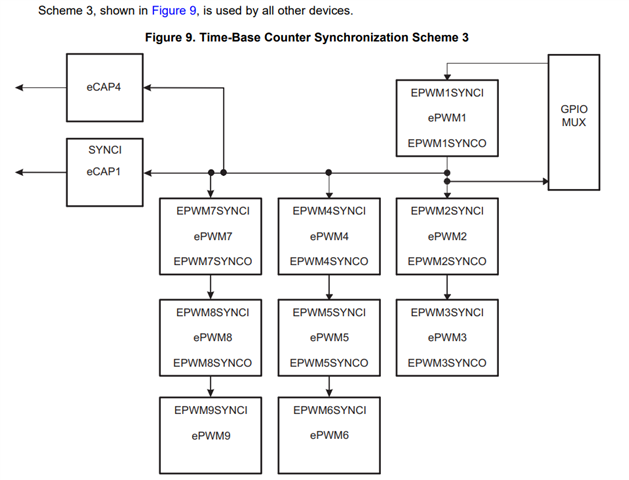
    Can you clarify what you mean by "different synchronization chains" in your setup?

    Do you have SYNCOUT enabled on EPWM3? And is phase shift disabled on EPWM4? TMS320C28346 has a fixed daisy-chain architecture. With the EPWMs in a single chain, the phase shift from EPWM1 may be causing phase shift failure on EPWM7 with certain timings- e.g. at 100kHz, the timing relationship between EPWM1 and EPWM4 sync signals may coincidentally align, masking the interference. At other frequencies, the sync signals conflict, causing the visible jitter.

    Best Regards,

    Allison

  • Hi Allison,

    Apologies for the late response. I mistakenly thought I hadn't received a reply yet, so I was waiting.

    Thank you for the detailed insight. Let me clarify my question based on my test results.

    1. Question on "Dual Masters" in a Single Chain: I am fully aware that the F28346 has a single fixed daisy-chain architecture. My specific question is: Is it structurally impossible to have TWO active Masters (e.g., ePWM1 and ePWM4) running simultaneously within this single chain?

    Scenario A (1 Master, 8 Slaves): If I set ePWM1 as the only Master and ePWM2~9 as Slaves, everything works fine.

    Scenario B (2 Masters): If I configure ePWM1 as Master (for Group A: 1-3) and ePWM4 as Master (for Group B: 4-9), ePWM7 fails.

    Failure Symptom: Phase shift control does not work, and duty cycle/frequency become unstable on ePWM7 (especially visible at lower frequencies).

    2. Test Result regarding ePWM3: Regarding your question about ePWM3: I have tested enabling/disabling SYNCOUT on ePWM3. The ONLY way ePWM7 works correctly is when I completely isolate Group B from Group A. Specifically, I had to:

    Disable ePWM1's Master Sync generation.

    AND strictly set EPwm3Regs.TBCTL.bit.SYNCOSEL = TB_SYNC_DISABLE; (Please refer to line 19 in my code snippet).

    If any sync pulse from Group A (ePWM1~3) is allowed to propagate to ePWM4, the issue on ePWM7 persists.

    3. The Mystery of ePWM7: What I still fail to understand is why this issue is isolated specifically to ePWM7. ePWM 5 and 6 (which are also in Group B and receive signals from ePWM4) work perfectly fine. Why does the interference affect only ePWM7?

    4. Conclusion: It seems that the upstream sync signal (from ePWM1) corrupts the downstream logic (ePWM7) even if ePWM4 attempts to act as a new Master. Does this mean the F28346 hardware enforces a "One System, One Master" rule? Is it impossible for ePWM4 to block the upstream sync signal and start a new sync chain for ePWM 5-9?

    Best Regards, 

    June

  • June,

    Allison is currently out of office and will get back to you as soon as she returns to the office after the holidays. Thank you for your patience.

    Best Regards,

    Aishwarya

  • Aishwarya, Understood. Thank you for the update. Happy holidays!

    Best Regards, 

    June