This thread has been locked.

If you have a related question, please click the "Ask a related question" button in the top right corner. The newly created question will be automatically linked to this question.

TMS320F28377S: cl2000 22.6.3 compiler errors where 22.6.1 had none

Part Number: TMS320F28377S
Other Parts Discussed in Thread: C2000WARE

With cl2000 22.6.1 device.cpp builds without error.

With cl2000 22.6.3 it has the build errors below.

What have I done wrong?

Both compile outputs below


22.6.3 compile with error

[0]**** Build of configuration 'DEBUG_UPDATE' for project 'CMCScannerPlusPlus' ****

[1]"C:\\ti\\ccs2040\\ccs\\utils\\bin\\gmake" -k -j 2 device/device.obj -O

[2]Building file: "../device/device.c"
[3]Invoking: C2000 Compiler
[4]"C:/ti/ccs2040/ccs/tools/compiler/ti-cgt-c2000_22.6.3.LTS/bin/cl2000" -v28 -ml -mt --cla_support=cla1 --float_support=fpu32 --isr_save_vcu_regs=on --tmu_support=tmu0 --vcu_support=vcu0 --include_path="C:/Projects/CMCScannerPlusPlus/device" --include_path="C:/ti/c2000/C2000Ware_6_00_01_00/device_support/f2837xs/headers/include" --include_path="C:/ti/c2000/C2000Ware_6_00_01_00/device_support/f2837xs/common/include" --include_path="C:/ti/ccs2040/ccs/tools/compiler/ti-cgt-c2000_22.6.3.LTS/include" --include_path="C:/Projects/CMCScannerPlusPlus" --include_path="C:/Projects/CMCScannerPlusPlus/dsp_shared" --include_path="C:/Projects/CMCScannerPlusPlus/inc" --include_path="C:/Projects/CMCScannerPlusPlus/inc/common" --include_path="C:/Projects/CMCScannerPlusPlus/inc/common/fromCMCESMCPlus" --include_path="C:/ti/c2000/C2000Ware_6_00_01_00/driverlib/f2837xs/driverlib" --include_path="C:/ti/c2000/C2000Ware_5_04_00_00/libraries/flash_api/f2837xs/include" --include_path="C:/ti/c2000/C2000Ware_5_04_00_00/libraries/dsp/VCU/c28/include/vcu0" --advice:performance=all --define=_FLASH --define=BUILD_CONFIG_DEBUG_FLASH --define=DEBUG_PRINTF_STDOUT --define=CPU1 --define=_DUAL_HEADERS -g --c11 --cpp_default --diag_warning=225 --diag_wrap=off --display_error_number --abi=coffabi --preproc_with_compile --preproc_dependency="device/device.d_raw" --include_path="C:/Projects/CMCScannerPlusPlus/DEBUG_UPDATE/syscfg" --obj_directory="device"  "../device/device.c"
[5]"C:\ti\c2000\C2000Ware_6_00_01_00\driverlib\f2837xs\driverlib\interrupt.h", line 483: error #313: cannot overload functions distinguished by return type alone
[6]"C:\ti\c2000\C2000Ware_6_00_01_00\driverlib\f2837xs\driverlib\interrupt.h", line 484: error #313: cannot overload functions distinguished by return type alone
[7]"C:/ti/c2000/C2000Ware_6_00_01_00/driverlib/f2837xs/driverlib/can.h", line 362: error #169: argument of type "int16_t *" is incompatible with parameter of type "int *"
[8]"C:/ti/c2000/C2000Ware_6_00_01_00/driverlib/f2837xs/driverlib/can.h", line 410: error #169: argument of type "int16_t *" is incompatible with parameter of type "int *"
[9]"C:/ti/c2000/C2000Ware_6_00_01_00/driverlib/f2837xs/driverlib/can.h", line 459: error #169: argument of type "int16_t *" is incompatible with parameter of type "int *"
[10]"C:/ti/c2000/C2000Ware_6_00_01_00/driverlib/f2837xs/driverlib/can.h", line 500: error #169: argument of type "int16_t *" is incompatible with parameter of type "int *"
[11]6 errors detected in the compilation of "../device/device.c".

[12] Build finished


22.6.1 compile without error

[0]**** Build of configuration 'DEBUG_UPDATE' for project 'CMCScannerPlusPlus' ****

[1]"C:\\ti\\ccs2001\\ccs\\utils\\bin\\gmake" -k -j 16 device/device.obj -O

[2]Building file: "../device/device.c"
[3]Invoking: C2000 Compiler
[4]"C:/ti/ccs2001/ccs/tools/compiler/ti-cgt-c2000_22.6.1.LTS/bin/cl2000" -v28 -ml -mt --cla_support=cla1 --float_support=fpu32 --isr_save_vcu_regs=on --tmu_support=tmu0 --vcu_support=vcu0 --include_path="C:/BlueCrest/projects/CMCScannerPlusPlus/device" --include_path="C:/ti/c2000/C2000Ware_5_04_00_00/device_support/f2837xs/headers/include" --include_path="C:/ti/c2000/C2000Ware_5_04_00_00/device_support/f2837xs/common/include" --include_path="C:/ti/ccs2001/ccs/tools/compiler/ti-cgt-c2000_22.6.1.LTS/include" --include_path="C:/BlueCrest/projects/CMCScannerPlusPlus" --include_path="C:/BlueCrest/projects/CMCScannerPlusPlus/dsp_shared" --include_path="C:/BlueCrest/projects/CMCScannerPlusPlus/inc" --include_path="C:/BlueCrest/projects/CMCScannerPlusPlus/inc/common" --include_path="C:/BlueCrest/projects/CMCScannerPlusPlus/inc/common/fromCMCESMCPlus" --include_path="C:/ti/c2000/C2000Ware_5_04_00_00/driverlib/f2837xs/driverlib" --include_path="C:/ti/c2000/C2000Ware_5_04_00_00/libraries/flash_api/f2837xs/include" --include_path="C:/ti/c2000/C2000Ware_5_04_00_00/libraries/dsp/VCU/c28/include/vcu0" --advice:performance=all --define=_FLASH --define=BUILD_CONFIG_DEBUG_FLASH --define=DEBUG_PRINTF_STDOUT --define=CPU1 --define=_DUAL_HEADERS -g --c11 --cpp_default --diag_warning=225 --diag_wrap=off --display_error_number --abi=coffabi --preproc_with_compile --preproc_dependency="device/device.d_raw" --include_path="C:/BlueCrest/projects/CMCScannerPlusPlus/DEBUG_UPDATE/syscfg" --obj_directory="device"  "../device/device.c"
[5]Finished building: "../device/device.c"

[6]* Build finished *


  • I have the same error on my side by building the empty C++ template project in this CCS version:

  • I've reverted to the TI v22.6.1 LTS and it built successfully.

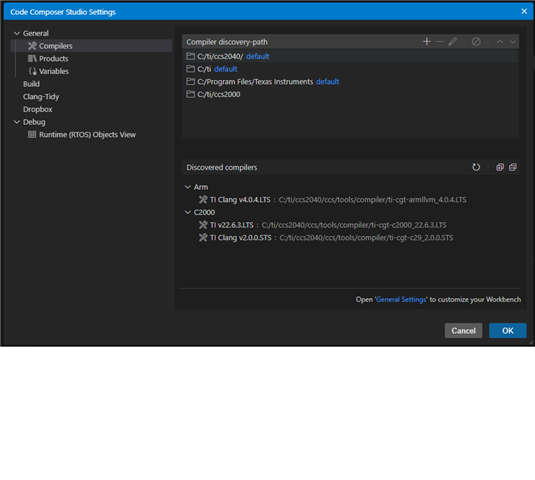
  • The machine Im trying to fix didn't  have 22.6.1. I installed CCS20.0 to add it, but CCS20.4 is not "discovering" as shown above. 

    Getting it to build with 22.6.1 would be a welcome improvement over where I am now, but it would be better if it could be determined why 22.6.3 is not working.

  • I added c:/ti/ccs2000 to the compiler discovery path and had clicked the Refresh button (several times). It didn't find 22.6.1.  Notice that c:/ti/ccs2000 does not have the text "default" next to it as the other paths do.

  • You need to place it in the compiler folder, it will auto-detect all the compatible C2000 toolchains (it even detects the one that I added _test):

  • After adding c:/ti/ccs2000/ccs/tools/compiler to the compiler discovery-path list, it was discovered. Compile now works with TI v22.6.1A233259.

    My version of 22.6.1 has a different subversion (1A233259 vs LTS).  Do you know the significance of LTS?

    Thanks very much....

    BTW -

    I've found that when you change the compiler selection for a project, other relevant thing(s) are also modified in .cproject. Ex files excluded are no longer excluded.

    Im wondering if the compile failure is due to something else changing and not the compiler selection itself.

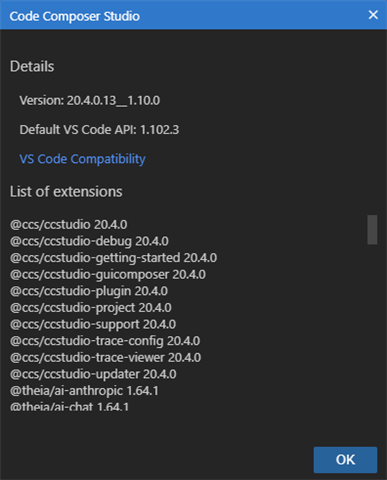
    CCS 20.4.0.13_1.10.0

  • The machine Im trying to fix didn't  have 22.6.1. I installed CCS20.0 to add it,

    Please note that you can download/install standalone compiler versions:

    https://www.ti.com/tool/download/C2000-CGT/22.6.1.LTS

    And have it discovered by CCS:

    https://www.ti.com/video/6369988068112

    I've found that when you change the compiler selection for a project, other relevant thing(s) are also modified in .cproject.

    This is expected. There is a lot of metadata in that file that would get updated.

    My version of 22.6.1 has a different subversion (1A233259 vs LTS).  Do you know the significance of LTS?

    I have brought this thread to the attention of the compiler experts. Please note that due to the holiday season, many people are currently on vacation. Hence responses may be delayed.

    Thanks

    ki

  • I compared the 2 build log fragments from the first post.  The one that uses compiler version 22.6.3.LTS has header files paths that sometimes use C:/ti/c2000/C2000Ware_6_00_01_00 and other times use C:/ti/c2000/C2000Ware_5_04_00_00.  The one that uses compiler version 22.6.1.LTS consistently uses C:/ti/c2000/C2000Ware_5_04_00_00.  I suspect this is the root cause of the problem.

    Both builds uses --cpp_default, which tells the compiler to process the C file as if it is C++.  I don't know if this documented and supported by the C2000Ware package.

    Thanks and regards,

    -George

  • I fixed the C2000 paths but still get the same error. Output below. Will attach .cproject that corresponds to 22.6.3 compile fail.

    22.6.3 Compile with error


    [0]**** Build of configuration 'DEBUG_FLASH' for project 'CMCScannerPlusPlus' ****

    [1]"C:\\ti\\ccs2001\\ccs\\utils\\bin\\gmake" -k -j 16 device/device.obj -O

    [2]Building file: "../device/device.c"
    [3]Invoking: C2000 Compiler
    [4]"C:/ti/ccs2001/ccs/tools/compiler/ti-cgt-c2000_22.6.3.LTS/bin/cl2000" -v28 -ml -mt --cla_support=cla1 --float_support=fpu32 --isr_save_vcu_regs=on --tmu_support=tmu0 --vcu_support=vcu0 --include_path="C:/BlueCrest/projects/CMCScannerPlusPlus/device" --include_path="C:/ti/c2000/C2000Ware_6_00_01_00/device_support/f2837xs/headers/include" --include_path="C:/ti/c2000/C2000Ware_6_00_01_00/device_support/f2837xs/common/include" --include_path="C:/ti/ccs2001/ccs/tools/compiler/ti-cgt-c2000_22.6.3.LTS/include" --include_path="C:/BlueCrest/projects/CMCScannerPlusPlus" --include_path="C:/BlueCrest/projects/CMCScannerPlusPlus/dsp_shared" --include_path="C:/BlueCrest/projects/CMCScannerPlusPlus/inc" --include_path="C:/BlueCrest/projects/CMCScannerPlusPlus/inc/common" --include_path="C:/BlueCrest/projects/CMCScannerPlusPlus/inc/common/fromCMCESMCPlus" --include_path="C:/ti/c2000/C2000Ware_6_00_01_00/driverlib/f2837xs/driverlib" --include_path="C:/ti/c2000/C2000Ware_6_00_01_00/libraries/flash_api/f2837xs/include" --include_path="C:/ti/c2000/C2000Ware_6_00_01_00/libraries/dsp/VCU/c28/include/vcu0" --advice:performance=all --define=_FLASH --define=BUILD_CONFIG_DEBUG_FLASH --define=DEBUG_PRINTF_STDOUT --define=CPU1 --define=_DUAL_HEADERS -g --c11 --cpp_default --diag_warning=225 --diag_wrap=off --display_error_number --abi=coffabi --preproc_with_compile --preproc_dependency="device/device.d_raw" --include_path="C:/BlueCrest/projects/CMCScannerPlusPlus/DEBUG_FLASH/syscfg" --obj_directory="device" "../device/device.c"
    [5]"C:\ti\c2000\C2000Ware_6_00_01_00\driverlib\f2837xs\driverlib\interrupt.h", line 483: error #313: cannot overload functions distinguished by return type alone
    [6]"C:\ti\c2000\C2000Ware_6_00_01_00\driverlib\f2837xs\driverlib\interrupt.h", line 484: error #313: cannot overload functions distinguished by return type alone
    [7]"C:/ti/c2000/C2000Ware_6_00_01_00/driverlib/f2837xs/driverlib/can.h", line 362: error #169: argument of type "int16_t *" is incompatible with parameter of type "int *"
    [8]"C:/ti/c2000/C2000Ware_6_00_01_00/driverlib/f2837xs/driverlib/can.h", line 410: error #169: argument of type "int16_t *" is incompatible with parameter of type "int *"
    [9]"C:/ti/c2000/C2000Ware_6_00_01_00/driverlib/f2837xs/driverlib/can.h", line 459: error #169: argument of type "int16_t *" is incompatible with parameter of type "int *"
    [10]"C:/ti/c2000/C2000Ware_6_00_01_00/driverlib/f2837xs/driverlib/can.h", line 500: error #169: argument of type "int16_t *" is incompatible with parameter of type "int *"
    [11]"C:/ti/c2000/C2000Ware_6_00_01_00/device_support/f2837xs/headers/include/F2837xS_device.h", line 64: error #148: declaration is incompatible with "volatile uint16_t IFR" (declared at line 63 of "C:\ti\c2000\C2000Ware_6_00_01_00\driverlib\f2837xs\driverlib\cpu.h")
    [12]"C:/ti/c2000/C2000Ware_6_00_01_00/device_support/f2837xs/headers/include/F2837xS_device.h", line 65: error #148: declaration is incompatible with "volatile uint16_t IER" (declared at line 70 of "C:\ti\c2000\C2000Ware_6_00_01_00\driverlib\f2837xs\driverlib\cpu.h")
    [13]"..\device\device.h", line 192: error #148: declaration is incompatible with "Uint16 RamfuncsLoadStart" (declared at line 345 of "C:\ti\c2000\C2000Ware_6_00_01_00\device_support\f2837xs\common\include\F2837xS_GlobalPrototypes.h")
    [14]"..\device\device.h", line 193: error #148: declaration is incompatible with "Uint16 RamfuncsLoadEnd" (declared at line 346 of "C:\ti\c2000\C2000Ware_6_00_01_00\device_support\f2837xs\common\include\F2837xS_GlobalPrototypes.h")
    [15]"..\device\device.h", line 194: error #148: declaration is incompatible with "Uint16 RamfuncsLoadSize" (declared at line 347 of "C:\ti\c2000\C2000Ware_6_00_01_00\device_support\f2837xs\common\include\F2837xS_GlobalPrototypes.h")
    [16]"..\device\device.h", line 195: error #148: declaration is incompatible with "Uint16 RamfuncsRunStart" (declared at line 348 of "C:\ti\c2000\C2000Ware_6_00_01_00\device_support\f2837xs\common\include\F2837xS_GlobalPrototypes.h")
    [17]"..\device\device.h", line 196: error #148: declaration is incompatible with "Uint16 RamfuncsRunEnd" (declared at line 349 of "C:\ti\c2000\C2000Ware_6_00_01_00\device_support\f2837xs\common\include\F2837xS_GlobalPrototypes.h")
    [18]"..\device\device.h", line 197: error #148: declaration is incompatible with "Uint16 RamfuncsRunSize" (declared at line 350 of "C:\ti\c2000\C2000Ware_6_00_01_00\device_support\f2837xs\common\include\F2837xS_GlobalPrototypes.h")
    [19]"../device/device.c", line 57: warning #48-D: incompatible redefinition of macro "FAIL" (declared at line 258 of "C:/ti/c2000/C2000Ware_6_00_01_00/device_support/f2837xs/headers/include/F2837xS_device.h")
    [20]14 errors detected in the compilation of "../device/device.c".


    [21]**** Build finished ****

    22.6.1 Compile without error


    [0]**** Build of configuration 'DEBUG_FLASH' for project 'CMCScannerPlusPlus' ****

    [1]"C:\\ti\\ccs2001\\ccs\\utils\\bin\\gmake" -k -j 16 device/device.obj -O

    [2]Building file: "../device/device.c"
    [3]Invoking: C2000 Compiler
    [4]"C:/ti/ccs2001/ccs/tools/compiler/ti-cgt-c2000_22.6.1.LTS/bin/cl2000" -v28 -ml -mt --cla_support=cla1 --float_support=fpu32 --isr_save_vcu_regs=on --tmu_support=tmu0 --vcu_support=vcu0 --include_path="C:/BlueCrest/projects/CMCScannerPlusPlus/device" --include_path="C:/ti/c2000/C2000Ware_6_00_01_00/device_support/f2837xs/headers/include" --include_path="C:/ti/c2000/C2000Ware_6_00_01_00/device_support/f2837xs/common/include" --include_path="C:/ti/ccs2001/ccs/tools/compiler/ti-cgt-c2000_22.6.1.LTS/include" --include_path="C:/BlueCrest/projects/CMCScannerPlusPlus" --include_path="C:/BlueCrest/projects/CMCScannerPlusPlus/dsp_shared" --include_path="C:/BlueCrest/projects/CMCScannerPlusPlus/inc" --include_path="C:/BlueCrest/projects/CMCScannerPlusPlus/inc/common" --include_path="C:/BlueCrest/projects/CMCScannerPlusPlus/inc/common/fromCMCESMCPlus" --include_path="C:/ti/c2000/C2000Ware_6_00_01_00/driverlib/f2837xs/driverlib" --include_path="C:/ti/c2000/C2000Ware_6_00_01_00/libraries/flash_api/f2837xs/include" --include_path="C:/ti/c2000/C2000Ware_6_00_01_00/libraries/dsp/VCU/c28/include/vcu0" --advice:performance=all --define=_FLASH --define=BUILD_CONFIG_DEBUG_FLASH --define=DEBUG_PRINTF_STDOUT --define=CPU1 --define=_DUAL_HEADERS -g --c11 --cpp_default --diag_warning=225 --diag_wrap=off --display_error_number --abi=coffabi --preproc_with_compile --preproc_dependency="device/device.d_raw" --include_path="C:/BlueCrest/projects/CMCScannerPlusPlus/DEBUG_FLASH/syscfg" --obj_directory="device" "../device/device.c"
    [5]"../device/device.c", line 57: warning #48-D: incompatible redefinition of macro "FAIL" (declared at line 258 of "C:/ti/c2000/C2000Ware_6_00_01_00/device_support/f2837xs/headers/include/F2837xS_device.h")
    [6]Finished building: "../device/device.c"


    [7]**** Build finished ****

  • cproject_files.zip

    .cproject_22_6_1 and .cproject_22_6_3 attached in zip. All changes in cproject_22_6_3 result from selecting 22.6.3 as the compiler.

  • //#############################################################################
    //
    // FILE:   device.c
    //
    // TITLE:  Device setup for examples.
    //
    //#############################################################################
    //
    // $Release Date: $
    // $Copyright:
    // Copyright (C) 2014-2024 Texas Instruments Incorporated - http://www.ti.com/
    //
    // Redistribution and use in source and binary forms, with or without 
    // modification, are permitted provided that the following conditions 
    // are met:
    // 
    //   Redistributions of source code must retain the above copyright 
    //   notice, this list of conditions and the following disclaimer.
    // 
    //   Redistributions in binary form must reproduce the above copyright
    //   notice, this list of conditions and the following disclaimer in the 
    //   documentation and/or other materials provided with the   
    //   distribution.
    // 
    //   Neither the name of Texas Instruments Incorporated nor the names of
    //   its contributors may be used to endorse or promote products derived
    //   from this software without specific prior written permission.
    // 
    // THIS SOFTWARE IS PROVIDED BY THE COPYRIGHT HOLDERS AND CONTRIBUTORS 
    // "AS IS" AND ANY EXPRESS OR IMPLIED WARRANTIES, INCLUDING, BUT NOT 
    // LIMITED TO, THE IMPLIED WARRANTIES OF MERCHANTABILITY AND FITNESS FOR
    // A PARTICULAR PURPOSE ARE DISCLAIMED. IN NO EVENT SHALL THE COPYRIGHT 
    // OWNER OR CONTRIBUTORS BE LIABLE FOR ANY DIRECT, INDIRECT, INCIDENTAL, 
    // SPECIAL, EXEMPLARY, OR CONSEQUENTIAL DAMAGES (INCLUDING, BUT NOT 
    // LIMITED TO, PROCUREMENT OF SUBSTITUTE GOODS OR SERVICES; LOSS OF USE,
    // DATA, OR PROFITS; OR BUSINESS INTERRUPTION) HOWEVER CAUSED AND ON ANY
    // THEORY OF LIABILITY, WHETHER IN CONTRACT, STRICT LIABILITY, OR TORT 
    // (INCLUDING NEGLIGENCE OR OTHERWISE) ARISING IN ANY WAY OUT OF THE USE 
    // OF THIS SOFTWARE, EVEN IF ADVISED OF THE POSSIBILITY OF SUCH DAMAGE.
    // $
    //#############################################################################
    
    //
    // Included Files
    //
    #include "device.h"
    #include "driverlib.h"
    #ifdef __cplusplus
    using std::memcpy;
    #endif
    
    #ifdef CMDTOOL
    #include "device_cmd.h"
    #endif
    
    #define PASS 0
    #define FAIL 1
    
    uint32_t Example_Result = FAIL;
    uint32_t Example_PassCount = 0;
    uint32_t Example_Fail = 0;
    
    //*****************************************************************************
    //
    // Function to initialize the device. Primarily initializes system control to a
    // known state by disabling the watchdog, setting up the SYSCLKOUT frequency,
    // and enabling the clocks to the peripherals.
    //
    //*****************************************************************************
    void Device_init(void)
    {
        //
        // Disable the watchdog
        //
        SysCtl_disableWatchdog();
    
    #ifdef CMDTOOL
        CMD_init();
    #endif
    
    #ifdef _FLASH
    #ifndef CMDTOOL
        //
        // Copy time critical code and flash setup code to RAM. This includes the
        // following functions: InitFlash();
        //
        // The RamfuncsLoadStart, RamfuncsLoadSize, and RamfuncsRunStart symbols
        // are created by the linker. Refer to the device .cmd file.
        //
        memcpy(&RamfuncsRunStart, &RamfuncsLoadStart, (size_t)&RamfuncsLoadSize);
    #endif
    
        //
        // Call Flash Initialization to setup flash waitstates. This function must
        // reside in RAM.
        //
        Flash_initModule(FLASH0CTRL_BASE, FLASH0ECC_BASE, DEVICE_FLASH_WAITSTATES);
    #endif
    #ifdef CPU1
    
        //
        // Configure Analog Trim in case of untrimmed or TMX sample
        //
        if((SysCtl_getDeviceParametric(SYSCTL_DEVICE_QUAL) == 0x0U)       &&
           (HWREGH(ANALOGSUBSYS_BASE + ASYSCTL_O_ANAREFTRIMA) == 0x0U))
        {
            Device_configureTMXAnalogTrim();
        }
    
        //
        // Set up PLL control and clock dividers
        //
        SysCtl_setClock(DEVICE_SETCLOCK_CFG);
    
        //
        // Make sure the LSPCLK divider is set to the default (divide by 4)
        //
        SysCtl_setLowSpeedClock(SYSCTL_LSPCLK_PRESCALE_4);
    
        //
        // These asserts will check that the #defines for the clock rates in
        // device.h match the actual rates that have been configured. If they do
        // not match, check that the calculations of DEVICE_SYSCLK_FREQ and
        // DEVICE_LSPCLK_FREQ are accurate. Some examples will not perform as
        // expected if these are not correct.
        //
        ASSERT(SysCtl_getClock(DEVICE_OSCSRC_FREQ) == DEVICE_SYSCLK_FREQ);
        ASSERT(SysCtl_getLowSpeedClock(DEVICE_OSCSRC_FREQ) == DEVICE_LSPCLK_FREQ);
    
    #ifndef _FLASH
        //
        // Call Device_cal function when run using debugger
        // This function is called as part of the Boot code. The function is called
        // in the Device_init function since during debug time resets, the boot code
        // will not be executed and the gel script will reinitialize all the
        // registers and the calibrated values will be lost.
        // Sysctl_deviceCal is a wrapper function for Device_Cal
        //
        SysCtl_deviceCal();
    #endif
    
    #endif
        //
        // Turn on all peripherals
        //
        Device_enableAllPeripherals();
    
        //
        // Initialize result parameter as FAIL
        //
        Example_Result = FAIL;
    }
    
    //*****************************************************************************
    //
    // Function to turn on all peripherals, enabling reads and writes to the
    // peripherals' registers.
    //
    // Note that to reduce power, unused peripherals should be disabled.
    //
    //*****************************************************************************
    void Device_enableAllPeripherals(void)
    {
        SysCtl_enablePeripheral(SYSCTL_PERIPH_CLK_CLA1);
        SysCtl_enablePeripheral(SYSCTL_PERIPH_CLK_DMA);
        SysCtl_enablePeripheral(SYSCTL_PERIPH_CLK_TIMER0);
        SysCtl_enablePeripheral(SYSCTL_PERIPH_CLK_TIMER1);
        SysCtl_enablePeripheral(SYSCTL_PERIPH_CLK_TIMER2);
        SysCtl_enablePeripheral(SYSCTL_PERIPH_CLK_HRPWM);
        SysCtl_enablePeripheral(SYSCTL_PERIPH_CLK_TBCLKSYNC);
    
        SysCtl_enablePeripheral(SYSCTL_PERIPH_CLK_EMIF1);
        SysCtl_enablePeripheral(SYSCTL_PERIPH_CLK_EMIF2);
    
        SysCtl_enablePeripheral(SYSCTL_PERIPH_CLK_EPWM1);
        SysCtl_enablePeripheral(SYSCTL_PERIPH_CLK_EPWM2);
        SysCtl_enablePeripheral(SYSCTL_PERIPH_CLK_EPWM3);
        SysCtl_enablePeripheral(SYSCTL_PERIPH_CLK_EPWM4);
        SysCtl_enablePeripheral(SYSCTL_PERIPH_CLK_EPWM5);
        SysCtl_enablePeripheral(SYSCTL_PERIPH_CLK_EPWM6);
        SysCtl_enablePeripheral(SYSCTL_PERIPH_CLK_EPWM7);
        SysCtl_enablePeripheral(SYSCTL_PERIPH_CLK_EPWM8);
        SysCtl_enablePeripheral(SYSCTL_PERIPH_CLK_EPWM9);
        SysCtl_enablePeripheral(SYSCTL_PERIPH_CLK_EPWM10);
        SysCtl_enablePeripheral(SYSCTL_PERIPH_CLK_EPWM11);
        SysCtl_enablePeripheral(SYSCTL_PERIPH_CLK_EPWM12);
    
        SysCtl_enablePeripheral(SYSCTL_PERIPH_CLK_ECAP1);
        SysCtl_enablePeripheral(SYSCTL_PERIPH_CLK_ECAP2);
        SysCtl_enablePeripheral(SYSCTL_PERIPH_CLK_ECAP3);
        SysCtl_enablePeripheral(SYSCTL_PERIPH_CLK_ECAP4);
        SysCtl_enablePeripheral(SYSCTL_PERIPH_CLK_ECAP5);
        SysCtl_enablePeripheral(SYSCTL_PERIPH_CLK_ECAP6);
    
        SysCtl_enablePeripheral(SYSCTL_PERIPH_CLK_EQEP1);
        SysCtl_enablePeripheral(SYSCTL_PERIPH_CLK_EQEP2);
        SysCtl_enablePeripheral(SYSCTL_PERIPH_CLK_EQEP3);
    
        SysCtl_enablePeripheral(SYSCTL_PERIPH_CLK_SD1);
        SysCtl_enablePeripheral(SYSCTL_PERIPH_CLK_SD2);
    
        SysCtl_enablePeripheral(SYSCTL_PERIPH_CLK_SCIA);
        SysCtl_enablePeripheral(SYSCTL_PERIPH_CLK_SCIB);
        SysCtl_enablePeripheral(SYSCTL_PERIPH_CLK_SCIC);
        SysCtl_enablePeripheral(SYSCTL_PERIPH_CLK_SCID);
    
        SysCtl_enablePeripheral(SYSCTL_PERIPH_CLK_SPIA);
        SysCtl_enablePeripheral(SYSCTL_PERIPH_CLK_SPIB);
        SysCtl_enablePeripheral(SYSCTL_PERIPH_CLK_SPIC);
    
        SysCtl_enablePeripheral(SYSCTL_PERIPH_CLK_I2CA);
        SysCtl_enablePeripheral(SYSCTL_PERIPH_CLK_I2CB);
    
        SysCtl_enablePeripheral(SYSCTL_PERIPH_CLK_CANA);
        SysCtl_enablePeripheral(SYSCTL_PERIPH_CLK_CANB);
    
        SysCtl_enablePeripheral(SYSCTL_PERIPH_CLK_MCBSPA);
        SysCtl_enablePeripheral(SYSCTL_PERIPH_CLK_MCBSPB);
    
        SysCtl_enablePeripheral(SYSCTL_PERIPH_CLK_USBA);
    
        SysCtl_enablePeripheral(SYSCTL_PERIPH_CLK_UPPA);
    
        SysCtl_enablePeripheral(SYSCTL_PERIPH_CLK_ADCA);
        SysCtl_enablePeripheral(SYSCTL_PERIPH_CLK_ADCB);
        SysCtl_enablePeripheral(SYSCTL_PERIPH_CLK_ADCC);
        SysCtl_enablePeripheral(SYSCTL_PERIPH_CLK_ADCD);
    
        SysCtl_enablePeripheral(SYSCTL_PERIPH_CLK_CMPSS1);
        SysCtl_enablePeripheral(SYSCTL_PERIPH_CLK_CMPSS2);
        SysCtl_enablePeripheral(SYSCTL_PERIPH_CLK_CMPSS3);
        SysCtl_enablePeripheral(SYSCTL_PERIPH_CLK_CMPSS4);
        SysCtl_enablePeripheral(SYSCTL_PERIPH_CLK_CMPSS5);
        SysCtl_enablePeripheral(SYSCTL_PERIPH_CLK_CMPSS6);
        SysCtl_enablePeripheral(SYSCTL_PERIPH_CLK_CMPSS7);
        SysCtl_enablePeripheral(SYSCTL_PERIPH_CLK_CMPSS8);
    
        SysCtl_enablePeripheral(SYSCTL_PERIPH_CLK_DACA);
        SysCtl_enablePeripheral(SYSCTL_PERIPH_CLK_DACB);
        SysCtl_enablePeripheral(SYSCTL_PERIPH_CLK_DACC);
    }
    
    //*****************************************************************************
    //
    // Function to disable pin locks on GPIOs.
    //
    //*****************************************************************************
    void Device_initGPIO(void)
    {
        //
        // Disable pin locks.
        //
        GPIO_unlockPortConfig(GPIO_PORT_A, 0xFFFFFFFF);
        GPIO_unlockPortConfig(GPIO_PORT_B, 0xFFFFFFFF);
        GPIO_unlockPortConfig(GPIO_PORT_C, 0xFFFFFFFF);
        GPIO_unlockPortConfig(GPIO_PORT_D, 0xFFFFFFFF);
        GPIO_unlockPortConfig(GPIO_PORT_E, 0xFFFFFFFF);
        GPIO_unlockPortConfig(GPIO_PORT_F, 0xFFFFFFFF);
    
        //
        // Enable GPIO Pullups
        //
        Device_enableUnbondedGPIOPullups();
    }
    
    //*****************************************************************************
    //
    // Function to enable pullups for the unbonded GPIOs on the 176PTP package:
    // GPIOs     Grp Bits
    // 95-132    C   31
    //           D   31:0
    //           E   4:0
    // 134-168   E   31:6
    //           F   8:0
    //
    //*****************************************************************************
    
    void Device_enableUnbondedGPIOPullupsFor176Pin(void)
    {
        EALLOW;
        HWREG(GPIOCTRL_BASE + GPIO_O_GPCPUD) = ~0x80000000U;
        HWREG(GPIOCTRL_BASE + GPIO_O_GPDPUD) = ~0xFFFFFFF7U;
        HWREG(GPIOCTRL_BASE + GPIO_O_GPEPUD) = ~0xFFFFFFDFU;
        HWREG(GPIOCTRL_BASE + GPIO_O_GPFPUD) = ~0x000001FFU;
        EDIS;
    }
    
    //*****************************************************************************
    //
    // Function to enable pullups for the unbonded GPIOs on the 100PZ package:
    // GPIOs     Grp Bits
    // 0-1       A   1:0
    // 5-9       A   9:5
    // 22-40     A   31:22
    //           B   8:0
    // 44-57     B   25:12
    // 67-68     C   4:3
    // 74-77     C   13:10
    // 79-83     C   19:15
    // 93-168    C   31:29
    //           D   31:0
    //           E   31:0
    //           F   8:0
    //
    //*****************************************************************************
    void Device_enableUnbondedGPIOPullupsFor100Pin(void)
    {
        EALLOW;
        HWREG(GPIOCTRL_BASE + GPIO_O_GPAPUD) = ~0xFFC003E3U;
        HWREG(GPIOCTRL_BASE + GPIO_O_GPBPUD) = ~0x03FFF1FFU;
        HWREG(GPIOCTRL_BASE + GPIO_O_GPCPUD) = ~0xE10FBC18U;
        HWREG(GPIOCTRL_BASE + GPIO_O_GPDPUD) = ~0xFFFFFFF7U;
        HWREG(GPIOCTRL_BASE + GPIO_O_GPEPUD) = ~0xFFFFFFFFU;
        HWREG(GPIOCTRL_BASE + GPIO_O_GPFPUD) = ~0x000001FFU;
        EDIS;
    }
    
    //*****************************************************************************
    //
    // Function to enable pullups for the unbonded GPIOs on the 100PZ or
    // 176PTP package.
    //
    //*****************************************************************************
    void Device_enableUnbondedGPIOPullups(void)
    {
        //
        // bits 8-10 have pin count
        //
        uint16_t pinCount = ((HWREG(DEVCFG_BASE + SYSCTL_O_PARTIDL) &
                              (uint32_t)SYSCTL_PARTIDL_PIN_COUNT_M) >>
                             SYSCTL_PARTIDL_PIN_COUNT_S);
    
        /*
         * 5 = 100 pin
         * 6 = 176 pin
         * 7 = 337 pin
         */
        if(pinCount == 5)
        {
            Device_enableUnbondedGPIOPullupsFor100Pin();
        }
        else if(pinCount == 6)
        {
            Device_enableUnbondedGPIOPullupsFor176Pin();
        }
        else
        {
            //
            // Do nothing - this is 337 pin package
            //
        }
    }
    
    //*****************************************************************************
    //
    // Function to implement Analog trim of TMX devices
    //
    //*****************************************************************************
    void Device_configureTMXAnalogTrim(void)
    {
        //
        // Enable ADC clock
        //
        SysCtl_enablePeripheral(SYSCTL_PERIPH_CLK_ADCA);
        SysCtl_enablePeripheral(SYSCTL_PERIPH_CLK_ADCB);
        SysCtl_enablePeripheral(SYSCTL_PERIPH_CLK_ADCC);
        SysCtl_enablePeripheral(SYSCTL_PERIPH_CLK_ADCD);
    
        //
        // Configure ADC reference trim for TMX devices
        //
        EALLOW;
        HWREGH(ANALOGSUBSYS_BASE + ASYSCTL_O_ANAREFTRIMA) = 0x7BDDU;
        HWREGH(ANALOGSUBSYS_BASE + ASYSCTL_O_ANAREFTRIMB) = 0x7BDDU;
        HWREGH(ANALOGSUBSYS_BASE + ASYSCTL_O_ANAREFTRIMC) = 0x7BDDU;
        HWREGH(ANALOGSUBSYS_BASE + ASYSCTL_O_ANAREFTRIMD) = 0x7BDDU;
    
        //
        // Configure ADC offset trim. The user should generate the trim values
        // by following the instructions in the "ADC Zero Offset Calibration"
        // section in device TRM. The below lines needs to be uncommented and
        // updated with the correct trim values.
        //
    //    HWREGH(ADCA_BASE + ADC_O_OFFTRIM) = 0x0U;
    //    HWREGH(ADCB_BASE + ADC_O_OFFTRIM) = 0x0U;
    //    HWREGH(ADCC_BASE + ADC_O_OFFTRIM) = 0x0U;
    //    HWREGH(ADCD_BASE + ADC_O_OFFTRIM) = 0x0U;
    
        //
        // Configure internal oscillator trim. If the internal oscillator trim
        // contains all zeros, the user can adjust the lowest 10 bits of the
        // oscillator trim register between 1 (minimum) and 1023 (maximum)
        // while observing the system clock on the XCLOCKOUT pin. The below
        // lines needs to be uncommented and updated with the correct trim values.
        //
    //    if(HWREGH(ANALOGSUBSYS_BASE + ASYSCTL_O_INTOSC1TRIM) == 0x0U)
    //    {
    //        HWREGH(ANALOGSUBSYS_BASE + ASYSCTL_O_INTOSC1TRIM) = 0x0U;
    //    }
    //    if( HWREGH(ANALOGSUBSYS_BASE + ASYSCTL_O_INTOSC2TRIM) = 0x0U)
    //    {
    //        HWREGH(ANALOGSUBSYS_BASE + ASYSCTL_O_INTOSC2TRIM) = 0x0U;
    //    }
    
        EDIS;
    
        //
        // Disable ADC clock
        //
        SysCtl_disablePeripheral(SYSCTL_PERIPH_CLK_ADCA);
        SysCtl_disablePeripheral(SYSCTL_PERIPH_CLK_ADCB);
        SysCtl_disablePeripheral(SYSCTL_PERIPH_CLK_ADCC);
        SysCtl_disablePeripheral(SYSCTL_PERIPH_CLK_ADCD);
    }
    
    //*****************************************************************************
    //
    // Error handling function to be called when an ASSERT is violated
    //
    //*****************************************************************************
    void __error__(const char *filename, uint32_t line)
    {
        //
        // An ASSERT condition was evaluated as false. You can use the filename and
        // line parameters to determine what went wrong.
        //
        ESTOP0;
    }
    
    void Example_setResultPass(void)
    {
        Example_Result = PASS;
    }
    
    void Example_setResultFail(void)
    {
        Example_Result = FAIL;
    }
    
    void Example_done(void)
    {
        while(1);
    }
    
    2047.device.h

  • Thank you for the additional information.  I am able to reproduce the same behavior.

    You are experiencing the known issue EXT_EP-13044. That entry has a link to another forum thread, which shows more context.  It also shows a workaround.  While it is not apparent from that external entry, there are two internal entries related to it.  One is for the compiler, and the other is for C2000Ware.

    Thanks and regards,

    -George