TMS320F28P550SG: TMS320F28P550SJ: Integration and Verification of Arc Fault Application

Part Number: TMS320F28P550SG


Hi, Dear experts,

I am currently developing arc-fault detection software using the new F28P55 (28P55) device. While validating the solution with the document “Arc Fault Detection using Embedded AI models”, I encountered some difficulties in Section 7 (Integration and Verification of Arc Fault Application as a CCS project).

When I use the provided reference example (ml_arc_detection_F28P55x) for testing and verification, I can obtain the correct verification result, with
result.buf0 = [57, -40].

eb2dbaa2-b282-4f19-a5da-7e3dbe7cfc98.png


However, after replacing the model with the one generated by Model Composer, along with the corresponding preprocessing parameters, and then integrating, compiling, and importing the test vectors, the resulting result.buf0 does not match the Golden output. In other words, the verification fails after model integration.

I have tried generating new models multiple times, as well as new test vectors and corresponding results, but the verification still fails every time.

Could you please help explain why this is happening? I have attached the model I generated—could you help verify it?

classes.zip 

_20251217-055614, ArcFault_model_1400_t_F28P55.zip 

image.png

  • Hello Zhang

    The firmware is based on total of 256 features. If you are using 128 features per frame, then you need to to concatenate two frames. Alternatively, you can use 256 features per frame. I would request you to try the verification this way and let me know how it goes.

    Thank you 

    Amir Hussain

  • Hello Amir,

    Thank you for your reply and clarification.

    I have already tried using 256 features per frame, but unfortunately the verification results are still not satisfactory.
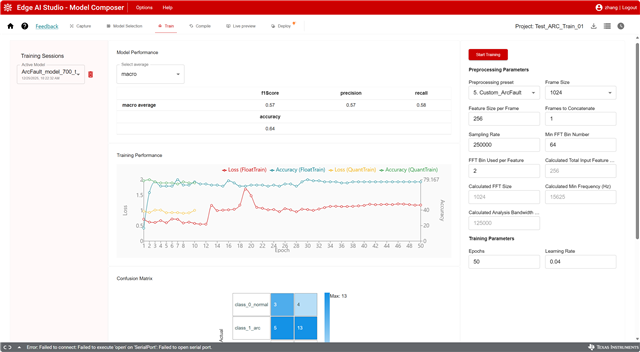
    To make the issue clearer, below are the main steps I have performed along with the corresponding outcomes:

    1. Training dataset used;

      4df212a0_dataset.zip
    2. Training results;

    3. Model compilation;

      _20251225-022527, ArcFault_model_700_t_F28P55.zip
    4. Updating the preprocessing parameters in the example project(ml_arc_detection_F28P55x);

    5. Replacing the test vectors in the example(ml_arc_detection_F28P55x);

    6. Replacing mod.a and tvmgen_default.h in the example project(ml_arc_detection_F28P55x);

    7. Final verification results.

    Despite following the above steps, the results are still not as expected.
    Could you please advise if there are any additional checks, configuration points, or recommended practices (e.g., feature scaling, frame alignment, window overlap, or verification methodology) that I should consider?

    Thank you for your support, and I look forward to your suggestions.

    Best regards,
    Zhang

  • Hi Zhang

    The model training is not looking good. The accuracy should be higher than 95%. Can you tell me how did you get the training data?

    Thank you 

    Amir Hussain

  • Hi Amir,

    Thank you very much for your reply.

    The raw data was collected from a signal generator and imported using the Model Composer reference example. I re-labeled the dataset by narrowing the boundary samples between arc and normal conditions, and analyzed the model logs (file_level_classification_summary.log) to remove unstable samples. After data refinement, a higher-accuracy model was obtained and integrated into CCS, and the verification results show very close agreement. Below are four groups of validation results(SET 0 ~ SET 3).

    Additionally, I would like to ask what level of accuracy is generally considered acceptable for engineering applications.

    Best regards,
    Zhang

  • Hi Zhang

    Great to see the satisfactory result.
    For good accuracy, I should be more than 95%. When we train with a well labelled data, we usually get around 98%.

    Thank you 

    Amir Hussain