Part Number: TMS320F28335
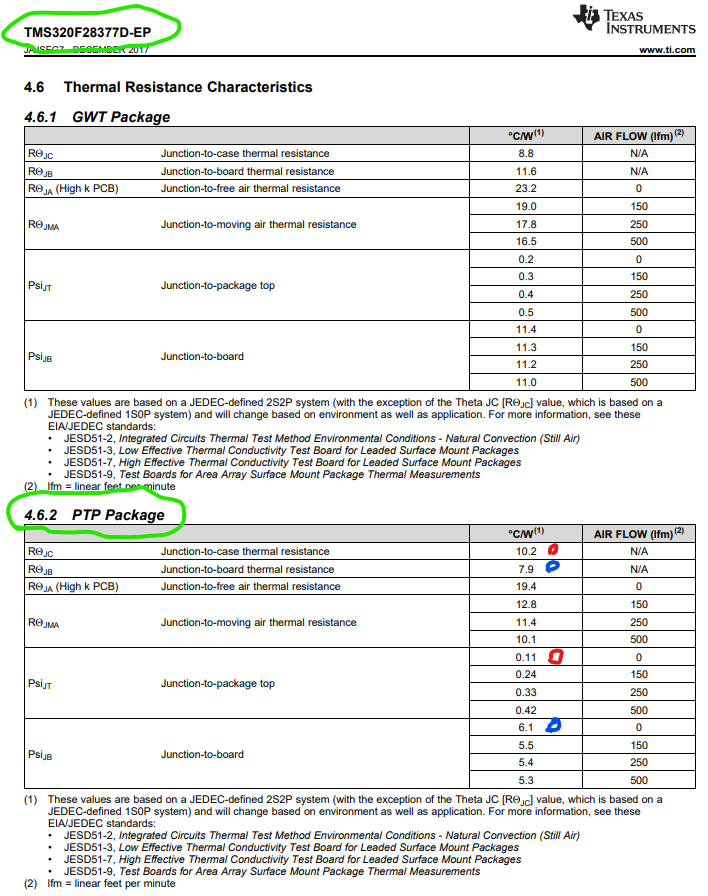
RJB (7.9 deg/W) and PsiJB (6.1 deg/W [No Air]) are similar values, but I don't understand why RJC (10.2 deg/W) and PsiJT (0.11 deg/W [No Air]) are about 100 times different. Please explain.
This thread has been locked.
If you have a related question, please click the "Ask a related question" button in the top right corner. The newly created question will be automatically linked to this question.
Part Number: TMS320F28335
RJB (7.9 deg/W) and PsiJB (6.1 deg/W [No Air]) are similar values, but I don't understand why RJC (10.2 deg/W) and PsiJT (0.11 deg/W [No Air]) are about 100 times different. Please explain.

Hello,
I would take a look at this app note: https://www.ti.com/lit/an/spra953d/spra953d.pdf it goes into more detail on how these thermal coefficients are calculated, and should give some insight on the PsiJT parameter vs ThetaJA.
Best,
Matthew
RJB (7.9 deg/W) and PsiJB (6.1 deg/W [without air]) are similar values, but RJC (10.2 deg/W) and PsiJT (0.11 deg/W [without air]) are an order of magnitude different. Why?
If the differences are listed in the spra953d.pdf, please let me know the page numbers.
I would look at page 8/9; it explains the derivation of PsiJt, and its applications. The delta between PsiJT and RThetaJC is also addressed in this section.
Best,
Matthew
The https://www.ti.com/lit/an/spra953d/spra953d.pdf has a total of 15 pages.
Should I refer to pages 8/15 and 9/15?
Please also let me know the item numbers, such as 3ΨJT, Junction to Top of Package, etc.
Yes, please look at pages 8 and 9. This goes into more detail on how the PsiJt coefficient is derived. You will see this at the bottom of page 8:
For plastic packages, ΨJT is typically 0.5°C/W–2°C/W compared to RθJC values of 4°C/W–15°C/W. Thinner packages have smaller ΨJT values than thicker packages. Packages with embedded heat slugs have ΨJT values close to zero. You should be aware that ΨJT varies with both board construction and air flow conditions as shown in Table 3-1. The values in Table 3-1 were obtained through modeling.
Best,
Matthew