This thread has been locked.

If you have a related question, please click the "Ask a related question" button in the top right corner. The newly created question will be automatically linked to this question.

TMS320F28P550SJ: Connecting unused GPIO to VDDIO and VSS.

Part Number: TMS320F28P550SJ
Other Parts Discussed in Thread: SYSCONFIG

Hi Experts,

My customer using F28P55 on F28003x boards since the two devices are mostly pin-to-pin compactiable.

However, there are two pins which are VDDIO and VSS function on F28003x, and are GPIO on F28P55. If they install F28P55 on the board, it means that the GPIO is connected directly to VDDIO and VSS, without any resistors.

Is this ok? 

Regards,

Hang

  • Hi Hang,

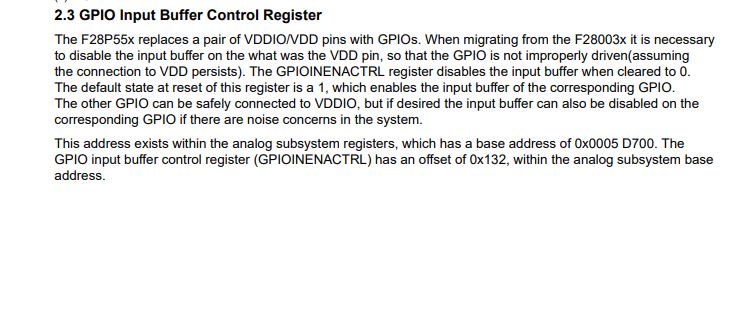
    Please refer to section 2.3 of the Migration Guide Migration Between TMS320F28P5xx and TMS320F28003x (Rev. A) . You will need to disable the input buffers so that the GPIOs don't get driven.

    Thanks and Regards,

    Ira

  • Hi Ira,

    I am confused on this requirements since it require customer to use software to disable the buffer. The VDD will ramp first way before they can run any software right? it seems that the GPIO will be driven improperly any way since power on and before the user software disables the buffer.

    Do you mean it's OK to let the GPIO driven by VDD for a short period? What's the time required and what's the risk of not doing so?

    Regards,

    Hang

  • Hi Ira,

    Any update on this issue?

    Regards,

    Hang

  • Hi Hang,

    Connecting F28P55 GPIOs directly to VDDIO and VSS falls within the device's recommended operating conditions, and the brief exposure before software can disable the input buffers poses no risk to the device. There is no specific time limit on for how long these GPIOs can remain exposed ot VDDIO and VSS. This is because the concern here is not electrical damage but rather it is noise coupling effects. 

    The recommendation is to disable the input buffers as early as possible in your initialization code using ASysCtl_disableGPIOInputBuffer(). This isn't available in SysConfig's graphical interface, so you'll need to call it directly in your application code. The brief exposure during boot (sub-millisecond for the reset sequence, plus your boot code execution time) is well within safe operating parameters.

    Thanks,

    Ira