This thread has been locked.

If you have a related question, please click the "Ask a related question" button in the top right corner. The newly created question will be automatically linked to this question.

TMDSCNCD28388D: EtherCAT-Based Multi-Motor Control Using TI Hardware – Board Recommendation Inquiry

Part Number: TMDSCNCD28388D
Other Parts Discussed in Thread: TMS320F28388D, TMDXIDDK379D, DESIGNDRIVE, C2000WARE, LP-AM243, TIDEP-01032, TMDSCNCD263P, TIDM-02006, MCU-PLUS-SDK-AM263X,

Hello TI Experts,

My name is Eric Kang, an Application Engineer at MathWorks Korea, focusing on motor control and electrification.

We are planning to build a demonstration of EtherCAT-based multi-motor control using TI hardware, intended for technical demo purposes (exhibitions or seminars). 

We have an initial system concept where multiple motor-control nodes are connected via EtherCAT (see attached diagram), and we would appreciate advice on the following:

  • Whether this system configuration can be realized using TI devices, and which MCU/SoC or evaluation boards are recommended
  • Recommended TI boards for EtherCAT-based motor control, especially for multi-motor or multi-axis systems
  • Any additional required hardware (e.g., EtherCAT interface, communication expansion boards)
  • Relevant documentation or reference designs for EtherCAT-based motor control
  • Recommended support or contact points for deeper technical guidance

This demo aims to showcase an EtherCAT-based multi-motor control architecture using TI hardware together with MathWorks tools.

Thank you for your support.
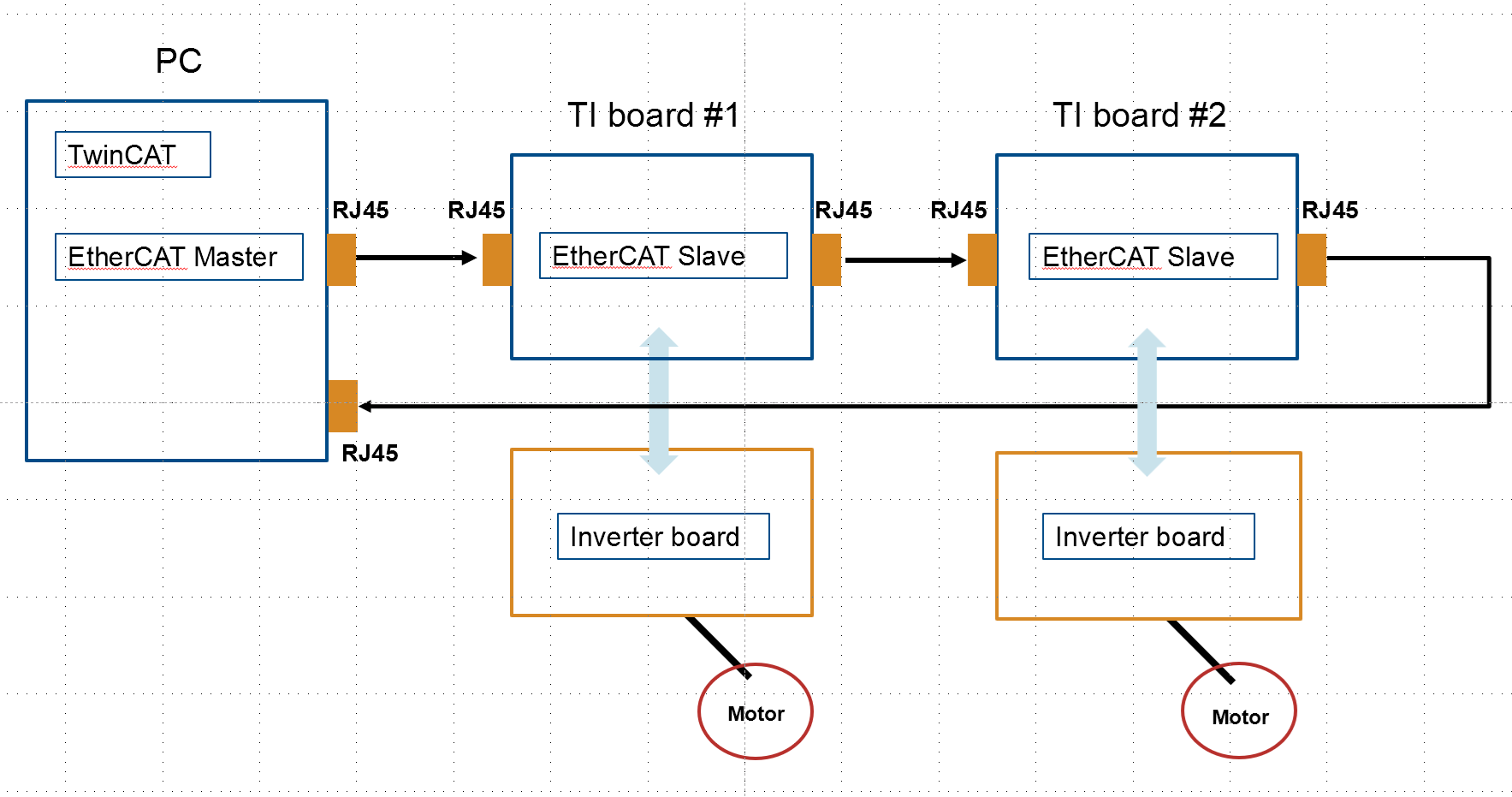
EtherCAT_based_Motor_Control.png

  • Hi Eric,

    Your EtherCAT-based multi-motor control demonstration is absolutely achievable with TI hardware. Let me walk through your questions systematically.

    A Few Points to Keep in Mind

    Before diving in, there are some items that will shape the final recommendation:

    • EtherCAT Master: TI does not provide an EtherCAT Master stack on its MCUs [1]. You'll need either a PC-based master (e.g., TwinCAT) or a third-party stack from partners like Acontis, Codesys, or BE.Services [1]. Since you're integrating with MathWorks tools, it's worth confirming whether your Simulink/EtherCAT workflow provides master functionality on the PC side.
    • Number of axes and motor types (PMSM, BLDC, power ratings) will determine whether a single F28388D can handle all control loops or whether a distributed architecture is needed.
    • MathWorks integration specifics — C2000 hardware support packages exist for Simulink, but the exact code-generation workflow for the EtherCAT + motor control partition may need validation.

    Recommended Hardware

    Primary Recommendation: TMDSCNCD28388D (Your Current Part)

    The board you've already identified is purpose-built for this use case. The TMS320F28388D features:

    • Integrated EtherCAT Slave Controller (ESC) with two dedicated EtherCAT ports (P0/P1) via RJ45 connectors, enabling direct daisy-chain topology — no additional EtherCAT expansion hardware is needed [2][3]
    • Dual C28x cores (200 MHz each) + Arm Cortex-M4 — the Cortex-M4 "Connectivity Manager" handles the EtherCAT stack while the C28x cores run high-performance motor control loops concurrently [4][5]
    • FSI (Fast Serial Interface) header for high-speed inter-board communication in distributed multi-axis architectures [3]

    For a complete motor-control evaluation platform, pair the controlCARD with the TMDXIDDK379D (DesignDRIVE Development Kit), which is TI's recommended EVM for EtherCAT-based servo drive evaluation [6]. Software support comes through the C2000Ware MotorControl SDK [6].

    Alternative / Additional Nodes: Sitara AM243x or AM263x

    If you need additional slave nodes or want to explore Sitara-based platforms:

    Platform
    EtherCAT Implementation
    Key Advantage
    LP-AM243 LaunchPad
    PRU-ICSSG firmware-based EtherCAT slave [7]
    TIDEP-01032 reference design with dual-servo + EtherCAT out-of-box [8]
    AM263Px controlCARD (TMDSCNCD263P)
    PRU-ICSS based EtherCAT slave [9]
    TwinCAT integration guide available [10]
    AM64x-EVM (TMDS64GPEVM)
    PRU-ICSSG based [11]
    CiA402 profile example supporting 3-axis (extendable to 6/9-axis) [12]

    No Additional EtherCAT Hardware Required

    Both the F2838x controlCARD and the Sitara evaluation boards include integrated EtherCAT interfaces. You do not need separate EtherCAT communication expansion boards.


    Key Reference Designs and Documentation

    Resource
    Description
    SPRACM9B — "EtherCAT-Based Connected Servo Drive Using FCL on PMSM"
    Directly addresses your use case: EtherCAT + PMSM servo control on F28388D [5][14]
    TIDM-02006
    Distributed multi-axis servo drive: single F28388D manages position/speed + EtherCAT, while F280049/F280025 controllers handle individual motor current loops via FSI [14]
    TIDEP-01032
    AM243x dual-servo motor control with EtherCAT daisy-chain, using TwinCAT as master [8]
    SPRADQ4
    AM263x EtherCAT SubDevice with TwinCAT integration guide [10]
    MCU-PLUS-SDK-AM263x / Industrial Communications SDK
    Software stacks for Sitara-based EtherCAT slave implementations [15][11]
    Hardware Developer's Kit
    Schematics, BOM, Gerber files for the F2838x controlCARD [16]

    Recommended Next Steps

    1. Start with the TMDSCNCD28388D + DesignDRIVE IDDK as your primary EtherCAT slave motor-control node — this gives you the most direct path with integrated ESC hardware.
    2. For multi-node expansion, daisy-chain additional F2838x controlCARDs or mix in AM243x LaunchPads using the TIDEP-01032 reference design.
    3. For the EtherCAT master, use a PC running TwinCAT (or your MathWorks-based master solution) connected to the first node.
    4. For deeper technical guidance, TI's E2E support forums for C2000 and Sitara MCUs are the primary channels. For strategic partnership-level support (MathWorks + TI co-demos), reaching out through your TI field application engineer contact would be most effective.

    If you can share the number of motor axes planned and whether MathWorks will provide the EtherCAT master layer, that would help narrow the architecture further.


    Resources:

    1. TI E2E FAQ: EtherCAT Master with Sitara Devices
    2. TMDSCNCD28388D controlCARD User's Guide (SPRUJ17I)
    3. F2838x controlCARD Hardware Reference (SPRUIL8B)
    4. TMS320F2838x Technical Reference Manual (SPRUII0F)
    5. SPRACM9B: EtherCAT-Based Connected Servo Drive Using FCL on PMSM
    6. TMS320F2838x Datasheet (SPRSP14E)
    7. AM263x Datasheet (SPRSP74E)
    8. TIDEP-01032 Reference Design — AM243x Motor Control SDK
    9. AM263x Sitara MCU Family Overview (SPRABJ8D)
    10. SPRADQ4: AM263x EtherCAT SubDevice with TwinCAT
    11. Industrial Communications SDK — AM64x EtherCAT SubDevice
    12. AM64x EtherCAT CiA402 Multi-Axis Example
    13. AM64x EtherCAT SubDevice Quick Start
    14. TMS320F2838x Datasheet — Reference Designs Section
    15. MCU-PLUS-SDK-AM263x User Guide (SPRUJ42E)
    16. F2838x controlCARD Hardware Developer's Kit (SPRUIL8B)

    Best Regards,

    Zackary Fleenor