Part Number: TMDSCNCD28388D
Other Parts Discussed in Thread: C2000WARE
Hi Team,
Posting on behalf of our customer.
I am running the enet_lwip example code on the TMDSCNCD28388D using C2000Ware_6_00_01_00. The example works properly with the default dynamic IP / MAC settings, but stops working after I change the IP address and MAC address.
OBSERVED:
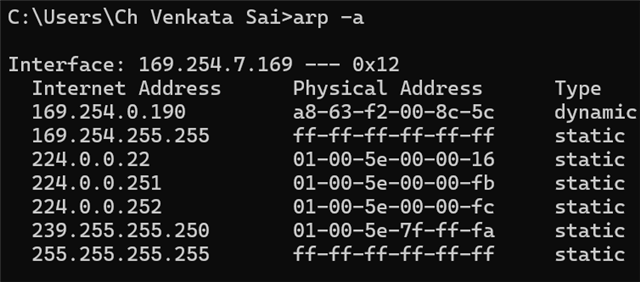
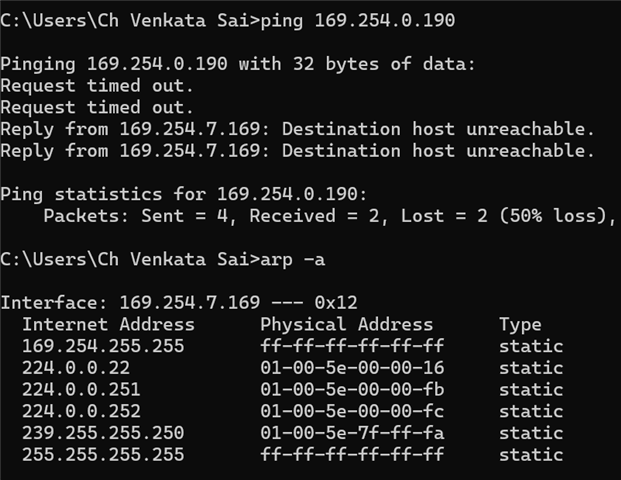
C:\Users\gpc3>ping 192.168.1.190
Pinging 192.168.1.190 with 32 bytes of data:
Reply from 192.168.1.53: Destination host unreachable.
Reply from 192.168.1.53: Destination host unreachable.
Reply from 192.168.1.53: Destination host unreachable.
Reply from 192.168.1.53: Destination host unreachable.
Ping statistics for 192.168.1.190:
Packets: Sent = 4, Received = 4, Lost = 0 (0% loss),
//###########################################################################
//
// FILE:   enet_lwip.c
//
// TITLE:  lwIP based Ethernet Example.
//
//###########################################################################
// $TI Release: $
// $Release Date: $
//
// C2000Ware v6.00.01.00
//
// Copyright (C) 2024 Texas Instruments Incorporated - http://www.ti.com
//
// Redistribution and use in source and binary forms, with or without
// modification, are permitted provided that the following conditions
// are met:
//
//   Redistributions of source code must retain the above copyright
//   notice, this list of conditions and the following disclaimer.
//
//   Redistributions in binary form must reproduce the above copyright
//   notice, this list of conditions and the following disclaimer in the
//   documentation and/or other materials provided with the
//   distribution.
//
//   Neither the name of Texas Instruments Incorporated nor the names of
//   its contributors may be used to endorse or promote products derived
//   from this software without specific prior written permission.
//
// THIS SOFTWARE IS PROVIDED BY THE COPYRIGHT HOLDERS AND CONTRIBUTORS
// "AS IS" AND ANY EXPRESS OR IMPLIED WARRANTIES, INCLUDING, BUT NOT
// LIMITED TO, THE IMPLIED WARRANTIES OF MERCHANTABILITY AND FITNESS FOR
// A PARTICULAR PURPOSE ARE DISCLAIMED. IN NO EVENT SHALL THE COPYRIGHT
// OWNER OR CONTRIBUTORS BE LIABLE FOR ANY DIRECT, INDIRECT, INCIDENTAL,
// SPECIAL, EXEMPLARY, OR CONSEQUENTIAL DAMAGES (INCLUDING, BUT NOT
// LIMITED TO, PROCUREMENT OF SUBSTITUTE GOODS OR SERVICES; LOSS OF USE,
// DATA, OR PROFITS; OR BUSINESS INTERRUPTION) HOWEVER CAUSED AND ON ANY
// THEORY OF LIABILITY, WHETHER IN CONTRACT, STRICT LIABILITY, OR TORT
// (INCLUDING NEGLIGENCE OR OTHERWISE) ARISING IN ANY WAY OUT OF THE USE
// OF THIS SOFTWARE, EVEN IF ADVISED OF THE POSSIBILITY OF SUCH DAMAGE.
// $
//###########################################################################

#include <string.h>

#include "inc/hw_ints.h"
#include "inc/hw_memmap.h"
#include "inc/hw_nvic.h"
#include "inc/hw_types.h"
#include "inc/hw_sysctl.h"
#include "inc/hw_emac.h"

#include "driverlib_cm/ethernet.h"
#include "driverlib_cm/gpio.h"
#include "driverlib_cm/interrupt.h"
#include "driverlib_cm/flash.h"

#include "driverlib_cm/sysctl.h"
#include "driverlib_cm/systick.h"

#include "utils/lwiplib.h"
#include "driver/device.h"
#include "driver/ethernet.h"
#include "board_drivers/pinout.h"

#include "lwip/apps/httpd.h"

#include "lwipopts.h"
//*****************************************************************************
//
//! \addtogroup master_example_list
//! <h1>Ethernet with lwIP (enet_lwip)</h1>
//!
//! This example application demonstrates the operation of the F2838x
//! microcontroller Ethernet controller using the lwIP TCP/IP Stack. Once
//! programmed, the device sits endlessly waiting for ICMP ping requests. It
//! has a static IP address. To ping the device, the sender has to be in the
//! same network. The stack also supports ARP.
//!
//! For additional details on lwIP, refer to the lwIP web page at:
//! savannah.nongnu.org/.../
//
//*****************************************************************************

#define MAKE_IP_ADDRESS(a0,a1,a2,a3) (((a0<<24) & 0xFF000000) | ((a1<<16) & 0x00FF0000) | ((a2<<8)  & 0x0000FF00) | (a3 & 0x000000FF) )

#define RX_ISR_BIT  1
#define TX_ISR_BIT  4

#define RX_ISR_MASK (1 << RX_ISR_BIT)
#define TX_ISR_MASK (1 << TX_ISR_BIT)

/*
g_uiISRsignal variable signals the Interrupt.
*/
uint32_t g_uiISRsignal = 0;


const unsigned long IPAddr =  0xC0A801BE; // 0xC0A80004; //192.168.1.190
const unsigned long NetMask = 0xFFFFFF00;
const unsigned long GWAddr = 0x00000000;

Ethernet_Handle emac_handle;
Ethernet_InitConfig *pInitCfg;
extern Ethernet_Device Ethernet_device_struct;

/*
systick Timer acts as source for lwip timer,
125000 implies 1ms.
*/
const uint32_t systickPeriodValue = 125000;


/***********************************************************************************************
 * Ethernet_transmitISRCustom
 *
 * This function is a custom interrupt service routine (ISR) for handling Ethernet
 * transmission interrupts. It is called when a packet is succesfully transmitted.
 *
 ************************************************************************************************/
void Ethernet_transmitISRCustom(void);
/************************************************************************************************
 * Ethernet_receiveISRCustom
 *
 * This function is a custom interrupt service routine (ISR) for handling Ethernet
 * reception interrupts. It is called when a packet is received.
 *
************************************************************************************************/
void Ethernet_receiveISRCustom(void);
//*****************************************************************************
//
//  This function is a callback function called by the example to
//  get a Packet Buffer. Has to return a Ethernet_Pkt_Desc Structure.
//  Rewrite this API for custom use case.
//
//*****************************************************************************
Ethernet_Pkt_Desc* Ethernet_getPacketBufferCustom(void)
{
    Ethernet_Pkt_Desc* pktPtr = lwIP_getFreePacket();
    ENET_DRIVER_STATS_INC(RXgetPacketBuffer);
    return (pktPtr);
}

//*****************************************************************************
//
//  This is a hook function and called by the driver when it receives a
//  packet. Application is expected to replenish the buffer after consuming it.
//  Has to return a ETHERNET_Pkt_Desc Structure.
//  Rewrite this API for custom use case.
//
//*****************************************************************************
Ethernet_Pkt_Desc* Ethernet_receivePacketCallbackCustom(
        Ethernet_Handle handleApplication,
        Ethernet_Pkt_Desc *pPacket)
{

	Ethernet_Pkt_Desc* temp_eth_pkt;

    ENET_DRIVER_STATS_INC(RXPacketCallback);

      temp_eth_pkt=lwIPEthernetIntHandler(pPacket);

      return temp_eth_pkt;
}

void Ethernet_releaseTxPacketBufferCustom(
        Ethernet_Handle handleApplication,
        Ethernet_Pkt_Desc *pPacket)
{
    //
    // Once the packet is sent, reuse the packet memory to avoid
    // memory leaks. Call this interrupt handler function which will take care
    // of freeing the memory used by the packet descriptor.
    //
    lwIPEthernetIntHandler(pPacket);


    ENET_DRIVER_STATS_INC(TXreleasePacket);
}

void
Ethernet_init(const unsigned char *mac)
{

    Ethernet_InitInterfaceConfig initInterfaceConfig;
    uint32_t macLower;
    uint32_t macHigher;
    uint8_t *temp;

    initInterfaceConfig.ssbase = EMAC_SS_BASE;
    initInterfaceConfig.enet_base = EMAC_BASE;
    initInterfaceConfig.phyMode = ETHERNET_SS_PHY_INTF_SEL_MII;

    //
    // Assign SoC specific functions for Enabling,Disabling interrupts
    // and for enabling the Peripheral at system level
    //
    initInterfaceConfig.ptrPlatformInterruptDisable =
                                                    &Platform_disableInterrupt;
    initInterfaceConfig.ptrPlatformInterruptEnable =
                                                     &Platform_enableInterrupt;
    initInterfaceConfig.ptrPlatformPeripheralEnable =
                                                    &Platform_enablePeripheral;
    initInterfaceConfig.ptrPlatformPeripheralReset =
                                                     &Platform_resetPeripheral;

    //
    // Assign the peripheral number at the SoC
    //
    initInterfaceConfig.peripheralNum = SYSCTL_PERIPH_CLK_ENET;

    //
    // Assign the default SoC specific interrupt numbers of Ethernet interrupts
    //
    initInterfaceConfig.interruptNum[0] = INT_EMAC;
    initInterfaceConfig.interruptNum[1] = INT_EMAC_TX0;
    initInterfaceConfig.interruptNum[2] = INT_EMAC_TX1;
    initInterfaceConfig.interruptNum[3] = INT_EMAC_RX0;
    initInterfaceConfig.interruptNum[4] = INT_EMAC_RX1;

    pInitCfg = Ethernet_initInterface(initInterfaceConfig);

    Ethernet_getInitConfig(pInitCfg);
    pInitCfg->dmaMode.InterruptMode = ETHERNET_DMA_MODE_INTM_MODE2;

    //
    // Assign the callbacks for Getting packet buffer when needed
    // Releasing the TxPacketBuffer on Transmit interrupt callbacks
    // Receive packet callback on Receive packet completion interrupt
    //
    pInitCfg->pfcbRxPacket = &Ethernet_receivePacketCallbackCustom;
    pInitCfg->pfcbGetPacket = &Ethernet_getPacketBufferCustom;
    pInitCfg->pfcbFreePacket = &Ethernet_releaseTxPacketBufferCustom;

    pInitCfg->numChannels = 1U;

    //
    // The Application handle is not used by this application
    // Hence using a dummy value of 1
    //
    Ethernet_getHandle((Ethernet_Handle)1, pInitCfg , &emac_handle);

    //
    // Disable transmit buffer unavailable and normal interrupt which
    // are enabled by default in Ethernet_getHandle.
    //
    Ethernet_disableDmaInterrupt(Ethernet_device_struct.baseAddresses.enet_base,
                                 0, (ETHERNET_DMA_CH0_INTERRUPT_ENABLE_TBUE |
                                     ETHERNET_DMA_CH0_INTERRUPT_ENABLE_NIE));

    //
    // Enable the MTL interrupt to service the receive FIFO overflow
    // condition in the Ethernet module.
    //
    Ethernet_enableMTLInterrupt(Ethernet_device_struct.baseAddresses.enet_base,0,
                                ETHERNET_MTL_Q0_INTERRUPT_CONTROL_STATUS_RXOIE);

    //
    // Disable the MAC Management counter interrupts as they are not used
    // in this application.
    //
    HWREG(Ethernet_device_struct.baseAddresses.enet_base + ETHERNET_O_MMC_RX_INTERRUPT_MASK) = 0xFFFFFFFF;
    HWREG(Ethernet_device_struct.baseAddresses.enet_base + ETHERNET_O_MMC_IPC_RX_INTERRUPT_MASK) = 0xFFFFFFFF;
	HWREG(Ethernet_device_struct.baseAddresses.enet_base + ETHERNET_O_MMC_TX_INTERRUPT_MASK) = 0xFFFFFFFF;
    //
    //Do global Interrupt Enable
    //
    (void)Interrupt_enableInProcessor();

    //
    //Assign default ISRs
    //
    Interrupt_registerHandler(INT_EMAC_TX0, Ethernet_transmitISRCustom);
    Interrupt_registerHandler(INT_EMAC_RX0, Ethernet_receiveISRCustom);
    Interrupt_registerHandler(INT_EMAC, Ethernet_genericISRCustom);


    //
    // Convert the mac address string into the 32/16 split variables format
    // that is required by the driver to program into hardware registers.
    // Note: This step is done after the Ethernet_getHandle function because
    //       a dummy MAC address is programmed in that function.
    //
    temp = (uint8_t *)&macLower;
    temp[0] = mac[0];
    temp[1] = mac[1];
    temp[2] = mac[2];
    temp[3] = mac[3];

    temp = (uint8_t *)&macHigher;
    temp[0] = mac[4];
    temp[1] = mac[5];

    //
    // Program the unicast mac address.
    //
    Ethernet_setMACAddr(EMAC_BASE,
                        0,
                        macHigher,
                        macLower,
                        ETHERNET_CHANNEL_0);

    Ethernet_clearMACConfigurationCustom(Ethernet_device_struct.baseAddresses.enet_base,ETHERNET_MAC_CONFIGURATION_RE);
    Ethernet_setMACConfigurationCustom(Ethernet_device_struct.baseAddresses.enet_base,ETHERNET_MAC_CONFIGURATION_RE);

    (&Ethernet_device_struct.dmaObj.txDma[ETHERNET_DMA_CHANNEL_NUM_0])->descCount = 0;

}
void httpLEDToggle(void);
void(*ledtoggleFuncPtr)(void) = &httpLEDToggle;

//*****************************************************************************
//
// The interrupt handler for the SysTick interrupt.
//
//*****************************************************************************
void
SysTickIntHandler(void)
{
    //
    // Call the lwIP timer handler.
    //
    lwIPTimer(1);
}

//*****************************************************************************
//
// This example demonstrates the use of the Ethernet Controller.
//
//*****************************************************************************
int
main(void)
{
    unsigned long ulUser0, ulUser1;
    unsigned char pucMACArray[8];

    //
    // User specific IP Address Configuration.
    // Current implementation works with Static IP address only.
    //
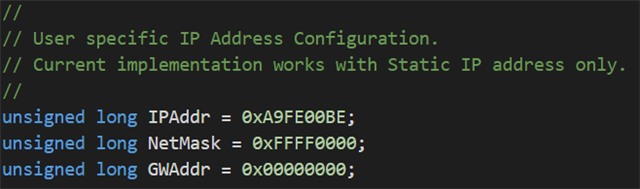
    unsigned long IPAddr = 0xC0A801BE;
    unsigned long NetMask = 0xFFFFFF00;
    unsigned long GWAddr = 0x00000000;

    //
    // Initializing the CM. Loading the required functions to SRAM.
    //
    CM_init();

    SYSTICK_setPeriod(systickPeriodValue);
    SYSTICK_enableCounter();
    SYSTICK_registerInterruptHandler(SysTickIntHandler);
    SYSTICK_enableInterrupt();

    //
    // Enable processor interrupts.
    //
    Interrupt_enableInProcessor();

    // Set user/company specific MAC octets
    // (for this code we are using A8-63-F2-00-3C-5C)
    // 0x00 MACOCT3 MACOCT2 MACOCT1
    ulUser0 = 0x00F263A8;

    // 0x00 MACOCT6 MACOCT5 MACOCT4
    ulUser1 = 0x005C3C00;

    //
    // Convert the 24/24 split MAC address from NV ram into a 32/16 split MAC
    // address needed to program the hardware registers, then program the MAC
    // address into the Ethernet Controller registers.
    //
    pucMACArray[0] = ((ulUser0 >>  0) & 0xff);
    pucMACArray[1] = ((ulUser0 >>  8) & 0xff);
    pucMACArray[2] = ((ulUser0 >> 16) & 0xff);
    pucMACArray[3] = ((ulUser1 >>  0) & 0xff);
    pucMACArray[4] = ((ulUser1 >>  8) & 0xff);
    pucMACArray[5] = ((ulUser1 >> 16) & 0xff);

    Interrupt_enable(INT_EMAC_TX0);
    Interrupt_enable(INT_EMAC_RX0);
    Interrupt_enable(INT_EMAC);

    //
    // Initialze the lwIP library, using DHCP.
    //
    lwIPInit(0, pucMACArray, IPAddr, NetMask, GWAddr, IPADDR_USE_STATIC);

    //
    // Initialize ethernet module.
    //
    Ethernet_init(pucMACArray);

    //
    // Initialize the netif and start lwIP
    //
    lwIPStart(0);

    //
    // Initialize the HTTP webserver daemon.
    //
    httpd_init();

    //
    // Loop forever. All the work is done in interrupt handlers.
    //
    while(1)
    {
        uint32_t uiISRsignal = g_uiISRsignal;

        if((uiISRsignal & RX_ISR_MASK) != 0)
        {
            Ethernet_removePacketsFromRxQueueCustom(
                (Ethernet_DescCh*)&Ethernet_device_struct.dmaObj.rxDma[ETHERNET_DMA_CHANNEL_NUM_0], ETHERNET_COMPLETION_NORMAL);

            ETHERNET_DISABLE_INTERRUPTS();
            g_uiISRsignal &= (~RX_ISR_MASK);
            ETHERNET_ENABLE_INTERRUPTS();
        }

        if((uiISRsignal & TX_ISR_MASK) != 0)
        {
            Ethernet_removePacketsFromTxQueueCustom(
                (Ethernet_DescCh*)&Ethernet_device_struct.dmaObj.txDma[ETHERNET_DMA_CHANNEL_NUM_0], ETHERNET_COMPLETION_NORMAL);

            ETHERNET_DISABLE_INTERRUPTS();
            g_uiISRsignal &= (~TX_ISR_MASK);
            ETHERNET_ENABLE_INTERRUPTS();
        }
    }
}

void Ethernet_transmitISRCustom(void)
{

    ENET_DRIVER_STATS_INC(TXinterrupt);

    Ethernet_clearDMAChannelInterrupt(
            Ethernet_device_struct.baseAddresses.enet_base,
            ETHERNET_DMA_CHANNEL_NUM_0,
            ETHERNET_DMA_CH0_STATUS_TI);

    g_uiISRsignal |= TX_ISR_MASK;
}

void Ethernet_receiveISRCustom(void)
{

    ENET_DRIVER_STATS_INC(RXinterrupt);

    Ethernet_clearDMAChannelInterrupt(
            Ethernet_device_struct.baseAddresses.enet_base,
            ETHERNET_DMA_CHANNEL_NUM_0,
            ETHERNET_DMA_CH0_STATUS_RI);

    g_uiISRsignal |= RX_ISR_MASK;
}


//*****************************************************************************
//
// Called by lwIP Library. Toggles the led when a command is received by the
// HTTP webserver.
//
//*****************************************************************************
void httpLEDToggle(void)
{
    //
    // Toggle the LED D1 on the control card.
    //
    GPIO_togglePin(DEVICE_GPIO_PIN_LED1);
}


//*****************************************************************************
//
// Called by lwIP Library. Could be used for periodic custom tasks.
//
//*****************************************************************************
void lwIPHostTimerHandler(void)
{

}
Regards,
Danilo