Part Number: F28377D-SEP
Other Parts Discussed in Thread: TMS320F28377D, C2000WARE
Device: TMS320F28377D custom board
Issue:
CPU1 boots correctly from FLASH after power cycle, but CPU2 does not boot standalone after POR.
Observation:
-
Same CPU1/CPU2 code works correctly on F28379D LaunchPad.
-
On custom board:
-
CPU1 GPIO toggle works after POR.
-
CPU2 GPIO toggle works only during debugger load/run.
-
After complete power cycle, CPU2 never starts.
-
CPU1 code:
-
CPU1 calls:
Device_bootCPU2(C1C2_BROM_BOOTMODE_BOOT_FROM_FLASH); -
CPU1 GPIO59 toggles continuously.
CPU2 code:
-
CPU2 GPIO60 toggles continuously.
Flash linker:
-
CPU1 and CPU2 FLASH sectors are now separated correctly.
-
CPU1 uses FLASHB/C/D/E.
-
CPU2 uses FLASHF/G/H.
-
No overlap exists.
Additional information:
-
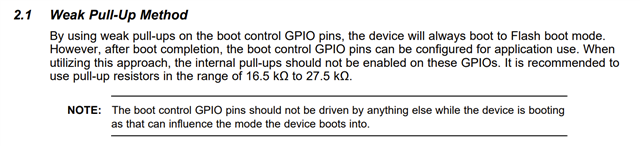
GPIO72 and GPIO84 are currently floating on custom board.
-
TRSTn is available.
-
LaunchPad works with same software.
-
CPU2 boot issue only occurs on custom hardware after POR.
Questions:
-
Can floating GPIO72/GPIO84 affect CPU2 standalone FLASH boot reliability even if CPU1 boots correctly?
-
Does CPU2 standalone boot depend indirectly on CPU1 boot-mode sampling/reset sequence?
-
Are external pull-ups on GPIO72 and GPIO84 mandatory for reliable dual-core FLASH boot?
-
Is there any recommended reset timing or CPU2 boot delay sequence for custom F28377D hardware?
-
Is there any additional hardware requirement for standalone CPU2 FLASH boot on custom boards?
Any guidance regarding reliable standalone CPU2 boot would be appreciated.