


Part Number: TMS320F2800137
Other Parts Discussed in Thread: SYSCONFIG
I have a F2800137 C2000 microcontroller and I am trying to generate four sets of complementary ePWM signals, for a total of eight signals. I am using Sysconfig to configure these ePWMs. For some reason, when I run my program from flash, one and sometimes two ePWM signals (not complementary -- usually it's only one of the signals in a complementary pair) doesn't come out. But, when I run it from RAM, all of the PWMs come out.
I thought originally that somehow the deadband module wasn't setting some registers correctly, but since I am choosing both the outputs to be based off of the same ePWM signal, I don't see how one of the ePWMs in the complementary pair can come out, but not the other.
I also thought it might be because I have an ADC ISR to read values from an ADC which triggers every 5 cycles, and that it might be taking too long. But I commented out the entire ISR, and it still gives this behavior.
My ePWMs have a frequency of 100 kHz. I've screenshotted some relevant Sysconfig settings and code below:
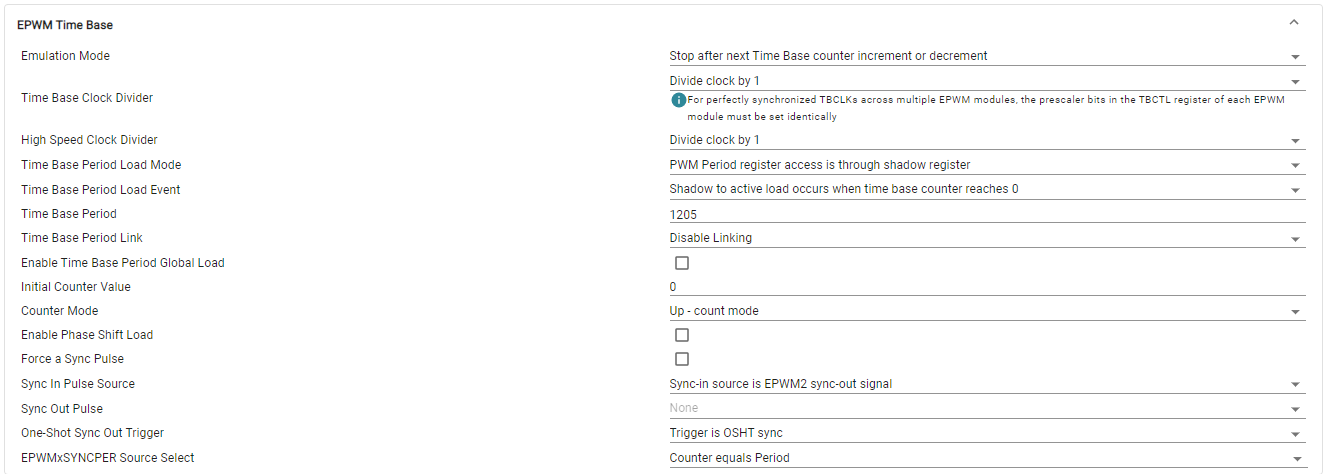
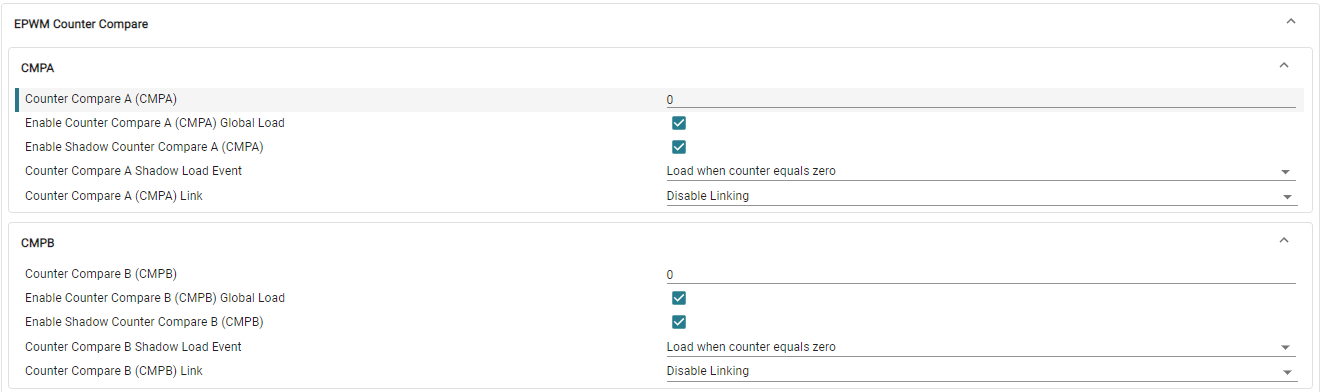
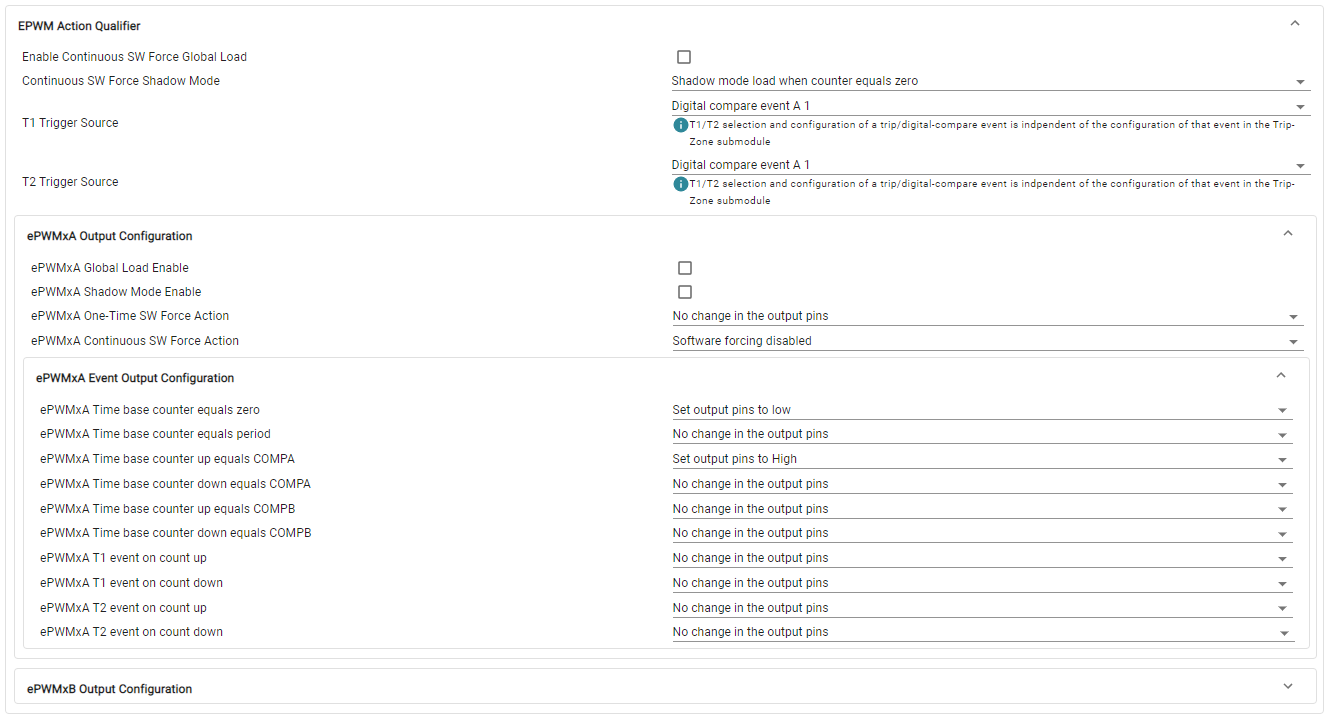
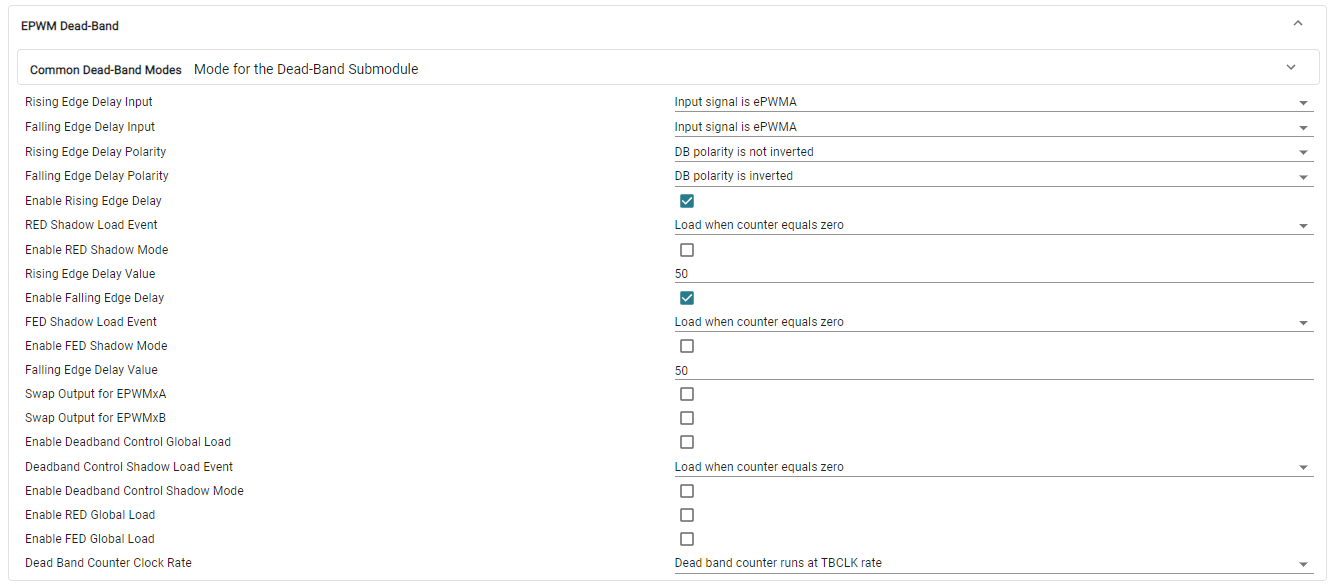
void main(void){ // *********************** Initialization (from example) ********************** // Device_init(); // Initialize device clock and peripherals Device_initGPIO(); // Disable pin locks and enable internal pull-ups. Interrupt_initModule(); // Initialize PIE and clear PIE registers. Disables CPU interrupts. Interrupt_initVectorTable(); // Initialize the PIE vector table with pointers to the shell ISRs
Board_init(); // Configure peripherals (from SysConfig)
// Disable and re-enable sync and EPWM clock (don't ask why, it's from the example) SysCtl_disablePeripheral(SYSCTL_PERIPH_CLK_TBCLKSYNC); SysCtl_enablePeripheral(SYSCTL_PERIPH_CLK_TBCLKSYNC);
// Configure the CPU Timer configCPUTimer(TIMER_BASE, DEVICE_SYSCLK_FREQ, 1000000);
// Enable global Interrupts and higher priority real-time debug events: EINT; // Enable Global interrupt INTM ERTM; // Enable Global realtime interrupt DBGM
CPUTimer_startTimer(TIMER_BASE); // start CPU 0 timer
// set 50% duties for testing set_duty(PJX_BUCK_BASE, 605); set_duty(PJX_BOOST_BASE, 605); set_duty(MJX_BUCK_BASE, 605); set_duty(MJX_BOOST_BASE, 605);
use_control = 0;
// Enter main control loop (does nothing for now) while (1) { ; }}
void set_duty(uint32_t epwm_module, volatile uint16_t desired_duty){ // invert +jx buck and +jx boost if (epwm_module == PJX_BUCK_BASE || epwm_module == PJX_BOOST_BASE) { desired_duty = (uint16_t) EPWM_TBPRD - desired_duty; }
// set EPWM A counter compare value EPWM_setCounterCompareValue(epwm_module, EPWM_COUNTER_COMPARE_A, desired_duty);
// set to low at zero, high at counter compare EPWM_setActionQualifierAction(epwm_module, EPWM_AQ_OUTPUT_A, EPWM_AQ_OUTPUT_HIGH, EPWM_AQ_OUTPUT_ON_TIMEBASE_ZERO); EPWM_setActionQualifierAction(epwm_module, EPWM_AQ_OUTPUT_A, EPWM_AQ_OUTPUT_LOW, EPWM_AQ_OUTPUT_ON_TIMEBASE_UP_CMPA); EPWM_setActionQualifierAction(epwm_module, EPWM_AQ_OUTPUT_A, EPWM_AQ_OUTPUT_LOW, EPWM_AQ_OUTPUT_ON_TIMEBASE_PERIOD);}
I am programming my C2000 using JTAG, and I have the boot pins GPIO24 and GPIO37 pulled high through 3.3k pullup resistors, so it should be running from flash on startup.
Thanks in advance for your input!
