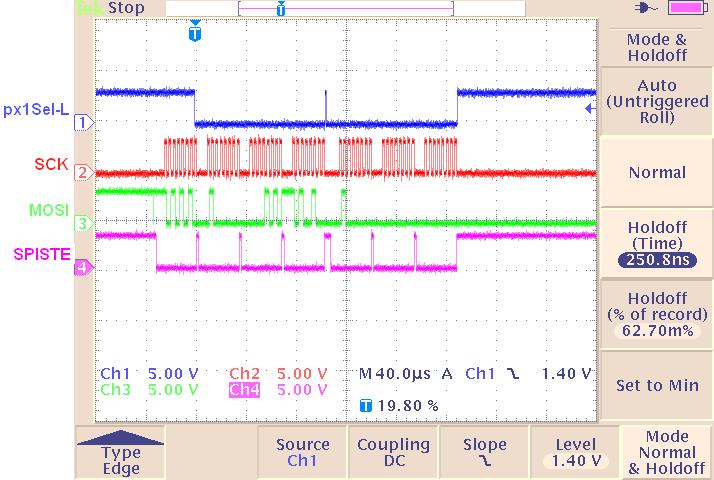
I am using the SPI port on a TMS320F2812 in a single-master,
multiple slave configuration, and thus must select my
devices with GPIO pins. Devices are serviced asynchronously,
so it is important to know that the prior SPI transaction
has finished before starting a new one. As far as I can
tell, there is no bit in any status register dedicated to
this condition.
I have had this problem on other processors and got around
it by polling the SPI interrupt bit (SPIST.6 = SPI INT
FLAG). This is giving me trouble as the hardware apparently
sets the bit on the leading edge of the last bit, or half a
bit time before the transaction is complete, causing me to
pull chip select high too soon (sending 0xAA):
SCK ___|¯|_|¯|_|¯|_|¯|_|¯|_|¯|_|¯|_|¯|___
MOSI ___|¯¯¯|___|¯¯¯|___|¯¯¯|___|¯¯¯|_____
1 0 1 0 1 0 1 0
__ __ _____
CS |____________________________|
I got it to work by inserting a 'twiddle-thumbs' loop to
waste 1 bit time after SPI INT FLAG goes true before raising
CS-L, but I don't like kludges.
The SPI reference guide shows the SPISTEA output of the
F2812 staying low all the way to the last clock edge when
operating as a master, and I have confirmed this with my
scope. It occurs to me I could route this signal back in
through an unused GPIO pin and poll it, but again, this
seems like a lot of effort to achieve basic functionality.
Am I missing something obvious?