I wanna use SCI transmit and EQEP blocks on simulink. Can someone explain how I can read data from encoder...?
This thread has been locked.
If you have a related question, please click the "Ask a related question" button in the top right corner. The newly created question will be automatically linked to this question.
I wanna use SCI transmit and EQEP blocks on simulink. Can someone explain how I can read data from encoder...?
Hi,
Reading data from encoder can be done by accessing the respective register which can then be transmitted via SCI.
Please refer the eqep peripheral user guide for details about the registers: 5383.eQEP.pdf
Regards,
Gautam
how can i access that register? i know GPIO number of it... But problem is how to configure their source block parameters and which blocks i ll use in simulink for this
But problem is how to configure their source block parameters and which blocks i ll use in simulink for this
Babe, simulink support over here would be very limited. I would like to direct you to the matlab forums where you can be well assisted in this respect. For, all technical aspects of eQEP module and working you can refer the above doc and sample codes present in conrolSuite.
Regards,
Gautam
Lets wait, for any assistance from TIers having experience in this field.
Regards,
Gautam
Babe, sorry for your query to be kept pending. But as I said previously Matlab support over here would be very limited. If you'd used CCS for coding and implementing eQEP and SCI, it would've been a very easy task. As its simulink, I don't have any experience!
Regards,
Gautam
Hi Babe,
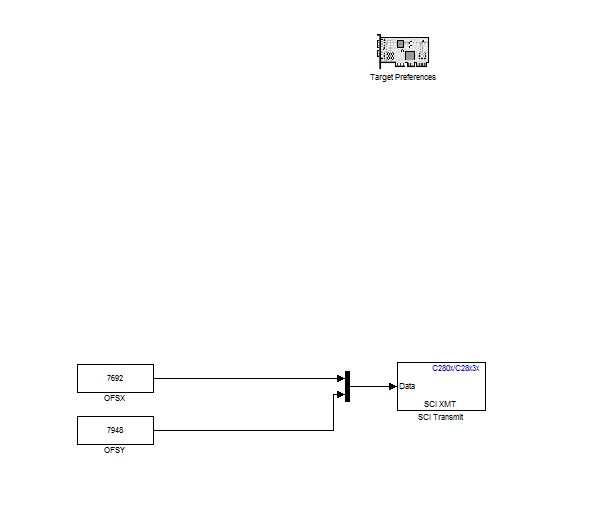
Please go through the screenshot, i have shown how to configure the SCI registers.
1. Click on target preference --> Peripherals--> SCI. Configure the SCI parameters
2. To configure a register of an external device use constant blocks
Ex: In the above constant block, i am sending a value 7692 ( decimal) in hex ( 1E0C ). which means 1E is register address of an external device and 0C is the data i.e ( Register configuration ) . Let me know for further support.
Regards,
Nishanth