This thread has been locked.

If you have a related question, please click the "Ask a related question" button in the top right corner. The newly created question will be automatically linked to this question.

F2837xD Internal Temperature Sensor

Other Parts Discussed in Thread: TMS320F28031

Hi all,

I can not find in documentation the scale factor between temperature and digital value of the internal temperature sensor on the F2837xD device. Where can I look at?

Thank you. BR,

Gianluca

  • Hi Gianluca,

    Yes, the information is not present in the technical reference manual. I'm forwarding your query to one of my TI buddy.

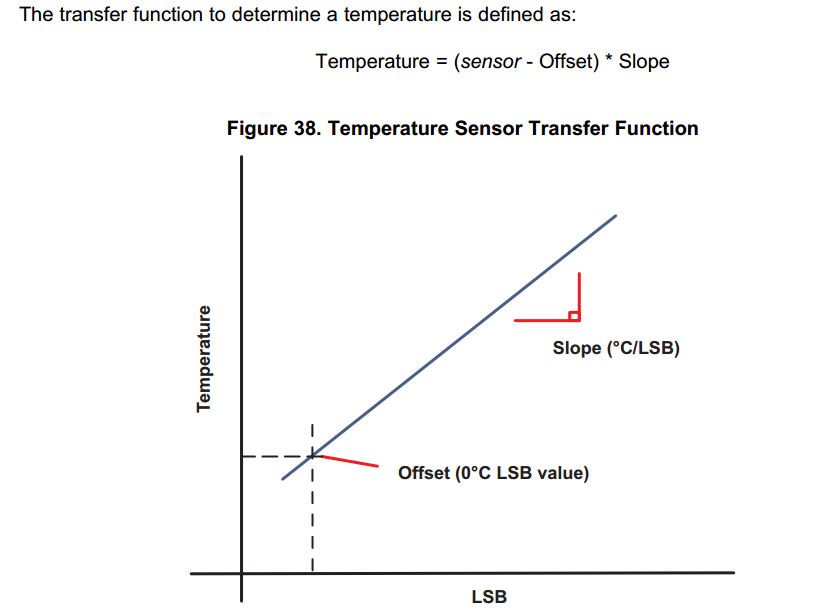
    Generally, what one needs here is the slope value:

    Regards,

    Gautam

  • Hi Gianluca,

    For TMS devices, each device will have factory generated slope/offset value programmed into OTP.

    For early samples, you can use 4mV/deg. C as a typical slope.  Sample the temperature sensor at ambient conditions to generate an offset for your device. 

  • Thanks Devin, for the info.

    Regards,

    Gautam

  • Hi,


    We have the same wish to use the internal TMS320 temperature sensor on a TMS320F28031.

    But the data sheet sheet does not mention any accuracy on the offset, although it seems from the previous discussion that the offset and slope are written by TI inside at a specific Flash location.


    Therefore we would expect that some kind of calibration is performed by TI. But somewhere else in the forum, I read that the accuracy of the integrated sensor is no better than -20/+20°C !!!


    Does this means that using the values written in Flash by TI, we cannot expect a better accuracy than -20/20°C ?

    Should we setup a calibration ?


    Thanks in advance for a clarification.

  • Hi aprocha,

    We can't guarantee a temperature accuracy in the datasheet for F2803x devices.

    Newer devices will be around +/-10C, with worst case occurring at cold temp (room temp to high temp range is generally better than +/-10C). However, older devices, which were calibrated differently, could be up to +/-20C.  It is possible, but unlikely, that some distributors still have some of these old devices in their inventory. 

    The linearity/reproducibility of the sensor itself is good, so if you can calibrate the sensor yourself you should be able to get much better accuracy.   


  • Hi Devin,

    What is the status of the internal temperature sensor calibration for Rev B silicon?
    Is the slope and offset programmed into the OTP?
    Is the calibration routine called by the Boot ROM?

    The slope of 4mV/C seems very small. (The 0V to 3V range [0 to 4096 counts] covers a variation of 750C.)
    I measured the count value at approximately 1667 counts for 25C. This seems very high for a low sensitivity of 4mV/C. (The offset will be large [1529] and the value must be known very accurately to give reasonable measurement accuracy.)
    Do you have an update for the slope and offset values?

    Thanks for your help.

    Simon
  • Hi Simon,

    Currently shipping TMX devices do not have complete temp. sensor calibration data programmed.  This data will be a slope/offset that can be used by software in the header files to correlate sensor readings to temperature readings. The Boot ROM won't do anything with these calibration values (unlike trim values for other analog modules that get loaded into the respective trim registers by the Boot ROM).

    The same limitations that applied to F2802x, F2803x, F2805x, and F2806x device families will also apply to F2837xD; we don't expect to get better accuracy out of this sensor than +/-10 deg. C and we won't be able to put Min/Max accuracy values in the datasheet (we tentatively list typical performance as +/-15 deg. C in the TMX datasheet). 

  • Hi Devin,

    Thanks for the update.

    The accuracy is OK for our application. We will use the 4mV/C scale (0.183C/bit) and 1529 offset for our development. (I note these are similar to the Piccolo devices.) We will update the values when the data and header files for the TMS devices are available.

    Best Regards,

    Simon