This thread has been locked.

If you have a related question, please click the "Ask a related question" button in the top right corner. The newly created question will be automatically linked to this question.

TI HV RESONANT LLC KIT - ADC samples

Hello,

I have a TI HV RESONSANT LLC KIT.  I noticed in the accompanied code:

// ADC Channel Selection
ChSel[0] = 9; // Dummy read for first sample bug
ChSel[1] = 9; // B1 - Ipri

ChSel[2] = 2; // A2 - V_SR1 / I_SR1
ChSel[3] = 2; // A2 - V_SR1 / I_SR1

ChSel[4] = 4; // A4 - V_SR2 / I_SR2
ChSel[5] = 4; // A4 - V_SR2 / I_SR2

ChSel[6] = 7; // A7 - Vout
ChSel[7] = 7; // A7 - Vout

// ADC Trigger Selection
TrigSel[0] = ADCTRIG_EPWM1_SOCA; // ePWM1, ADCSOCA
TrigSel[1] = ADCTRIG_EPWM1_SOCA; // ePWM1, ADCSOCA

TrigSel[2] = ADCTRIG_EPWM2_SOCA; // ePWM2, ADCSOCA
TrigSel[3] = ADCTRIG_EPWM2_SOCA; // ePWM2, ADCSOCA

TrigSel[4] = ADCTRIG_EPWM3_SOCA; // ePWM3, ADCSOCA
TrigSel[5] = ADCTRIG_EPWM3_SOCA; // ePWM3, ADCSOCA

TrigSel[6] = ADCTRIG_EPWM4_SOCA; // ePWM4, ADCSOCA
TrigSel[7] = ADCTRIG_EPWM4_SOCA; // ePWM4, ADCSOCA

Why are each ADC input assigned to 2 channels (i.e. ADCB1 assigned to channel 0 and 1)?

Is this necessary?

Thanks,

Brent

  • Brent,

    This is to get around the ADC first sample issue that exist in some of our C2000 MCUs, such as the F28027.  Note that here we are sampling the ADC channels at four separate times (4 SOC trigger points). 
    (post modification: made the above more clear)

    Take a look at the "ADC: Initial Conversion" advisory in the Errata.  Sampling an ADC twice (doing a dummy sample) is one method of avoiding the issue.  The other, on RevA and later silicon, is to use the ADCNONOVERLAP and CLK2DIVEN bits of the ADC.  The choice between which of these two is better depends on your use-case.

    Hopefully this helps!


    Thank you,
    Brett

  • This is for the errata related to adc initial conversion , refer:

    http://www.ti.com/lit/er/sprz295k/sprz295k.pdf

  • Thanks for the reply Brett.

    I had a couple questions for clarification.

    1)  In the kit's code I pasted above aren't there actually 10 SOC (0 - 9)?  I may need to reread what a SOC is.

    2) I had read the 2803x errata talking about this.  From reading the errata:

              For sequential mode, discard the first sample at the beginning of every series of

              conversions. For instance, if the application calls for a given series of conversions,

              SOC0→SOC1→SOC2, to initiate periodically, then set up the series instead as

              SOC0→SOC1→SOC2→SOC3 and only use the last three conversions, ADCRESULT1,

              ADCRESULT2, ADCRESULT3, thereby discarding ADCRESULT0.

    This would seem to indicate just SOC0 would need to be “dumped”.  If that is the case, I am not sure why in the kit’s code they are sampling each input twice (i.e. have 2 separate SOC for each ADC input)?

    If it is only SOC0 that needs to be dumped, in essence the number of usable ADC channels is 15?

    If you need to assign 2 SOC per ADC channel, in essence the number of usable ADC channels is 8?

    3) Does this hold for the 2806x (this is the controlCard I am using with the HVLLC kit)?  I cannot find the errata for it => SPRZ342.  If I click on the link for this document at the bottom of the 28069 data sheet it says it cannot find the document.  The same goes for a link I found in a community post http://www.ti.com/lit/pdf/sprz342.  Or http://www.ti.com/product/tms320f28069.

    4) The other work around for REV A silicon (2803x), you are running at ½ the CPU clock speed.  The 28069 is on REV D.  I am running at 80MHZ, is there a base ADC Clock I could run at to avoid this issue?

    Thanks for your help,

    Brent

  • Sorry meant 8 SOC in question 1) not 10

  • Brent,

    Sorry for being unclear, I can understand the confusion in my response.

    There are 8 SOCs in the code but only 4 SOC triggers. 

    In this code, when a trigger occurs the ADC will sample once and then immediately sample the same signal again.  The first sample will be subject to the errata and the 'second' sample will be valid.  You'll notice that we use only the second conversions in our control loops.  Note that the signal sampled first does not need to be from the same channel as the second.

    If you can structure your code such that you use less triggers, you'll only need to dump the first conversion from each SOC trigger.  Subsequent conversions from the same trigger point will be valid. 

    If you have many SOC trigger points, it may be better to use the ADCNONOVERLAP/CLKDIV2EN method.  Note that this will reduce the ADC sampling speed.


    Thank you,
    Brett

  • I'll check up on why the F2806x Errata is missing in action.

    -Brett

  • Thanks for the reply Brett.

    That makes sense.  So in essence for any sample, you need to sample twice unless you are running at the slower ADC clock rate.

    In our application we need 15 ADC inputs.

    2 of ADC channels would trigger off of 2 different PWM signals.

    For the other 13 ADC inputs I was planning on using 1 SOC trigger – cpu timer - to read the 13 result registers of the other 13 ADC inputs.

    With the 2 ADC channels triggering off the 2 different PWM signals, that eats 4 of the SOC channel selects leaving only 12.  I would need to have 14 for the other ADC channels tied to the cpu timer SOC trigger (13 for the other ADC channels + 1 for the dummy read).

    It may not be a problem on the 28069 because the 28069 has a max ADC clock rate of 45MHZ when running at 90MHZ (i.e. so you need to set AdcRegs.ADCCTL2.bit.CLKDIV2EN = 1 anyway).   I am running at 80MHZ and 40MHZ ADC Clock.  So I believe it is just a matter of setting the ADCNONOVERLAP bit (if that is what the 28069 errata states?) and I should be ok to NOT have to sample twice (i.e. could do the following)??

                ChSel[0] = 9;               // B1 - Ipri

                ChSel[1] = 7;               // A7 – Vout

                ChSel[2] = 0;               // A0

                ChSel[3] = 1;               // A1

                ChSel[4] = 2;               // A2

                ChSel[5] = 3;               // A3

                ChSel[6] = 4;               // A4

                ChSel[7] = 5;               // A5

                ChSel[8] = 6;               // A6

                ChSel[9] = 8;               // B0

                ChSel[10] = 10;           // B2

                ChSel[11] = 11;           // B3

                ChSel[12] = 12;           // B4

                ChSel[13] = 13;           // B5

                ChSel[14] = 14;           // B6

                ChSel[15] = 15;           // B7


               // ADC Trigger Selection

                TrigSel[0] = ADCTRIG_EPWM1_SOCA;      // ePWM1, ADCSOCA

                TrigSel[1] = ADCTRIG_EPWM1_SOCA;      // ePWM1, ADCSOCA

                TrigSel[2] = ADCTRIG_CPU_TINT; 

                TrigSel[3] = ADCTRIG_CPU_TINT; 

                TrigSel[4] = ADCTRIG_CPU_TINT; 

                TrigSel[5] = ADCTRIG_CPU_TINT; 

                TrigSel[6] = ADCTRIG_CPU_TINT; 

                TrigSel[7] = ADCTRIG_CPU_TINT; 

                TrigSel[8] = ADCTRIG_CPU_TINT; 

                TrigSel[9] = ADCTRIG_CPU_TINT; 

                TrigSel[10] = ADCTRIG_CPU_TINT; 

                TrigSel[11] = ADCTRIG_CPU_TINT;           

                TrigSel[12] = ADCTRIG_CPU_TINT;           

                TrigSel[13] = ADCTRIG_CPU_TINT;           

                TrigSel[14] = ADCTRIG_CPU_TINT;           

                TrigSel[15] = ADCTRIG_CPU_TINT;           

    Sorry again for your help and thanks for trying to find the 28069 errata. 

    Brent

  • Hi Brent,

    The 'F28069 errata is back online. 

    Thanks for letting us know about the problem.


    -Brett

  • Thanks Brett,

    Just one point of clarification.  This particular issue states affected revisions are 0, A, B.

    Piccolo is now on D.

    I take it this mean D no longer has this issue?

    Thanks,

    Brent

  • What do you mean by "Piccolo is now on D"?

    As of today's date: F2806x is currently on RevB, F28035 is currently on RevA

    Thank you,
    Brett

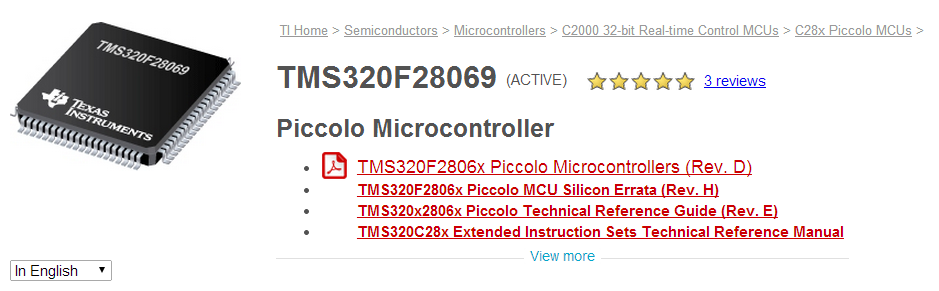
  • Sorry my bad, I saw the following and incorrectly assumed it meant silicon rev

    Thanks again for your help,

    Brent

  • FYI:
    For C2000, the Errata guides are always the best place to figure out which revisions are in-the-wild.

    -Brett