This thread has been locked.

If you have a related question, please click the "Ask a related question" button in the top right corner. The newly created question will be automatically linked to this question.

sci echo back in f28021

HI all

I compiled and programmed sci echoback code to f28021 controller. when I was testing it, I am able to transmit the data from controller to pc but not vice versa. could any one suggest me what could be the mistake or where could I get the sample code link other than control suite( I use now that).

  • Hi PN,

    I hope you're enabling these features in Hyper terminal.

    Regards,

    Gautam

  • where could I get the sample code link other than control suite( I use now that).
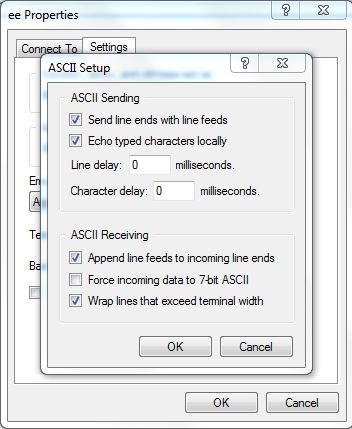
    http://www.ti.com/tool/sprc832

    Regards,

    Gautam

  • scia_fifo_init(){

    SCI_enableFifoEnh(mySci);
    SCI_resetTxFifo(mySci);
    SCI_clearTxFifoInt(mySci);
    SCI_resetChannels(mySci);
    SCI_setTxFifoIntLevel(mySci, SCI_FifoLevel_Empty); 
    SCI_enableTxFifoInt(mySci);

    SCI_resetRxFifo(mySci);
    SCI_clearRxFifoInt(mySci);
    SCI_setRxFifoIntLevel(mySci, SCI_FifoLevel_1_Word); //4_Words
    SCI_enableRxFifoInt(mySci);

    }

    this is my scia init fifo.. but am getting reply after two inputs from the pc hyper terminal. for the first time, i have to give four inputs from the keyboard, then for the fifth character i will get reply. from then i have to give two inputs from the keyboard to get the character.  is there any fifo initialization problem. what i require is i need to echo back what ever the character from keyboard for single attempt

    could u help on this

  • piccolo naga said:
    could u help on this

    Why don't you use this sample code?

    //#############################################################################
    //
    //  File:   f2802x_examples/sci_echoback/Example_F2802xSci_Echoback.c
    //
    //  Title:  F2802x Device SCI Echoback.
    //
    //  Group:          C2000
    //  Target Device:  TMS320F2802x
    //
    //! \addtogroup example_list
    //!  <h1>SCI Echoback</h1>
    //!
    //!   This test recieves and echo-backs data through the SCI-A port.
    //!
    //!   -# Configure hyperterminal:
    //!      Use the included hyperterminal configuration file SCI_96.ht.
    //!      To load this configuration in hyperterminal: file->open
    //!      and then select the SCI_96.ht file.
    //!   -# Check the COM port.
    //!      The configuration file is currently setup for COM1.
    //!      If this is not correct, disconnect Call->Disconnect
    //!      Open the File-Properties dialog and select the correct COM port.
    //!   -# Connect hyperterminal Call->Call
    //!      and then start the 2802x SCI echoback program execution.
    //!   -# The program will print out a greeting and then ask you to
    //!      enter a character which it will echo back to hyperterminal.
    //!
    //!   Watch Variables:
    //!   - LoopCount for the number of characters sent
    //!   - ErrorCount
    //
    //  (C) Copyright 2012, Texas Instruments, Inc.
    //#############################################################################
    // $TI Release: PACKAGE NAME $
    // $Release Date: PACKAGE RELEASE DATE $
    //#############################################################################
    
    #include "DSP28x_Project.h"     // Device Headerfile and Examples Include File
    
    #include "f2802x_common/include/adc.h"
    #include "f2802x_common/include/clk.h"
    #include "f2802x_common/include/flash.h"
    #include "f2802x_common/include/gpio.h"
    #include "f2802x_common/include/pie.h"
    #include "f2802x_common/include/pll.h"
    #include "f2802x_common/include/sci.h"
    #include "f2802x_common/include/wdog.h"
    
    // Prototype statements for functions found within this file.
    void scia_echoback_init(void);
    void scia_fifo_init(void);
    void scia_xmit(int a);
    void scia_msg(char *msg);
    
    // Global counts used in this example
    uint16_t LoopCount;
    uint16_t ErrorCount;
    
    
    ADC_Handle myAdc;
    CLK_Handle myClk;
    FLASH_Handle myFlash;
    GPIO_Handle myGpio;
    PIE_Handle myPie;
    SCI_Handle mySci;
    
    void main(void)
    {    
        uint16_t ReceivedChar;
        char *msg;
        
        CPU_Handle myCpu;
        PLL_Handle myPll;
        WDOG_Handle myWDog;
        
        // Initialize all the handles needed for this application    
        myAdc = ADC_init((void *)ADC_BASE_ADDR, sizeof(ADC_Obj));
        myClk = CLK_init((void *)CLK_BASE_ADDR, sizeof(CLK_Obj));
        myCpu = CPU_init((void *)NULL, sizeof(CPU_Obj));
        myFlash = FLASH_init((void *)FLASH_BASE_ADDR, sizeof(FLASH_Obj));
        myGpio = GPIO_init((void *)GPIO_BASE_ADDR, sizeof(GPIO_Obj));
        myPie = PIE_init((void *)PIE_BASE_ADDR, sizeof(PIE_Obj));
        myPll = PLL_init((void *)PLL_BASE_ADDR, sizeof(PLL_Obj));
        mySci = SCI_init((void *)SCIA_BASE_ADDR, sizeof(SCI_Obj));
        myWDog = WDOG_init((void *)WDOG_BASE_ADDR, sizeof(WDOG_Obj));
    
        // Perform basic system initialization    
        WDOG_disable(myWDog);
        CLK_enableAdcClock(myClk);
        (*Device_cal)();
        
        //Select the internal oscillator 1 as the clock source
        CLK_setOscSrc(myClk, CLK_OscSrc_Internal);
        
        // Setup the PLL for x10 /2 which will yield 50Mhz = 10Mhz * 10 / 2
        PLL_setup(myPll, PLL_Multiplier_12, PLL_DivideSelect_ClkIn_by_2);
        
        // Disable the PIE and all interrupts
        PIE_disable(myPie);
        PIE_disableAllInts(myPie);
        CPU_disableGlobalInts(myCpu);
        CPU_clearIntFlags(myCpu);
    
        // If running from flash copy RAM only functions to RAM   
    #ifdef _FLASH
        memcpy(&RamfuncsRunStart, &RamfuncsLoadStart, (size_t)&RamfuncsLoadSize);
    #endif   
        
    
        // Initalize GPIO
        GPIO_setPullUp(myGpio, GPIO_Number_28, GPIO_PullUp_Enable);
        GPIO_setPullUp(myGpio, GPIO_Number_29, GPIO_PullUp_Disable);
        GPIO_setQualification(myGpio, GPIO_Number_28, GPIO_Qual_ASync);
        GPIO_setMode(myGpio, GPIO_Number_28, GPIO_28_Mode_SCIRXDA);
        GPIO_setMode(myGpio, GPIO_Number_29, GPIO_29_Mode_SCITXDA);
    
        // Setup a debug vector table and enable the PIE
        PIE_setDebugIntVectorTable(myPie);
        PIE_enable(myPie);
    
        LoopCount = 0;
        ErrorCount = 0;
    
        scia_echoback_init();  // Initalize SCI for echoback
        scia_fifo_init();      // Initialize the SCI FIFO
    
        msg = "\r\n\n\nHello World!\0";
        scia_msg(msg);
    
        msg = "\r\nYou will enter a character, and the DSP will echo it back! \n\0";
        scia_msg(msg);
    
        for(;;)
        {
            msg = "\r\nEnter a character: \0";
            scia_msg(msg);
    
            // Wait for inc character
            while(SCI_getRxFifoStatus(mySci) < SCI_FifoStatus_1_Word){
            }
    
            // Get character
            ReceivedChar = SCI_getData(mySci);
    
            // Echo character back
            msg = "  You sent: \0";
            scia_msg(msg);
            scia_xmit(ReceivedChar);
    
            LoopCount++;
        }
    
    }
    
    // Test 1,SCIA  DLB, 8-bit word, baud rate 0x000F, default, 1 STOP bit, no parity
    void scia_echoback_init()
    {
    
        CLK_enableSciaClock(myClk);
    
        // 1 stop bit,  No loopback
        // No parity,8 char bits,
        // async mode, idle-line protocol
        SCI_disableParity(mySci);
        SCI_setNumStopBits(mySci, SCI_NumStopBits_One);
        SCI_setCharLength(mySci, SCI_CharLength_8_Bits);
        
        SCI_enableTx(mySci);
        SCI_enableRx(mySci);
        SCI_enableTxInt(mySci);
        SCI_enableRxInt(mySci);
    
        // SCI BRR = LSPCLK/(SCI BAUDx8) - 1
    #if (CPU_FRQ_60MHZ)
        SCI_setBaudRate(mySci, (SCI_BaudRate_e)194);
    #elif (CPU_FRQ_50MHZ)
        SCI_setBaudRate(mySci, (SCI_BaudRate_e)162);
    #elif (CPU_FRQ_40MHZ)
        SCI_setBaudRate(mySci, (SCI_BaudRate_e)129);
    #endif
    
        SCI_enable(mySci);
        
        return;
    }
    
    // Transmit a character from the SCI
    void scia_xmit(int a)
    {
    //    while (SciaRegs.SCIFFTX.bit.TXFFST != 0) {}
        while(SCI_getTxFifoStatus(mySci) != SCI_FifoStatus_Empty){
        }
    //    SciaRegs.SCITXBUF=a;
        SCI_putDataBlocking(mySci, a);
    
    }
    
    void scia_msg(char * msg)
    {
        int i;
        i = 0;
        while(msg[i] != '\0')
        {
            scia_xmit(msg[i]);
            i++;
        }
    }
    
    // Initalize the SCI FIFO
    void scia_fifo_init()
    {
        
        SCI_enableFifoEnh(mySci);
        SCI_resetTxFifo(mySci);
        SCI_clearTxFifoInt(mySci);
        SCI_resetChannels(mySci);
        SCI_setTxFifoIntLevel(mySci, SCI_FifoLevel_Empty);
    
        SCI_resetRxFifo(mySci);
        SCI_clearRxFifoInt(mySci);
        SCI_setRxFifoIntLevel(mySci, SCI_FifoLevel_4_Words);
    
        return;
    }
    
    //===========================================================================
    // No more.
    //===========================================================================


    This works perfectly well.

    Regards,

    Gautam