This thread has been locked.

If you have a related question, please click the "Ask a related question" button in the top right corner. The newly created question will be automatically linked to this question.

TMS320F28335 Power Requirements for Flash Programming and Wait States

I have two questions regarding power:

What are power needs to satisfy the FLASH programming requirements.

 The second question is the impact of wait states on power.   I could not find any information in the datasheet that gave a way to quantify the impact; examples use data is for running from FLASH and we are expecting to run from SRAM.

Thank you.

  • Hi Paul,

    Paul Joseph said:
    What are power needs to satisfy the FLASH programming requirements.

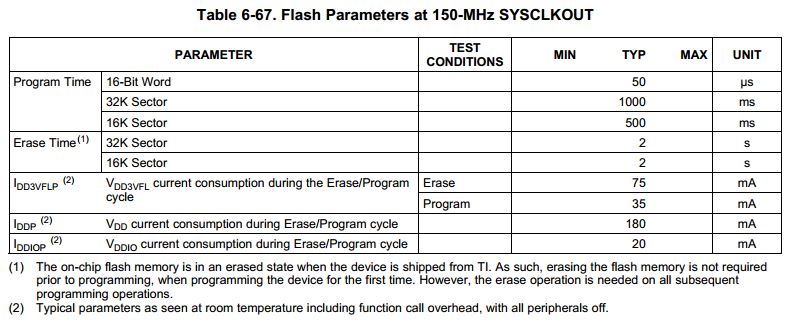
    During flash programming, extra current is drawn from the VDD and VDD3VFL rails, as indicated in Table 6-67. If the user application involves on-board flash programming, this extra current must be taken into account while architecting the power-supply stage.

    Paul Joseph said:
     The second question is the impact of wait states on power.   I could not find any information in the datasheet that gave a way to quantify the impact; examples use data is for running from FLASH and we are expecting to run from SRAM.

    When the identical code is run off SARAM, IDD would increase as the code operates with zero wait states.

    Regards,

    Gautam

  • Hi Gautam,

    Thanks for answering the questions, regarding the 1st question:

    The data from table 6-67 (flash programming power) to the normal operational currents:

    • VDDIO is lower during programming
    • VDD is lower during programming
    • VDD3VFL is higher during programming

    Could you please confirm that if accommodate the 75mA for VDD3VFL (compare to the normal max of 40mA), that is all. As note (2) from table 6-1 tells to allow the "extra" current indicated in the table 6-67.

    Best regards,

    Max

  • Xinyu Dai said:
    Could you please confirm that if accommodate the 75mA for VDD3VFL (compare to the normal max of 40mA), that is all. As note (2) from table 6-1 tells to allow the "extra" current indicated in the table 6-67.

    That's true! An extra margin has to considered and is supposed to be taken care of.

    Regards,

    Gautam

  • Okay, just to be clear, is 75mA sufficient margin?

  • Paul Joseph said:
    Okay, just to be clear, is 75mA sufficient margin?

    100mA would be suitable.

  • The number quoted in the datasheet should satisfy both scenarios (code running off flash or SARAM). When you run code off SARAM, it is true the Idd current will be higher , since code is now running with zero waitstates. However, the IDD3VFL current will decrease , since code is not running off flash. The change in current does not quite even out completely, so running code off SARAM would result in a  slight elevation in device power consumption (around 50 mW). Regardless, the number should still stay within the datasheet limits. Note, however, that the I/O loading will be different across designs. So, IDDIO current may be higher in a customer design.