Other Parts Discussed in Thread: TMS320F28023
I'm thinking about using the TMS320F28023 in a design. I'd like to use it to provide the PWM signal for a DC-DC converter in a hand-held battery powered device.
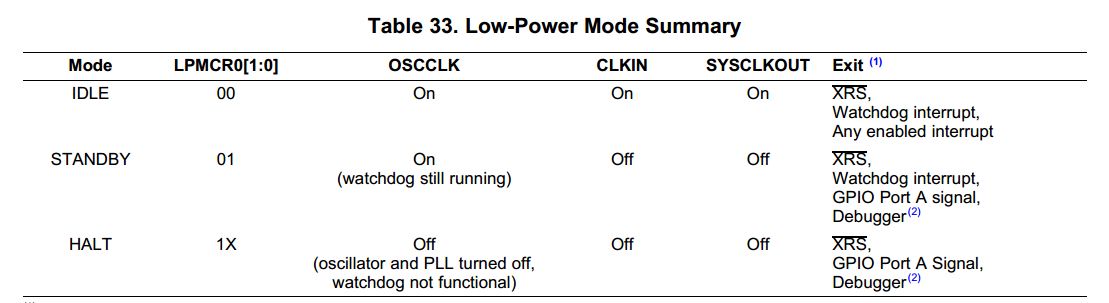
Looking at the data sheet I see a sleep mode that brings current draw down to about 60uA. This is a little high for the battery I would be using. Is there a way to further reduce current draw when the microcontroller goes to sleep.
The data sheet shows a current demand about 90mA with most things running which is pretty high for my device. What would roughly be the current demand at 50MHz with only one HRPWM clock, two ADC clocks, and three core timers.
The HRPWM module is only required when there's output power demand which is not full time for this device. Can the MCU switch clock speeds on the fly to reduce current demand when the higher speed is not required?
I didn't see off-hand in the data sheet if the processor has the ability to wake on input change. For example, if a user pushes a button, the MCU wakes up to service the request. Can this MCU wake on input change?
The LCD for this utilizes the SPI module, but only communicates one way and requires a GPIO to control the CE input (there's other stuff attached to it). So, I only need the SPI data out and clock lines. Is it possible to use the SPI module with the chip enable and master receive pins disabled through the mux registers or will that cause a problem for the SPI module?
That's all I'm concerned with at this point, but I'll probably run into more questions about features and function if I actually start a design with it.
TIA, Craig