Hello,
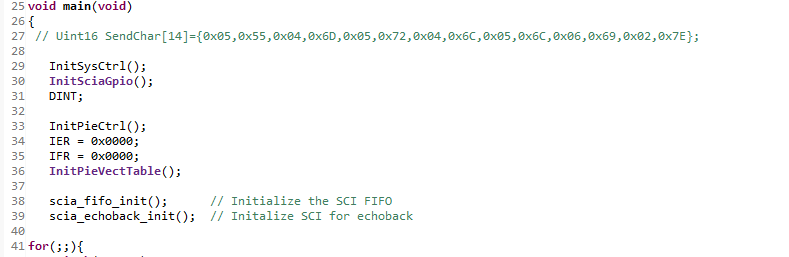
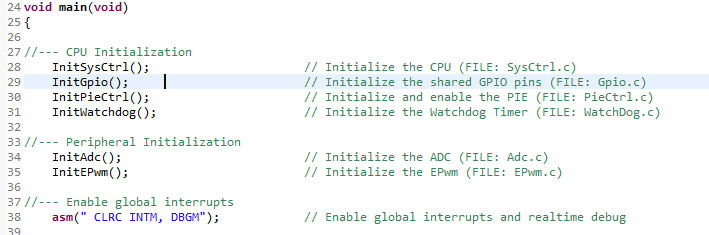
we have two code like in figure one for sci and other for adc
how can initialize different module available in C2000 Family ???
CODE FOR SCI
CODE FOR ADC
This thread has been locked.
If you have a related question, please click the "Ask a related question" button in the top right corner. The newly created question will be automatically linked to this question.
Hello,
we have two code like in figure one for sci and other for adc
how can initialize different module available in C2000 Family ???
CODE FOR SCI
CODE FOR ADC
Here, if we initialize ADC at start then that will affect SCI or not ??
How can we define ADC code initialize this in between the SCI code ?
After Using ADC code we have to again get into normal internalization, can we do that?
Yes sir,
Here main question is which things we are initialize for ADC ,we have to stop that after using ADC module,
we mixed and build with on error , now we have to try it is working or not...
Thank You
Follow this structure:
main()
{
// Step 1. Initialize System Control:
// PLL, WatchDog, enable Peripheral Clocks
// This example function is found in the DSP2803x_SysCtrl.c file.
InitSysCtrl();
InitSciaGpio();
// Step 2. Initialize GPIO:
// This example function is found in the DSP2802x_Gpio.c file and
// illustrates how to set the GPIO to it's default state.
// InitGpio(); // Skipped for this example
// Step 3. Clear all interrupts and initialize PIE vector table:
// Disable CPU interrupts
DINT;
// Initialize the PIE control registers to their default state.
// The default state is all PIE interrupts disabled and flags
// are cleared.
// This function is found in the DSP2802x_PieCtrl.c file.
InitPieCtrl();
// Disable CPU interrupts and clear all CPU interrupt flags:
IER = 0x0000;
IFR = 0x0000;
// Initialize the PIE vector table with pointers to the shell Interrupt
// Service Routines (ISR).
// This will populate the entire table, even if the interrupt
// is not used in this example. This is useful for debug purposes.
// The shell ISR routines are found in DSP2802x_DefaultIsr.c.
// This function is found in DSP2802x_PieVect.c.
InitPieVectTable();
// Interrupts that are used in this example are re-mapped to
// ISR functions found within this file.
EALLOW; // This is needed to write to EALLOW protected register
PieVectTable.ADCINT1 = &adc_isr;
EDIS; // This is needed to disable write to EALLOW protected registers
// Step 4. Initialize all the Device Peripherals:
// This function is found in DSP2802x_InitPeripherals.c
// InitPeripherals(); // Not required for this example
InitAdc(); // For this example, init the ADC
// Step 5. User specific code, enable interrupts:
// Enable ADCINT1 in PIE
PieCtrlRegs.PIEIER1.bit.INTx1 = 1; // Enable INT 1.1 in the PIE
IER |= M_INT1; // Enable CPU Interrupt 1
EINT; // Enable Global interrupt INTM
ERTM; // Enable Global realtime interrupt DBGM
LoopCount = 0;
ConversionCount = 0;
// Configure ADC
//Note: Channel ADCINA4 will be double sampled to workaround the ADC 1st sample issue for rev0 silicon errata
EALLOW;
AdcRegs.ADCCTL1.bit.INTPULSEPOS = 1; //ADCINT1 trips after AdcResults latch
AdcRegs.INTSEL1N2.bit.INT1E = 1; //Enabled ADCINT1
AdcRegs.INTSEL1N2.bit.INT1CONT = 0; //Disable ADCINT1 Continuous mode
AdcRegs.INTSEL1N2.bit.INT1SEL = 2; //setup EOC2 to trigger ADCINT1 to fire
AdcRegs.ADCSOC0CTL.bit.CHSEL = 4; //set SOC0 channel select to ADCINA4
AdcRegs.ADCSOC1CTL.bit.CHSEL = 4; //set SOC1 channel select to ADCINA4
AdcRegs.ADCSOC2CTL.bit.CHSEL = 2; //set SOC1 channel select to ADCINA2
AdcRegs.ADCSOC0CTL.bit.TRIGSEL = 5; //set SOC0 start trigger on EPWM1A, due to round-robin SOC0 converts first then SOC1
AdcRegs.ADCSOC1CTL.bit.TRIGSEL = 5; //set SOC1 start trigger on EPWM1A, due to round-robin SOC0 converts first then SOC1
AdcRegs.ADCSOC2CTL.bit.TRIGSEL = 5; //set SOC2 start trigger on EPWM1A, due to round-robin SOC0 converts first then SOC1, then SOC2
AdcRegs.ADCSOC0CTL.bit.ACQPS = 6; //set SOC0 S/H Window to 7 ADC Clock Cycles, (6 ACQPS plus 1)
AdcRegs.ADCSOC1CTL.bit.ACQPS = 6; //set SOC1 S/H Window to 7 ADC Clock Cycles, (6 ACQPS plus 1)
AdcRegs.ADCSOC2CTL.bit.ACQPS = 6; //set SOC2 S/H Window to 7 ADC Clock Cycles, (6 ACQPS plus 1)
EDIS;
// Assumes ePWM1 clock is already enabled in InitSysCtrl();
EPwm1Regs.ETSEL.bit.SOCAEN = 1; // Enable SOC on A group
EPwm1Regs.ETSEL.bit.SOCASEL = 4; // Select SOC from from CPMA on upcount
EPwm1Regs.ETPS.bit.SOCAPRD = 1; // Generate pulse on 1st event
EPwm1Regs.CMPA.half.CMPA = 0x0080; // Set compare A value
EPwm1Regs.TBPRD = 0xFFFF; // Set period for ePWM1
EPwm1Regs.TBCTL.bit.CTRMODE = 0; // count up and start
scia_fifo_init(); // Initialize the SCI FIFO
scia_echoback_init(); // Initalize SCI for echoback
for(;;)
{
}
void scia_echoback_init()
{
// Note: Clocks were turned on to the SCIA peripheral
// in the InitSysCtrl() function
SciaRegs.SCICCR.all =0x0007; // 1 stop bit, No loopback
// No parity,8 char bits,
// async mode, idle-line protocol
SciaRegs.SCICTL1.all =0x0003; // enable TX, RX, internal SCICLK,
// Disable RX ERR, SLEEP, TXWAKE
SciaRegs.SCICTL2.all =0x0003;
SciaRegs.SCICTL2.bit.TXINTENA =1;
SciaRegs.SCICTL2.bit.RXBKINTENA =1;
// SCI BRR = LSPCLK/(SCI BAUDx8) - 1
#if (CPU_FRQ_60MHZ)
SciaRegs.SCIHBAUD =0x0000; // 9600 baud @LSPCLK = 15MHz (60 MHz SYSCLK).
SciaRegs.SCILBAUD =0x00C2;
#elif (CPU_FRQ_50MHZ)
SciaRegs.SCHBAUD =0x0000; // 9600 baud @LSPCLK = 12.5 MHz (50 MHz SYSCLK)
#elif (CPU_FRQ_40MHZ) =0x00A1;
SciaRegs.SCIHBAUD =0x0000; // 9600 baud @LSPCLK = 10MHz (40 MHz SYSCLK).
SciaRegs.SCILBAUD =0x0081;
#endif
SciaRegs.SCICTL1.all =0x0023; // Relinquish SCI from Reset
}
// Transmit a character from the SCI
void scia_xmit(int a)
{
while (SciaRegs.SCIFFTX.bit.TXFFST != 0) {}
SciaRegs.SCITXBUF=a;
}
void scia_msg(char * msg)
{
int i;
i = 0;
while(msg[i] != '\0')
{
scia_xmit(msg[i]);
i++;
}
}
// Initalize the SCI FIFO
void scia_fifo_init()
{
SciaRegs.SCIFFTX.all=0xE040;
SciaRegs.SCIFFRX.all=0x2044;
SciaRegs.SCIFFCT.all=0x0;
}