This thread has been locked.

If you have a related question, please click the "Ask a related question" button in the top right corner. The newly created question will be automatically linked to this question.

Saving settings on TMS320F28027

Other Parts Discussed in Thread: TMS320F28027, CONTROLSUITE, MOTORWARE

Hello!

I build an ESC based on TMS320F28027 with InstaSPIN FOC. How and where can I store calibration settings to read them after power cycle?

  • Hi Roman,

    You can store calibration settings in user OTP, in the flash memory, or in an external EEPROM (addressed via SPI or I2C).

  • Dear Davin. Are there any examples or documentation about this?

    Thanks,
    Roman
  • Hi Roman,

    The flash API is used to program both flash memory and OTP on this device. You can find an example for this in ControlSUITE in the directory

    \ti\controlSUITE\libs\utilities\flash_api\2802x\v201a\example_ccsv5\

    and the documentation is in

    \ti\controlSUITE\libs\utilities\flash_api\2802x\v201a\doc\

    If you need to do multiple read-erase cycles for this calibration data, take a look at this application note about emulating EEPROM with C28x flash memory:

    www.ti.com/.../sprab69.pdf

    If you want to use an external EEPROM instead, there is an example in ControlSUITE using I2C here:

    \ti\controlSUITE\device_support\f2802x\v230\f2802x_examples_structs\i2c_eeprom
  • I tried to export F280xx_EEPROM.h and F280xx_EEPROM.с with Flash API but have compiler error:

    "C:/ti/motorware/motorware_1_01_00_17/sw/ide/ccs/cmd/f2802x/F28027F.cmd", line 130: error #10099-D:
    program will not fit into available memory. run placement with
    alignment/blocking fails for section "rom_accessed_data" size 0xc2 page 1.
    Available memory ranges:
    RAMM0_M1 size: 0x600 unused: 0x80 max hole: 0x80
    error #10010: errors encountered during linking; "proj_lab05b.out" not built

    Is this because variables in F280xx_EEPROM.с allocate too much memory ? and how can I solve this?
    What is Flash sector minimum size for TMS320F28027, can't find it in datasheet?
  • Hi Roman,

    Yes, the linking is failing because the linker is trying to fit "rom_accessed_data" of size 0xC2 into RAMM0_M1 but the only available slot is 0x80.  To fix this, you can edit the .cmd linker file to either move some items from RAMMM0_M1 to a different RAM bank to make space or you can place rom_accessed_data into a different RAM section that has space.

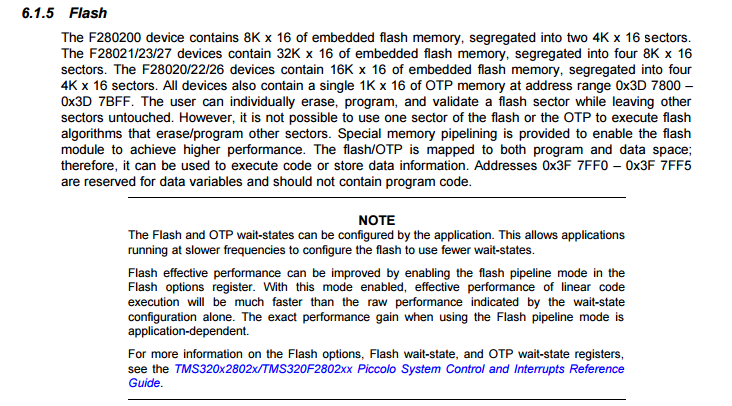
    The flash sector sizes depend on which specific part number you have in the F2802x family.  This is specified in the datasheet here:

  • Thanks. It seems little bit complicated to me.

    Can you please show me an example on how to save 2 16bit variables to flash?

    Best regards,
    Roman
  • Roman,

    This is how you need to program 1 data into flash.

    Flash_ptr = (Uint16 *) 0x3F0000;
    data = 0xFFFE;
    Length = 1;
    Status = Flash_Program(Flash_ptr,&data,Length,&FlashStatus);

    I would recommend you try running the below controlSuite example to better understand how to use Flash API functions.

    Path: <controlSUITE>\libs\utilities\flash_api\2802x\v201a\example_ccsv5\

    Regards,
    Manoj
  • Thanks for code example.

    Im using lab10a prject of from motorware and here is my .cmd file:

    MEMORY
    {
    PAGE 0:    /* Program Memory */
               /* Memory (RAM/FLASH/OTP) blocks can be moved to PAGE1 for data allocation */
    
       OTP         : origin = 0x3D7800, length = 0x000400     /* on-chip OTP */
       CSM_RSVD    : origin = 0x3F7F80, length = 0x000076     /* Part of FLASHA.  Program with all 0x0000 when CSM is in use. */
       BEGIN       : origin = 0x3F7FF6, length = 0x000002     /* Part of FLASHA.  Used for "boot to Flash" bootloader mode. */
       CSM_PWL_P0  : origin = 0x3F7FF8, length = 0x000008     /* Part of FLASHA.  CSM password locations in FLASHA */
    
       IQTABLES    : origin = 0x3FE000, length = 0x000B50     /* IQ Math Tables in Boot ROM */
       IQTABLES2   : origin = 0x3FEB50, length = 0x00008C     /* IQ Math Tables in Boot ROM */
       IQTABLES3   : origin = 0x3FEBDC, length = 0x0000AA     /* IQ Math Tables in Boot ROM */
    
       ROM         : origin = 0x3FF27C, length = 0x000D44     /* Boot ROM */
       RESET       : origin = 0x3FFFC0, length = 0x000002     /* part of boot ROM  */
       VECTORS     : origin = 0x3FFFC2, length = 0x00003E     /* part of boot ROM  */
       FLASHB_D    : origin = 0x3F0000, length = 0x006000     /* on-chip FLASH B, C and D */
       D_FLASHA    : origin = 0x3F6000, length = 0x001F80     /* on-chip FLASH A */
       P_RAML0     : origin = 0x008000, length = 0x000980     /* on-chip PRAM block L0 */
    
    PAGE 1 :   /* Data Memory */
               /* Memory (RAM/FLASH/OTP) blocks can be moved to PAGE0 for program allocation */
               /* Registers remain on PAGE1                                                  */
    
       RAMM0_M1    : origin = 0x000000, length = 0x000600     /* on-chip RAM block M0 + M1. 0x600 to 0x800 reserved for InstaSPIN */
       D_RAML0     : origin = 0x008980, length = 0x000680     /* on-chip DRAM block L0 */
    }
    
    /* Allocate sections to memory blocks.
       Note:
             codestart user defined section in DSP28_CodeStartBranch.asm used to redirect code
                       execution when booting to flash
             ramfuncs  user defined section to store functions that will be copied from Flash into RAM
    */
    
    SECTIONS
    {
       /* Allocate program areas: */
       .cinit              : > FLASHB_D     PAGE = 0
       .pinit              : > FLASHB_D,    PAGE = 0
       .text               : > FLASHB_D     PAGE = 0
       codestart           : > BEGIN        PAGE = 0
       ramfuncs            : LOAD = FLASHB_D,
                             RUN = P_RAML0,
                             LOAD_START(_RamfuncsLoadStart),
                             LOAD_END(_RamfuncsLoadEnd),
                             RUN_START(_RamfuncsRunStart),
                             PAGE = 0
    
       csmpasswds          : > CSM_PWL_P0   PAGE = 0
       csm_rsvd            : > CSM_RSVD     PAGE = 0
    
       /* Allocate uninitalized data sections: */
       .stack              : > RAMM0_M1     PAGE = 1
       .ebss               : > RAMM0_M1     PAGE = 1
       .esysmem            : > RAMM0_M1     PAGE = 1
    
       ebss_extension      : > P_RAML0      PAGE = 0
       rom_accessed_data   : > RAMM0_M1     PAGE = 1
    
       vib_buf_data	       : > D_RAML0      PAGE = 1
       graph_data		   : > D_RAML0      PAGE = 1
    
       /* Initalized sections go in Flash */
       /* For SDFlash to program these, they must be allocated to page 0 */
       .econst             : > D_FLASHA,    PAGE = 0
       .switch             : > D_FLASHA,    PAGE = 0
    
       /* Allocate IQ math areas: */
       IQmath              : > FLASHB_D     PAGE = 0            /* Math Code */
       IQmathTables        : > IQTABLES,    PAGE = 0, TYPE = NOLOAD
    
       /* Uncomment the section below if calling the IQNexp() or IQexp()
          functions from the IQMath.lib library in order to utilize the
          relevant IQ Math table in Boot ROM (This saves space and Boot ROM
          is 1 wait-state). If this section is not uncommented, IQmathTables2
          will be loaded into other memory (SARAM, Flash, etc.) and will take
          up space, but 0 wait-state is possible.
       */
       /*
       IQmathTables2    : > IQTABLES2, PAGE = 0, TYPE = NOLOAD
       {
    
                  IQmath.lib<IQNexpTable.obj> (IQmathTablesRam)
    
       }
       */
       /* Uncomment the section below if calling the IQNasin() or IQasin()
          functions from the IQMath.lib library in order to utilize the
          relevant IQ Math table in Boot ROM (This saves space and Boot ROM
          is 1 wait-state). If this section is not uncommented, IQmathTables2
          will be loaded into other memory (SARAM, Flash, etc.) and will take
          up space, but 0 wait-state is possible.
       */
       /*
       IQmathTables3    : > IQTABLES3, PAGE = 0, TYPE = NOLOAD
       {
    
                  IQmath.lib<IQNasinTable.obj> (IQmathTablesRam)
    
       }
       */
    
       /* .reset is a standard section used by the compiler.  It contains the */
       /* the address of the start of _c_int00 for C Code.   /*
       /* When using the boot ROM this section and the CPU vector */
       /* table is not needed.  Thus the default type is set here to  */
       /* DSECT  */
       .reset              : > RESET,      PAGE = 0, TYPE = DSECT
       vectors             : > VECTORS     PAGE = 0, TYPE = DSECT
    
    }

    I figured out that sections .reset and vectors not used (them have DSECT), but when I'm trying to program this sections like this:

    Flash_ptr = (Uint16 *)0x3FFFC0; //or 0x3FFFC2 for "vectors" section
    
    data[0] = *(Flash_ptr + 1);
    data[1] = *(Flash_ptr + 2);
    
    Status = Flash_Program(Flash_ptr,&data,2,&FlashStatus);

    Im getting status code 12 which means "Invalid address passed to the API"

    what I'm doing wrong? and how can I erase this sectors with flash API?

  • Address 0x3FFFC0 belong to BOOTROM and not flash. That is the reason why you get error.

    Valid Flash address : 0x3F0000 - 0x3F7FFF. So, should be using addresses within this range.
  • Is this issue resolved?
  • Got it, but still don't understand which sector in range 0x3F0000 - 0x3F7FFF I can Use, as I can understand from .cmd file FLASHB_D and D_FLASHA is under usage of .cinit, .pinit, .text, .econst, .switch, IQmath sectors, correct me if Im wrong. How can I find unused sections and how can I erase them without corrupting sectors, which my application use?

  • Simon,

    How often do you need to change calibration data? How many locations do you need? Do you have empty flash sector?

    Regards,
    Manoj
  • I use project from lab 10 from InstaSPIN FOC with few modification. I think, correct me if I'm wrong, .cmd file describes which sectors I'm using. I just need to store 2 dimensional array of uint16_t. this values can be changed by application user if recalibration is needed so I should be able to modify stored value any time.
  • Roman,

    Yes, you can check either .cmd file (or) .map file (this is more accurate).

    Regards,

    Manoj

  • Thank you Manoj.

    I moved everything from flash A to  B,C,D to be able to use A  with Flash API.

    Now when I'm trying to program it, it dons't retain data. What I'm doing wrong ?

      ENABLE_PROTECTED_REGISTER_WRITE_MODE;
      Flash_CPUScaleFactor = SCALE_FACTOR;    //Initalize the Flash_CPUScaleFactor variable to SCALE_FACTOR
      Flash_CallbackPtr = NULL;               //set callback function pointer to NULL
      DISABLE_PROTECTED_REGISTER_WRITE_MODE;
    
      // Flash A
      Flash_ptr = (Uint16 *)0x3F6000;
    
      for(;;) //Application loop
      {
    
        switch(operation)
        {
            case 1:
                Status = Flash_Program(Flash_ptr,data,2,&FlashStatus);
                operation = 0;
            break;
            case 2:
                operation = 0;
                data[0] = Flash_ptr[0];
                data[1] = Flash_ptr[1];
            break;
            case 3:
                Status = Flash_Erase(SECTORA, &FlashStatus);
                operation = 0;
            break;
        }
    
      }

  • I'm slightly confused, so many TI employees here and no answer on my question... only copy-pastes from manuals, documentations and code examples which I already read. Please someone help me with my problem, it is already more than a month :(
  • Roman,

    What error were you getting? When you execute Flash_Program() did you get the corresponding flash address getting programmed to begin with?

    Regards,

    Manoj

  • To be fair, I see two of earlier questions were answered.