Tool/software: TI C/C++ Compiler
Hello,

I want to test Can bus by using can_external_transmit.c
and I used 2 of mcp2551(can tranceiver) with LAUNCHXL-F28377S

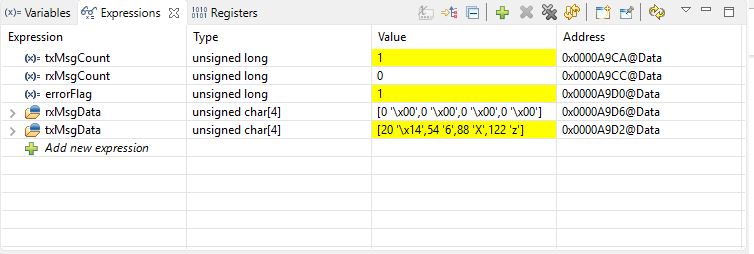
and the result is


this is my source code

//###########################################################################
//
// FILE: can_external_transmit.c
//
// TITLE: Example to demonstrate CAN external transmission
//
//! \addtogroup cpu01_example_list
//! <h1>CAN-A to CAN-B External Transmit (can_external_transmit)</h1>
//!
//! This example initializes CAN module A and CAN module B for external
//! communication. CAN-A module is setup to transmit incrementing data for "n"
//! number of times to the CAN-B module, where "n" is the value of TXCOUNT.
//! CAN-B module is setup to trigger an interrupt service routine (ISR) when
//! data is received. An error flag will be set if the transmitted data doesn't
//! match the received data.
//!
//! \note Both CAN modules on the device need to be
//! connected to each other via CAN transceivers.
//!
//! \b External \b Connections \n
//! - CANA is on GPIO31 (CANTXA) and GPIO30 (CANRXA)
//! - CANB is on GPIO8 (CANTXB) and GPIO10 (CANRXB)
//!
//! \b Watch \b Variables \n
//! - TXCOUNT - Adjust to set the number of messages to be transmitted
//! - txMsgCount - A counter for the number of messages sent
//! - rxMsgCount - A counter for the number of messages received
//! - txMsgData - An array with the data being sent
//! - rxMsgData - An array with the data that was received
//! - errorFlag - A flag that indicates an error has occurred
//!
//
//###########################################################################
// $TI Release: F2837xS Support Library v210 $
// $Release Date: Tue Nov 1 15:35:23 CDT 2016 $
// $Copyright: Copyright (C) 2014-2016 Texas Instruments Incorporated -
// http://www.ti.com/ ALL RIGHTS RESERVED $
//###########################################################################

//
// Included Files
//
#include "F28x_Project.h" // Device Headerfile and Examples Include File
#include <stdint.h>
#include <stdbool.h>
#include "inc/hw_types.h"
#include "inc/hw_memmap.h"
#include "inc/hw_can.h"
#include "driverlib/can.h"

//
// Defines
//
#define TXCOUNT 100
#define MSG_DATA_LENGTH 4
#define TX_MSG_OBJ_ID 1
#define RX_MSG_OBJ_ID 1

//
// Globals
//
volatile unsigned long i;
volatile uint32_t txMsgCount = 0;
volatile uint32_t rxMsgCount = 0;
volatile uint32_t errorFlag = 0;
unsigned char txMsgData[4];
unsigned char rxMsgData[4];
tCANMsgObject sTXCANMessage;
tCANMsgObject sRXCANMessage;

//
// Function Prototypes
//
__interrupt void canbISR(void);

//
// Main
//
void main(void)
{
//
// Initialize System Control:
// PLL, WatchDog, enable Peripheral Clocks
//
InitSysCtrl();

//
// Initialize GPIO and configure GPIO pins for CANTX/CANRX
// on module A and B
//
InitGpio();

//
// Setup GPIO pin mux for CAN-A TX/RX and CAN-B TX/RX
//
/*GPIO_SetupPinMux(30, GPIO_MUX_CPU1, 1); //GPIO30 - CANRXA
GPIO_SetupPinOptions(30, GPIO_INPUT, GPIO_ASYNC);
GPIO_SetupPinMux(31, GPIO_MUX_CPU1, 1); //GPIO31 - CANTXA
GPIO_SetupPinOptions(31, GPIO_OUTPUT, GPIO_PUSHPULL);
GPIO_SetupPinMux(10, GPIO_MUX_CPU1, 2); //GPIO10 - CANRXB
GPIO_SetupPinOptions(10, GPIO_INPUT, GPIO_ASYNC);
GPIO_SetupPinMux(8, GPIO_MUX_CPU1, 2); //GPIO8 - CANTXB
GPIO_SetupPinOptions(8, GPIO_OUTPUT, GPIO_PUSHPULL);*/

GPIO_SetupPinMux(18, GPIO_MUX_CPU1, 3); //PIN76-J8 - CANRXA
GPIO_SetupPinOptions(18, GPIO_INPUT, GPIO_ASYNC);
GPIO_SetupPinMux(19, GPIO_MUX_CPU1, 3); //PIN75-J8 - CANTXA
GPIO_SetupPinOptions(19, GPIO_OUTPUT, GPIO_PUSHPULL);
GPIO_SetupPinMux(21, GPIO_MUX_CPU1, 3); //PIN 33-J4 - CANRXB
GPIO_SetupPinOptions(17, GPIO_INPUT, GPIO_ASYNC);
GPIO_SetupPinMux(20, GPIO_MUX_CPU1, 3); //PIN 34-J4 - CANTXB
GPIO_SetupPinOptions(16, GPIO_OUTPUT, GPIO_PUSHPULL);
//
// Initialize the CAN controllers
//
CANInit(CANA_BASE);
CANInit(CANB_BASE);

//
// Setup CAN to be clocked off the PLL output clock
//
CANClkSourceSelect(CANA_BASE, 0); // 500kHz CAN-Clock
CANClkSourceSelect(CANB_BASE, 0); // 500kHz CAN-Clock

//
// Set up the CAN bus bit rate to 500kHz for each module
// This function sets up the CAN bus timing for a nominal configuration.
// You can achieve more control over the CAN bus timing by using the
// function CANBitTimingSet() instead of this one, if needed.
// Additionally, consult the device data sheet for more information about
// the CAN module clocking.
//
CANBitRateSet(CANA_BASE, 200000000, 500000);
CANBitRateSet(CANB_BASE, 200000000, 500000);

//
// Enable interrupts on the CAN B peripheral.
//
CANIntEnable(CANB_BASE, CAN_INT_MASTER | CAN_INT_ERROR | CAN_INT_STATUS);

//
// Clear all interrupts and initialize PIE vector table:
// Disable CPU interrupts
//
DINT;

//
// Initialize the PIE control registers to their default state.
// The default state is all PIE interrupts disabled and flags
// are cleared.
//
InitPieCtrl();

//
// Disable CPU interrupts and clear all CPU interrupt flags
//
IER = 0x0000;
IFR = 0x0000;

//
// Initialize the PIE vector table with pointers to the shell Interrupt
// Service Routines (ISR).
// This will populate the entire table, even if the interrupt
// is not used in this example. This is useful for debug purposes.
//
InitPieVectTable();

//
// Interrupts that are used in this example are re-mapped to
// ISR functions found within this file.
// This registers the interrupt handler in PIE vector table.
//
EALLOW;
PieVectTable.CANB0_INT = canbISR;
EDIS;

//
// Enable the CAN-B interrupt on the processor (PIE).
//
PieCtrlRegs.PIEIER9.bit.INTx7 = 1;
IER |= M_INT9;
EINT;

//
// Enable the CAN-B interrupt signal
//
CANGlobalIntEnable(CANB_BASE, CAN_GLB_INT_CANINT0);

//
// Initialize the transmit message object used for sending CAN messages.
// Message Object Parameters:
// Message Identifier: 0x5555
// Message ID Mask: 0x0
// Message Object Flags: None
// Message Data Length: 4 Bytes
// Message Transmit data: txMsgData
//
sTXCANMessage.ui32MsgID = 0x5555;
sTXCANMessage.ui32MsgIDMask = 0;
sTXCANMessage.ui32Flags = 0;
sTXCANMessage.ui32MsgLen = MSG_DATA_LENGTH;
sTXCANMessage.pucMsgData = txMsgData;

//
// Initialize the receive message object used for receiving CAN messages.
// Message Object Parameters:
// Message Identifier: 0x5555
// Message ID Mask: 0x0
// Message Object Flags: Receive Interrupt
// Message Data Length: 4 Bytes
// Message Receive data: rxMsgData
//
sRXCANMessage.ui32MsgID = 0x5555;
sRXCANMessage.ui32MsgIDMask = 0;
sRXCANMessage.ui32Flags = MSG_OBJ_RX_INT_ENABLE;
sRXCANMessage.ui32MsgLen = MSG_DATA_LENGTH;
sRXCANMessage.pucMsgData = rxMsgData;
CANMessageSet(CANB_BASE, RX_MSG_OBJ_ID, &sRXCANMessage,
MSG_OBJ_TYPE_RX);

//
// Initialize the transmit message object data buffer to be sent
//
txMsgData[0] = 0x12;
txMsgData[1] = 0x34;
txMsgData[2] = 0x56;
txMsgData[3] = 0x78;

//
// Start CAN module A and B operations
//
CANEnable(CANA_BASE);
CANEnable(CANB_BASE);

//
// Transmit messages from CAN-A to CAN-B
//
for(i = 0; i < TXCOUNT; i++)
{
//
// Check the error flag to see if errors occurred
//
if(errorFlag)
{
asm(" ESTOP0");
}

//
// Verify that the number of transmitted messages equal the number of
// messages received before sending a new message
//
if(txMsgCount == rxMsgCount)
{
//
// Transmit Message
//
CANMessageSet(CANA_BASE, TX_MSG_OBJ_ID, &sTXCANMessage,
MSG_OBJ_TYPE_TX);

txMsgCount++;
}
else
{
errorFlag = 1;
}

//
// Delay 0.25 second before continuing
//
DELAY_US(1000 * 250);

//
// Increment the value in the transmitted message data.
//
txMsgData[0] += 0x01;
txMsgData[1] += 0x01;
txMsgData[2] += 0x01;
txMsgData[3] += 0x01;
}

//
// Stop application
//
asm(" ESTOP0");
}

//
// CAN B ISR - The interrupt service routine called when a CAN interrupt is
// triggered on CAN module B.
//
__interrupt void
canbISR(void)
{
uint32_t status;

//
// Read the CAN-B interrupt status to find the cause of the interrupt
//
status = CANIntStatus(CANB_BASE, CAN_INT_STS_CAUSE);

//
// If the cause is a controller status interrupt, then get the status
//
if(status == CAN_INT_INT0ID_STATUS)
{
//
// Read the controller status. This will return a field of status
// error bits that can indicate various errors. Error processing
// is not done in this example for simplicity. Refer to the
// API documentation for details about the error status bits.
// The act of reading this status will clear the interrupt.
//
status = CANStatusGet(CANB_BASE, CAN_STS_CONTROL);

//
// Check to see if an error occurred.
//
if(((status & ~(CAN_ES_RXOK)) != 7) &&
((status & ~(CAN_ES_RXOK)) != 0))
{
//
// Set a flag to indicate some errors may have occurred.
//
errorFlag = 1;
}
}
//
// Check if the cause is the CAN-B receive message object 1
//
else if(status == RX_MSG_OBJ_ID)
{
//
// Get the received message
//
CANMessageGet(CANB_BASE, RX_MSG_OBJ_ID, &sRXCANMessage, true);

//
// Getting to this point means that the RX interrupt occurred on
// message object 1, and the message RX is complete. Clear the
// message object interrupt.
//
CANIntClear(CANB_BASE, RX_MSG_OBJ_ID);

//
// Increment a counter to keep track of how many messages have been
// received. In a real application this could be used to set flags to
// indicate when a message is received.
//
rxMsgCount++;

//
// Since the message was received, clear any error flags.
//
errorFlag = 0;
}
//
// If something unexpected caused the interrupt, this would handle it.
//
else
{
//
// Spurious interrupt handling can go here.
//
}

//
// Clear the global interrupt flag for the CAN interrupt line
//
CANGlobalIntClear(CANB_BASE, CAN_GLB_INT_CANINT0);

//
// Acknowledge this interrupt located in group 9
//
PieCtrlRegs.PIEACK.all = PIEACK_GROUP9;
}

//
// End of File
//