This thread has been locked.

If you have a related question, please click the "Ask a related question" button in the top right corner. The newly created question will be automatically linked to this question.

TMS320F28069: eCAP Module Question - Clarification of SyncIn and SyncOut

Part Number: TMS320F28069

Hello All,

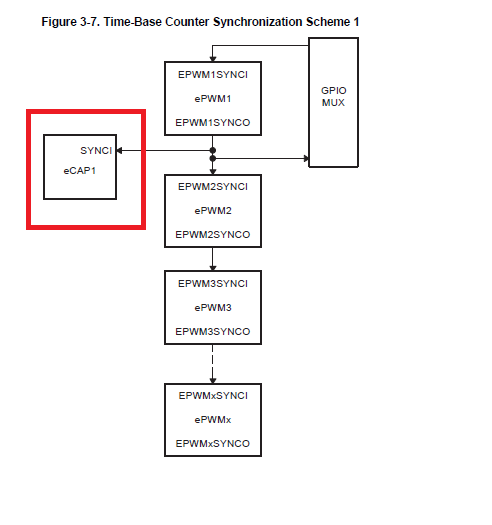
Just want to verify where the SyncIn and SyncOut signals are coming from in the following figure:

Are those coming from the EPWMSYNCI and EPWMSYNCO signals/pins (as long as configured correctly)?  Pretty sure that's correct - but just want to ask and make sure.

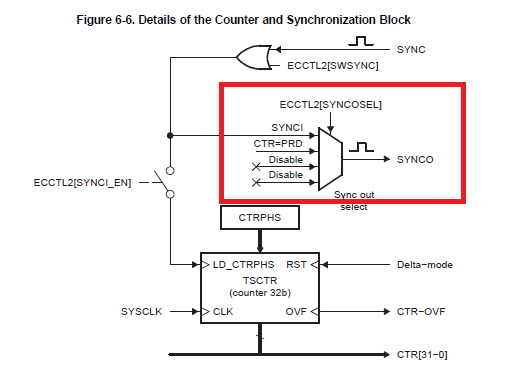
Some of the diagrams have just "SYNC" - like 6-15 in the datasheet - and at times it could appear that term is a little ambiguous.

Thanks In Advance,
John W.

  • Hi John,

    SYNCI comes from the EPWM.

    SYNCO comes from the ECAP but could just be a looped back SYNCI.

  • Frank,

    Is it necessary to enable the SyncIn passthrough?  And if that's done - will that go out of the EPWM1SYNCO pin?  If I don't want the sync out to be output - I just have to configure that pin as a GPIO or one of the other functions available with the MUX, correct?

    There are ambiguous terms and phrases in the datasheet - I thought this was interesting too:

    Are "External ePWM sync pulse input" and 

    and "Enhanced PWM external sync pulse input" the same or could there be a difference?  

    And,

    all refer to "SYNC" but the following:

    do help to clear things up - albeit "SYNC" can be interpreted to be somewhat ambiguous at times.

    Thanks,
    John W.

  • John,

    Is it necessary to enable the SyncIn passthrough?  And if that's done - will that go out of the EPWM1SYNCO pin?  If I don't want the sync out to be output - I just have to configure that pin as a GPIO or one of the other functions available with the MUX, correct?

    EPWM1 is the root source for SYNCO. This SYNCO goes to the ECAP, GPIO and other EPWM modules. This EPWM1SYNCO can be a pass through of EPWM1SYNCI (this comes from the GPIO) or it can be a pulse generated when CTR=ZRO or CTR=CMPB events of EPWM1 happen. So to answer your question, EPWM1SYNCO doesn't necessarily have to be a pass through of EPWM1SYNCI as EPWM1SYNCO can also be generated by CTR=ZRO or CTR=CMPB events. You only need to configure the GPIO as EPWM1SYNCO if you want that SYNCO signal on a pin. The routing is done internally for the modules (other EPWMs and ECAP).

    Are "External ePWM sync pulse input" and "Enhanced PWM external sync pulse input" the same or could there be a difference? 

    Good catch. Yes, those 2 are the same. I'll submit a ticket to get them corrected.

    On your last question: "SYNC" is just short for synchronization. In figures 6-8, 6-10, 6-15 and 6-28, "SYNC" block is just synchronization circuitry that is aligning the input signal with some clock source and have nothing to do with the EPWM or ECAP but i can see how that can be confusing. I'll submit a ticket to get "SYNC" instances in the EPWM and ECAP chapters fully qualified so it is a lot more clear. 

    Thanks for catching these little discrepancies. Our documentation is a continuous improvement and we will try to make it better :-).

  • Hi John,

    Did the previous responses answer you questions?
  • Hi John,

    Since it's been a while since we heard back from you, I am going to assume the answers provided cleared up all your questions and will be marking this thread as resolved. If that is not the case, feel free to reject the answers and reply to this thread or create a new one if this one locks out due to inactivity.
  • Hello Frank,

    Yes - that does answer all of my questions - and thanks for getting back to me. Sorry it took a little while to get back to you.

    Best Regards,
    John W.