This thread has been locked.

If you have a related question, please click the "Ask a related question" button in the top right corner. The newly created question will be automatically linked to this question.

TMS320F280049: Is the PGAx_GND pin an input or output pin?

Part Number: TMS320F280049
Other Parts Discussed in Thread: AMC1100

Hi, TI engineers,

I am using the PGA4 inside F280049 to be an amplifier for detecting outside diferential voltage purpose.

At first, I left the PGA4_GND pin disconnected while sent about 1.1V to PGA4_IN (C3 pin, actually), and then found badly noise output from PGA4_OUT, and measured about 800mV at PGA4_GND pin.

Then I tried to connect the PGA4_GND pin to VSSA directly and got a stable and constant ADC resault from PGA4_OUT internally.

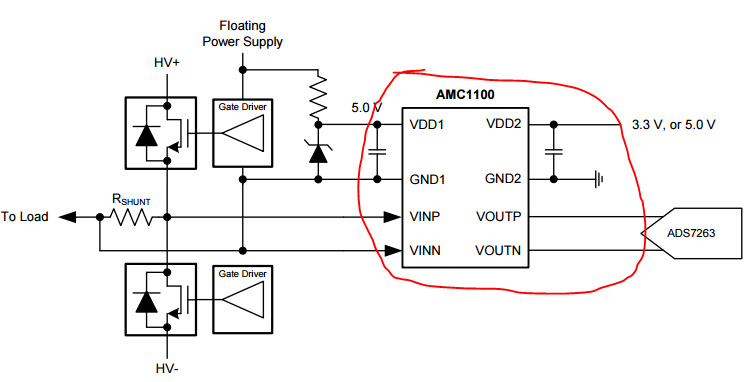
So it seems that PGA4_GND is more like an output pin and should be grounded. Here comes the problem: what if a voltage different from 800mV (maybe 1000mV or 600mV) is sent to PGA4_GND to be the negative signal of diferential volatage? Actually, I chose AMC1100 to the external differential voltage input for F280049, its VOUTN is about 1000mV in our application, can it connect to PGA4_GND directly? And should they grounded, too?
Best regards.

  • Hi Xiaoqing,

    The idea for the PGA_GND is to provide some rejection of noise on the ground coming out of the sensor. You will typically want to connect this to VSSA, but the allowable range is given as -50mV to 200mV by

    "Table 5-48. PGA Operating Conditions" in the device datasheet.

    1000mV is too high, so you can't connect this to the PGA ground.
  • Thanks for replying, Devin.

    I checked the datasheet for PGA GND range which is limitted between -50mV and 200mV as you said.

    I am wondering what if 1000mV is sent into PGA GND? Is it going to damage PGA inside or just can not get accurate PGA_OUT result? 

    In fact it seems that PGA still works quite well when I used it as a part of differential amplifier, linearity between (3/2*PGA_IN - PGA_GND) and PGA_OUT keeps almost a constant from several experiments.

    So is there any potential risk or uncertainty in other aspect for such application?

  • Hi Xiaoqing,

    We can't guarantee operation outside of the datasheet specifications.

    We set the specifications based on design expectations and/or device characterization and/or we test this in production.  If the limits are set this way there is a good reason for this; we work really hard to always give the best spec's that we can.

  • Thanks for your quickly reply and hard work to get the reliable spec's, Devin.
    And sorry for making the device operating out of the limits.
    Now we decide to use two ADC channels to get the differential voltage inside, instead of using PGA to be an differetial amplifier to acheive that.

    Thanks for your advice again, Devin :).
  • Hi Xiaoqing,

    I'll also point out that F2837x devices have 'fully differential' 16-bit resolution inputs (note these aren't 'truly differential'; they have a specific common-mode requirement so you'll have to condition the inputs into a specific format). This is probably the best way to get high resolution readings on a distant sensor with excellent noise rejection (but these devices are obviously larger/more expensive than F28004x and the PGAs have some other great features/advantages too).