This thread has been locked.

If you have a related question, please click the "Ask a related question" button in the top right corner. The newly created question will be automatically linked to this question.

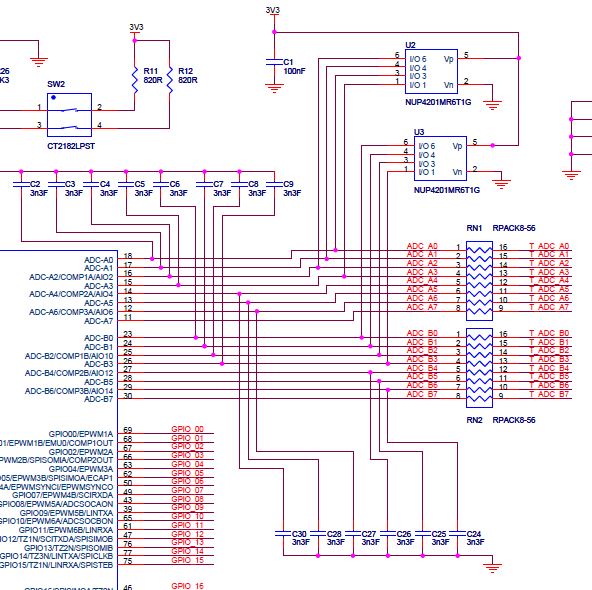
TMDSCNCD28035ISO: ADC pin connected with resistors, capacitors and protection chip NUP4201MR6T1G

Part Number: TMDSCNCD28035ISO
Other Parts Discussed in Thread: TMDSCNCD28379D, TPD4E001-Q1

Dear TI Experts:

In the schematic circuit of TMDSCNCD28035ISO, I found only ADC-A7 and ADC-B7 are not connected to 3.3nF cap. Is there a special reason?

I found many ADC pins are connected to NUP4201MR6T1G chip, which protects the ADC pins, right?   In TMDSHVMTRPFCKIT, I find 3.3V zener diodes are used to replace NUP4201MR6T1Gs, right?  Are 3.3V zener diodes enough to protect the ADC pins?  I just found that DigiKey said NUP4201MR6T1G were not in production. Do you have any suggestion?

RN1 and RN2 resistors are also necessary for ADC pins, right?

Look forward to hearing from you~

Cheers,

Tang Han
 (in TMDSHVMTRPFCKIT)

  • You are correct in terms of the use of both the protection circuits as well as the anti-aliasing filters.  In terms of why these are not on all ADC channels on the control CARD, it is just to provide the option of a bypassed channel depending on the use case for the analog channel, since these are multipurpose evaluation boards.

    On the newer control CARDs we have been using these devices http://www.ti.com/product/TPD4E001-Q1.  You can see these in a schematic on the TMDSCNCD28379D in C2000 Ware 

    Best,

    Matthew

  • Dear Matthew:

    I am so grateful to you for introducing TPD4E001-Q1, which seems the same as the NUP4201MR6T1G and can be directly replaced for the NUP4201MR6T1G.

    For the ADC pins in TMDSCNCD28379D, I also found that R27~R50=0 and C18~C41=dnp.

    Does it mean that the user should determine the appropriate valuse of R27~R50 and C18~C41 by himself?

    Does it mean that R and C combine a low pass filter, which acts as an anti-aliasing filters?

    I really need your final confirmation.

    Many thanks again!

    Tang Han
  • Tang,
    This is correct, we purposefully made the values generic since it will be very system dependent(even on our own designs that use the control CARDS). User should look at what the source characteristics is and along with the internal ADC input model(inside the datasheet) determine the correct R/C for LP/anti-aliasing, buffering, amp stability, etc.

    Matt
  • Dear Matt:
    I am so glad to receive your kind and professional reply.
    You have taught me a lot.
    Wish you a prosperous New Year!
    Tang Han