This thread has been locked.

If you have a related question, please click the "Ask a related question" button in the top right corner. The newly created question will be automatically linked to this question.

TMS320F28069: TMS320F28069 Short circuit

Part Number: TMS320F28069

Hello,

yesterday I wanted to test the TMS320F28069 MCU on my developed circuit board.
I was able to establish a connection between my MCU and the PC. I did that by using the Test Connection button in the new Target Configuration menu.
After that I wanted to run my first code, but in the meantime a short circuit occurred in the 3,3V Power supply.
After some research I am quite sure, that the short circuit is inside the MCU.

Information:
- Every VDDIO-Pin is connected to 3,3V
- Every VDD and VDDIO is stabilized with a 2,2uF Capacitor.
- Every VSS is connected to Ground
- X1 and VREGENZ is connected to Ground
- The Short circuit has approximately 6,5 ohms
- The ground potential of the circuit board was floating, but nobody touched it (ESD).

Maybe the Problem is:


- I connected the X2-Pin via a 10k Resistor to Ground.
I want to to this to prevent floating Pins. The ground potential will be around -300 V (B6-Circiut).
I was not sure want will happen with floating pins and a ground potential around -300V, therefor I want to give it a defined potential.


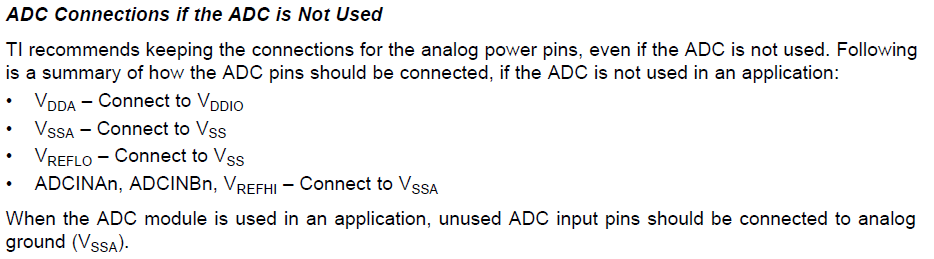
- I did not connect VDDA and VREFHI and it was floating. VREFLO was connected to ground.

Questions:
- Is it possible to connect the X2-Pin via a 10k Resistor to Ground, or will it damage the MCU. Is this pin even floating or will it have a definite potential.
The dataset says to the X2-Pin: "If X2 is not used, it must be left unconnected."
- Does the floating VDDA and VREFHI pin cause the damage?

I could just test this, but I am running low on circuit brands and MCUs, so I just wanted to research the problem before testing. Also, I am not an original English speaker. If something isn't understandable, please tell me.


Thank you in advance :).

  • If there is a short-circuit inside the MCU, it would become extremely hot when it is powered. Is this happening? 

    Did you measure the resistance with the device still soldered to the board? Are you able to measure the resistance in a known-good board? 

    I don’t understand what you mean by "The ground potential will be around -300 V (B6-Circiut)". Please explain this further.

    Is it possible to connect the X2-Pin via a 10k Resistor to Ground, or will it damage the MCU. Is this pin even floating or will it have a definite potential. The dataset says to the X2-Pin: "If X2 is not used, it must be left unconnected."

    It would be best to follow the datasheet recommendations. However, in this case, I doubt if the suspected short-circuit was caused by this.

    - Does the floating VDDA and VREFHI pin cause the damage?

    Leaving any power-supply pin un-connected should not be done. The datasheet has clear guidelines on this.

  • Tank you for the fast fast answer.

    1) The power supply is shuting down due to the overcurrent. But wehn i supply an external Power supply the MCU ist getting very hot.

    2) Teh restistance before I powerd up the MCU the resistance was 5 kohm.

    3) B6 circuit:
  • Thank you for the fast answer.
    1) The power supply is shutting down due to the overcurrent. But when I supply an external Power supply the MCU is getting very hot.
    2) The resistance before I power up the MCU was 5 kohm.
    3) The B6 circuit is a rectifier circuit. The ground voltage of this circuit with respect to earth is approx 300VAC. The Voltage for the MCU is generated with an isolated DC/DC-Converter in combination with a TLV75533PDBVR.

    I found another Mistake:
    I switched up a 0 ohm Resistor with a 2 Mohm Resistor. This had the result that VDDIO_1, VDDIO_2, VDDIO_5 and VDDIO_6 were effectively not connects to 3,3 V. Also the JTAG was not connected to the 3,3V source.

    Can this result in a short-circuit inside the MCU?
  • I don't have the complete picture on your side. With the limited information provided, it appears there are a few issues that are in violation of the datasheet specification, so it is conceivable one or more of those issues has damaged the device. I still don't understand the relevance of 300v in the discussion. Without access to the schematics, it is hard to tell.