


Part Number: TMS320F28035
Dear TI members,
I want to implement a hysteresis current control (HCC) method for a 3ph inverter in synchronism with the grid, and I was wondering if there is any example of this kind of application available. More specifically, I want my ePWMAx signals to turn on when ref_current - sensed_current < -band, and off when ref_current-sensed_current > band. The most similar mode that I found was the "Controlling a Peak Current Mode Controlled Buck Module" (page 305 in TMS320F2803x manual); however, this is not exactly HCC because it only triggers the ePWM off when a maximum threshold is reached, as can be seen in the figure below:
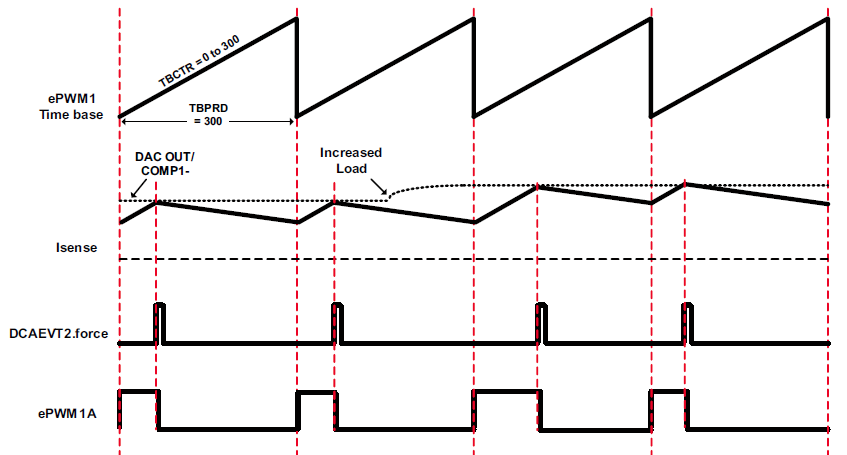
If there isn't any example of HCC available, I wanted to ask the following:
1) In this example model, DCAEVT2 forces ePWM1A to turn off based on the comparator output. Would it be possible to add a second DCAEVT to force ePWM1A to turn on also based on the comparator output? I do see the possibility of using more than one DCAEVT signal, but my confusion is related to how an asynchronous system based only on the comparator would behave under the timebase TBCTR. The way this example is designed ePWM1A will turn on whenever TBCTR reaches 300. How could I configure my ePWM to turn on/off based solely on the comparator output, but in a way that the interruption routine is called at a predetermined sampling frequency rate? Any feedback in this matter is appreciated!
Thank you,
Victor

