


Part Number: TMS320F28335
Tool/software: Code Composer Studio
I'm traying to sample a current signal but I have a problem with the sample, the sample frequency is a 12kHz from the ePMW2 and the current signal is 60Hz, the next figure shown the signal sampled and the second figure is of a signal current of 65Hz and the signal of 65 Hz is distorted, I'm using a 200 data circular buffer
void InitAdc(void)
{
//--- Reset the ADC module
	AdcRegs.ADCTRL1.bit.RESET = 1;		// Reset the ADC

// Must wait 2 ADCCLK periods for the reset to take effect.  The ADC is
// already reset after a DSP reset, but this example is just showing good
// coding practice to reset the peripheral before configuring it (as you
// never know why the DSP has started the code over again from the
// beginning).  Assuming a 12.5 MHz ADCCLK was previously configured, and
// a 150 MHz SYSCLKOUT, the wait period of 2 ADCCLK periods equates to 24
// CPU clocks.  This is the example being used below.

	asm(" RPT #22 || NOP");				// Must wait for ADC reset to take effect

//--- Call the ADC_cal() function located in the Boot ROM.
//    ADC_cal_func_ptr is a macro defined in the file example_nonBios.h or
//    example_BIOS.h (as may be the case for the example being used).  This
//    macro simply defines ADC_cal_func_ptr to be a function pointer to
//    the correct address in the boot ROM.
	(*ADC_cal_func_ptr)();

//--- Select the ADC reference
	AdcRegs.ADCREFSEL.bit.REF_SEL = 0;	// 0=internal, 1=external

//--- Power-up the ADC
	AdcRegs.ADCTRL3.all = 0x00EC;		// Power-up reference and main ADC
// bit 15-8      0's:    reserved
// bit 7-6       11:     ADCBGRFDN, reference power, 00=off, 11=on
// bit 5         1:      ADCPWDN, main ADC power, 0=off, 1=on
// bit 4-1       0110:   ADCCLKPS, clock prescaler, FCLK=HSPCLK/(2*ADCCLKPS)
// bit 0         0:      SMODE_SEL, 0=sequential sampling, 1=simultaneous sampling

	DelayUs(5000);						// Wait 5ms before using the ADC

//--- Configure the other ADC register
	AdcRegs.ADCMAXCONV.all = 0xB;

// For CPU servicing of ADC, we are only doing 1 conversion in the
// sequence.  So, we only need to configure the first channel
// selection in the sequence.  All other channel selection fields
// are don't cares in this example.
	AdcRegs.ADCCHSELSEQ1.bit.CONV00 = 0x0;	// Convert Channel 0
	AdcRegs.ADCCHSELSEQ1.bit.CONV01 = 0x1;
	AdcRegs.ADCCHSELSEQ1.bit.CONV02 = 0x2;
	AdcRegs.ADCCHSELSEQ1.bit.CONV03 = 0x3;
	AdcRegs.ADCCHSELSEQ2.bit.CONV04 = 0x4;
	AdcRegs.ADCCHSELSEQ2.bit.CONV05 = 0x5;
	AdcRegs.ADCCHSELSEQ2.bit.CONV06 = 0x6;
	AdcRegs.ADCCHSELSEQ2.bit.CONV07 = 0x7;
	AdcRegs.ADCCHSELSEQ3.bit.CONV08 = 0x8;
	AdcRegs.ADCCHSELSEQ3.bit.CONV09 = 0x9;
	AdcRegs.ADCCHSELSEQ3.bit.CONV10 = 0x10;

	AdcRegs.ADCTRL1.all = 0x0710;
// bit 15        0:      reserved
// bit 14        0:      RESET, 0=no action, 1=reset ADC
// bit 13-12     00:     SUSMOD, 00=ignore emulation suspend
// bit 11-8      0111:/1111   ACQ_PS (Acquisition), 0111 = 8 x ADCCLK
// bit 7         0:      CPS (Core clock), 0: ADCCLK=FCLK/1, 1: ADCCLK=FCLK/2
// bit 6         0:      CONT_RUN, 0=start/stop mode, 1=continuous run
// bit 5         0:      SEQ_OVRD, 0=disabled, 1=enabled
// bit 4         1:      SEQ_CASC, 0=dual sequencer, 1=cascaded sequencer
// bit 3-0       0000:   reserved


	AdcRegs.ADCTRL2.all = 0x0900;
// bit 15        0:      ePWM_SOCB_SEQ, 0=no action
// bit 14        0:       RST_SEQ1, 0=no action
// bit 13        0:      SOC_SEQ1, 0=clear any pending SOCs
// bit 12        0:      reserved
// bit 11        1:      INT_ENA_SEQ1, 1=enable interrupt
// bit 10        0:      INT_MOD_SEQ1, 0=int on every SEQ1 conv
// bit 9         0:      reserved
// bit 8         1:      ePWM_SOCA_SEQ1, 1=SEQ1 start from ePWM_SOCA trigger
// bit 7         0:      EXT_SOC_SEQ1, 1=SEQ1 start from ADCSOC pin
// bit 6         0:      RST_SEQ2, 0=no action
// bit 5         0:      SOC_SEQ2, no effect in cascaded mode
// bit 4         0:      reserved
// bit 3         0:      INT_ENA_SEQ2, 0=int disabled
// bit 2         0:      INT_MOD_SEQ2, 0=int on every other SEQ2 conv
// bit 1         0:      reserved
// bit 0         0:      ePWM_SOCB_SEQ2, 0=no action


//--- Enable the ADC interrupt
	PieCtrlRegs.PIEIER1.bit.INTx6 = 1;	// Enable ADCINT in PIE group 1
	IER |= 0x0001;						// Enable INT1 in IER to enable PIE group

} // end InitAdc()


//--- end of file -----------------------------------------------------

interrupt void ADCINT_ISR(void)					// PIE1.6 @ 0x000D4A  ADCINT (ADC)
{
static Uint16 *Current1Ptr = Current1;					// Pointer to ADC data buffer
static Uint16 *Current2Ptr = Current2;
static Uint16 *Current3Ptr = Current3;
static Uint16 *Current4Ptr = Current4;
static Uint16 *Current5Ptr = Current5;
static Uint16 *Voltage_ac1Ptr = Voltage_ac1;
static Uint16 *Voltage_ac2Ptr = Voltage_ac2;
static Uint16 *Voltage_ac3Ptr = Voltage_ac3;
static Uint16 *Voltage_dc1Ptr = Voltage_dc1;
static Uint16 *Voltage_dc2Ptr = Voltage_dc2;
static Uint16 *temperaturePtr = temperature;
static volatile Uint16 GPIO34_count = 0;		// Counter for pin toggle


	PieCtrlRegs.PIEACK.all = PIEACK_GROUP1;		// Must acknowledge the PIE group

//--- Manage the ADC registers
	AdcRegs.ADCTRL2.bit.RST_SEQ1 = 1;			// Reset SEQ1 to CONV00 state
	AdcRegs.ADCST.bit.INT_SEQ1_CLR = 1;			// Clear ADC SEQ1 interrupt flag
	AdcRegs.ADCTRL2.bit.RST_SEQ2 = 1;			// Reset SEQ2 to CONV08 state
    AdcRegs.ADCST.bit.INT_SEQ2_CLR = 1;			// Clear ADC SEQ2 interrupt flag

//--- Read the ADC result
		*Current1Ptr++= AdcMirror.ADCRESULT0;	// Read the result
		*Current2Ptr++ = AdcMirror.ADCRESULT1;
		*Current3Ptr++ = AdcMirror.ADCRESULT2;
		*Current4Ptr++ = AdcMirror.ADCRESULT3;
		*Current5Ptr++ = AdcMirror.ADCRESULT4;
		*Voltage_ac1Ptr++ = AdcMirror.ADCRESULT5;
		*Voltage_ac2Ptr++ = AdcMirror.ADCRESULT6;
		*Voltage_ac3Ptr++ = AdcMirror.ADCRESULT7;
		*Voltage_dc1Ptr++ = AdcMirror.ADCRESULT8;
		*Voltage_dc2Ptr++ = AdcMirror.ADCRESULT9;
		*temperaturePtr++ = AdcMirror.ADCRESULT10;

//--- Brute-force the circular buffer
	if( Current1Ptr == (Current1 + ADC_BUF_LEN) )
	{
		Current1Ptr = Current1;						// Rewind the pointer to the beginning

	}
	if( Current2Ptr == (Current2 + ADC_BUF_LEN) )
	{
		Current2Ptr = Current2;

	}
	if( Current3Ptr == (Current3 + ADC_BUF_LEN) )
	{
		Current3Ptr = Current3;
	}
	if( Current4Ptr == (Current4 + ADC_BUF_LEN) )
		{
		Current4Ptr = Current4;
		}
	if( Current5Ptr == (Current5 + ADC_BUF_LEN) )
			{
		Current5Ptr = Current5;
			}
	if( Voltage_ac1Ptr == (Voltage_ac1 + ADC_BUF_LEN) )
			{
		Voltage_ac1Ptr = Voltage_ac1;
			}
	if( Voltage_ac2Ptr == (Voltage_ac2 + ADC_BUF_LEN) )
		{
		Voltage_ac2Ptr = Voltage_ac2;
		}
	if( Voltage_ac3Ptr == (Voltage_ac3 + ADC_BUF_LEN) )
			{
		Voltage_ac3Ptr = Voltage_ac3;
			}
	if( Voltage_dc1Ptr == (Voltage_dc1 + ADC_BUF_LEN) )
			{
		Voltage_dc1Ptr = Voltage_dc1;
			}
	if( Voltage_dc2Ptr == (Voltage_dc2 + ADC_BUF_LEN) )
			{
		Voltage_dc2Ptr = Voltage_dc2;
			}
	if( temperaturePtr == (temperature+10) )
	{
		temperaturePtr = temperature;
	}
}

void InitEPwm(void)
{
//---------------------------------------------------------------------
//--- Must disable the clock to the ePWM modules if you
//--- want all ePMW modules synchronized.
//---------------------------------------------------------------------
	asm(" EALLOW");						// Enable EALLOW protected register access
	SysCtrlRegs.PCLKCR0.bit.TBCLKSYNC = 0;
	asm(" EDIS");						// Disable EALLOW protected register access


//---------------------------------------------------------------------

//---------------------------------------------------------------------
	EPwm2Regs.TBCTL.bit.CTRMODE = 0x3;		// Disable the timer
	EPwm2Regs.TBCTL.all = 0xC033;			// Configure timer control register
// bit 15-14     11:     FREE/SOFT, 11 = ignore emulation suspend
// bit 13        0:      PHSDIR, 0 = count down after sync event
// bit 12-10     000:    CLKDIV, 000 => TBCLK = HSPCLK/1
// bit 9-7       000:    HSPCLKDIV, 000 => HSPCLK = SYSCLKOUT/1
// bit 6         0:      SWFSYNC, 0 = no software sync produced
// bit 5-4       11:     SYNCOSEL, 11 = sync-out disabled
// bit 3         0:      PRDLD, 0 = reload PRD on counter=0
// bit 2         0:      PHSEN, 0 = phase control disabled
// bit 1-0       11:     CTRMODE, 11 = timer stopped (disabled)

	EPwm2Regs.TBCTR = 0x0000;				// Clear timer counter
	EPwm2Regs.TBPRD = ADC_SAMPLE_PERIOD;	// Set timer period ADC_SAMPLE_PERIOD=SYSCLK/12kHz=12500-1=12449
	EPwm2Regs.TBPHS.half.TBPHS = 0x0000;	// Set timer phase

	EPwm2Regs.ETPS.all = 0x0100;			// Configure SOCA
// bit 15-14     00:     EPWMxSOCB, read-only
// bit 13-12     00:     SOCBPRD, don't care
// bit 11-10     00:     EPWMxSOCA, read-only
// bit 9-8       01:     SOCAPRD, 01 = generate SOCA on first event
// bit 7-4       0000:   reserved
// bit 3-2       00:     INTCNT, don't care
// bit 1-0       00:     INTPRD, don't care

	EPwm2Regs.ETSEL.all = 0x0A00;			// Enable SOCA to ADC
// bit 15        0:      SOCBEN, 0 = disable SOCB
// bit 14-12     000:    SOCBSEL, don't care
// bit 11        1:      SOCAEN, 1 = enable SOCA
// bit 10-8      010:    SOCASEL, 010 = SOCA on PRD event
// bit 7-4       0000:   reserved
// bit 3         0:      INTEN, 0 = disable interrupt
// bit 2-0       000:    INTSEL, don't care

	EPwm2Regs.TBCTL.bit.CTRMODE = 0;		// Enable the timer in count up mode


//---------------------------------------------------------------------
//--- Enable the clocks to the ePWM module.
//--- Note: this should be done after all ePWM modules are configured
//--- to ensure synchronization between the ePWM modules.
//---------------------------------------------------------------------
	asm(" EALLOW");							// Enable EALLOW protected register access
	SysCtrlRegs.PCLKCR0.bit.TBCLKSYNC = 1;	// HSPCLK to ePWM modules enabled
	asm(" EDIS");							// Disable EALLOW protected register access

} // end InitEPwm()


//--- end of file -----------------------------------------------------
. Could you tell me why is happen?. The code is below.
Current signal of 60Hz
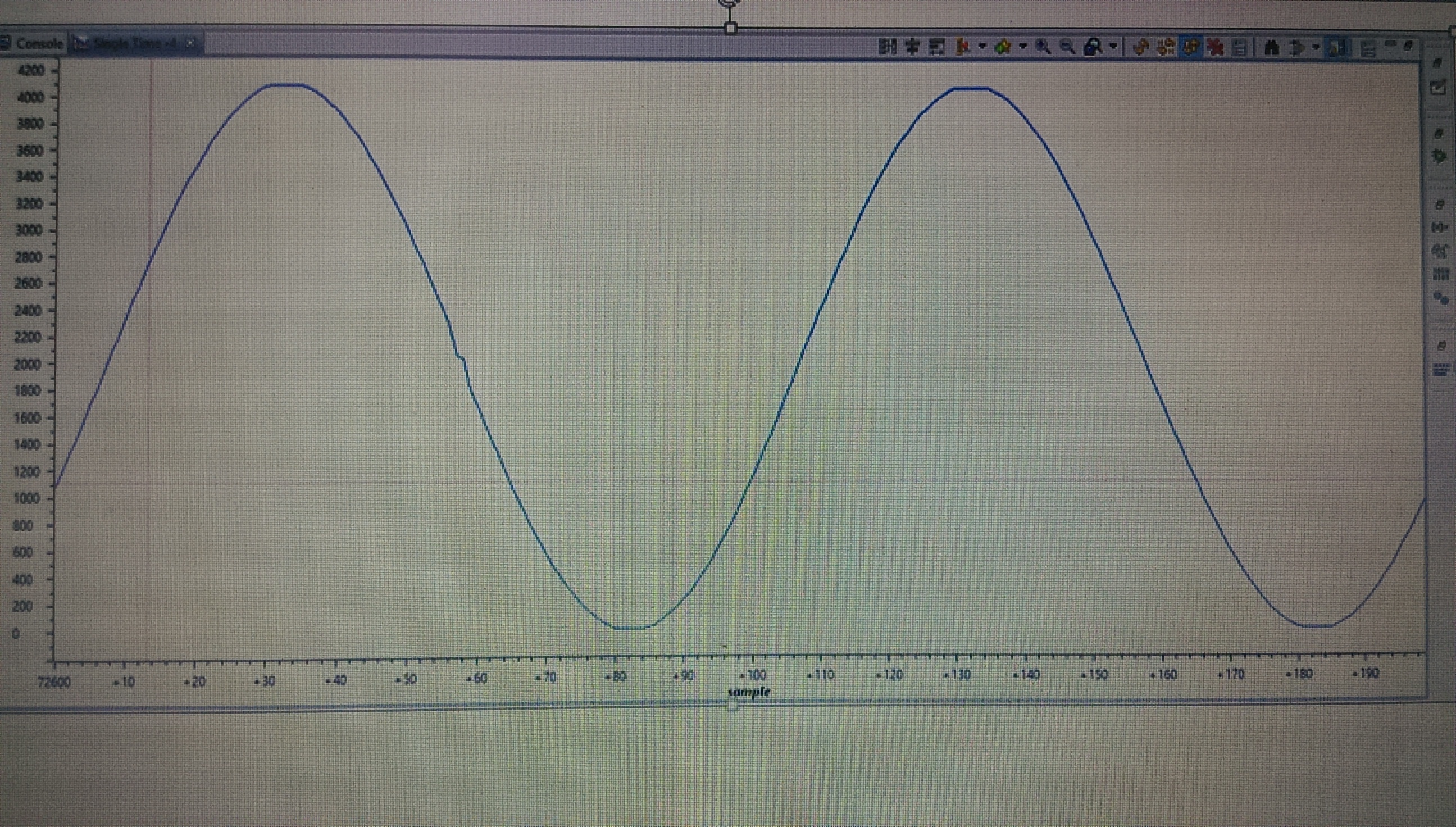
Current signal of 65Hz


