This thread has been locked.

If you have a related question, please click the "Ask a related question" button in the top right corner. The newly created question will be automatically linked to this question.

TMS320F280049: Internal DC/DC converter vs 1.2 regulator for motor control application

Part Number: TMS320F280049


Hello,

In order to reduce the size used by our electronics on a command card, we are staring a research oin the use/ not use of the DC/DC internal converter.

So far we initiated a small test and would like and have an idea how we can consider to use DC/DC intrernal converter or a1.2 external regulator.  

Our motion control is running around 20kHz, uses the 3 synchronised ADCs (current and voltage control/monitor), with CMPSS, uses some slow GPIO inpût/ output (ON/OFF, Fault...)  and generates the 6 PWM commands for a sensorless motor control.

The code is runnignfrom the DSP FLASH , with CPU running at 100MHz.

What is the impact on the ADCs accuracy between an 1.2 external regulator and the internal DC/DC ? Any way to compare?

Any specific caution to take wrt PWM generation?

We d like to add CAN communication, and various peripheral/memory on SPI buses. 

I d like to know if you have any kind of recommendation/guidelines how to insure / check the consumption wrt to our motion control and then adding the peripherals.

Thank you very much,

Regards,

PA .N.

Thank you,

PA.N.  

  • Hi PAN,

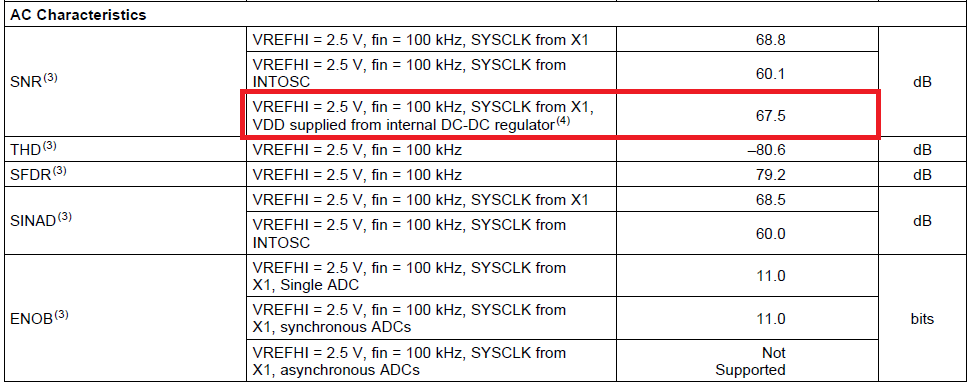
    There is a small degradation in ADC SNR when the DC-DC is used. It's specified in the datasheet.

    Are you asking how to measure the power consumption of your system?

  • Hello Franck,

    Thank you for the reply, Do you have any numbers for ADC accuracy using  internal supply VREG (LOD internal supply) with internal CLock?

    Can we assume that internal oscillator with DC-DC regulator is more efficient than DC_DC with external ?

    In case we use the DC-DC regulator, should we connect the VREF of the ADC to an external 2.5V ?  

     As for power consumption, i leave exact computation for my electronics engineer, i just like to know if you d have a method to estimate power consumption of a standard motion control application, and estimate if i can go with the DC-DC regulator..

    Thank you,

    PA N.

  • Sorry would you have those numbers for 3.3 refernce, please?

  • PAN,

    Thank you for the reply, Do you have any numbers for ADC accuracy using  internal supply VREG (LOD internal supply) with internal CLock?

    There is no performance difference in the ADC whether using internal or external LDO because there is no switching. The screen capture i sent in the previous reply shows the ADC performance with the internal oscillator.

    Can we assume that internal oscillator with DC-DC regulator is more efficient than DC_DC with external ?

    I'm not clear on what you are basing this on. Oscillator source doesn't make a big difference in power consumption. If you are concerned about power consumption, you will get the biggest gains by disabling clocks to unused peripherals.

    In case we use the DC-DC regulator, should we connect the VREF of the ADC to an external 2.5V ? 

    External ADC reference will give better ADC performance whether using the LDO or DCDC.

    Sorry would you have those numbers for 3.3 refernce, please?

    3.3 reference will give the same or better performance compared to 2.5 reference.

     As for power consumption, i leave exact computation for my electronics engineer, i just like to know if you d have a method to estimate power consumption of a standard motion control application, and estimate if i can go with the DC-DC regulator..

    There are multiple ways to accomplish this. The basic idea is you run your application (doesn't matter what the application is) for some time and then measure the current on the rails (VDDIO, VDDA, VDD). You can either measure peak current, avg current or log the current over time. 

  • Thank you Franck,

    We re getting somewhere...

    1. As for ADC vs internal regulator

    Could you explain the "switching" part of this sentence (i assume linked to the Dc-Dc regulator) ?

    " no performance difference in the ADC whether using internal or external LDO because there is no switching."

    To resume our research:

    So far we performed all our risk levelling test on the LDO internal sources and wanted to switch to DC-DC.

    My assumption was that the DC-DC regulator had better overall performances (as stated in the TMS32F28004X document "offers increased efficiency over the LDO for converting 3.3 V to 1.2 V.") 

    We didn't expect that it could have influence on the ADC which is very important for us (sampling 40A current at 20kHz for sensorless motor control).

    2 . Power consumption:

    As for power consumption , i had the idea that TI had a method to compute (without measuring) a minimum or maximum set of controllers (SPI, PWM, FLASH, ADC...) you could power up with the internal 1.2 power supply.(DC_DC or LOD)

    Can we just go through the dopcumentation and sum up the consumption of the peripherals we use?

    3. Finally my question be: What advantage can we get from an external regulator compared to your internal regulator? Is it only a power consumption issue?

    Thank you so mush for the support!

    Regards!

    Pierre-Axel. 


  • PAN,

    1.

    i. Yes, the switching here refers to the DC-DC. The DC-DC switches whilst the LDO does not.

    ii. It depends on what you mean by performance. The only advantage the DC-DC has over the LDO is efficiency.

    iii. As pointed out in the prior post, when using the DC-DC, the ADC will experience some performance degradation and it is heavily PCB layout dependent. This is one of the trade-offs you will have to make when moving from the LDO to the DC-DC. If best ADC performance is your priority, then you will need to stick with the LDO.

    2. Yes, we have a table in the datasheet that lists power consumption per disabled peripheral. This table was derived by running a specific test under a set of conditions. It is a very rough estimate and not 100% representative of every one's use-case. It's good for sizing your external supply. For the most accurate power consumption, you will need to measure the currents for your specific system under all possible operating conditions your system will experience.

    3. Our internal DC-DC is about 80% efficient. An external DC-DC can be more efficient than this but will not be a 0 cost add-on.

  • Thank you.

    It s perfectly clear now.

    With your help and some more dedicate TDI reading all is Under control.

    Best regards,

    Thank you.

    PA.

  • Hi PAN,

    Glad it's clear now. Let us know if you ran into anymore issues.