This thread has been locked.

If you have a related question, please click the "Ask a related question" button in the top right corner. The newly created question will be automatically linked to this question.

TMDSCNCD28379D: Control Card, ADC noise, Inline resistors and capacitors

Part Number: TMDSCNCD28379D
Other Parts Discussed in Thread: TMS320F28379D

Hi,

i am using the TMDSCNCD28379D Control Card for measuring a 50Hz sinusoidal output. The problem is that the results are too noisy. The 180 pin control card gets connected to the hardware prototype via a 100 pin DIM Adapter card as shown below. While reading the Delfino TMS320F28379D controlCARD R1.3 User's Guide, it mentions on page 7 of using the inline resistors and capacitors which are currently not populated on the board. Currently all inline resistors to the ADC pins are a simple 0-Ω shunt and all capacitors to the ground plane are not populated. Will this help me in improving the ADC results if i populate these inline resistors and capacitors? If not, please suggest alternatives. Answers awaited

Thanks
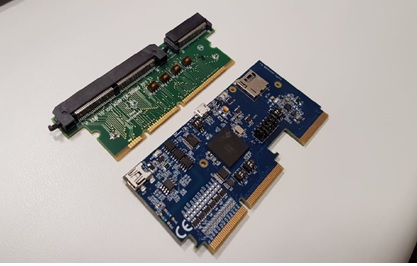
  • Check if the resistors in the reference voltage part of the ADC circuitry are really 0.1Ohm. Some control cards had 1Mega Ohm inserted. There should be a topic about this on the forum.

    As for the input circuitry, I had best results with 100pF capacitors and I used external resistors around 33 Ohm. But the resistance is highly dependent on outside driving circuitry. The resistor is there so that the driving opamp remains stable. And you really need to drive the ADC input with an opamp.

  • Hi Hasan,

    Depending on the signal source impedance, you may need to populate the input RC circuit on the board (and I believe the resistors are 0-ohm series).  If your source has very low, negligible impedance use an R of around 30 ohms and C of around 100 to 200pF to match the internal impedance of the ADC.  If your signal source has high impedance, you would need to derive the RC to get the accuracy and sample and hold and throughput targets.  Section 11.3.2 of the TRM has an excellent example for this case.

    Regards,

    Joseph