This thread has been locked.

If you have a related question, please click the "Ask a related question" button in the top right corner. The newly created question will be automatically linked to this question.

Continuous Software Force

Expert 2730 points


How Continuous Software Force really works? I mean how long will the PWM channel be in that state? Forever or until next period or what? What if I have used this for setting PWM output high and I have trip zone defined to make the pin go low (cycle by cycle or one shot) what happens then? I know I can try these with the hardware but I think you should have some kind of explanation in ePWM guide. At least I couldn't find anything specific.

  • JHi,

    We have both the options,

    Refer to the AQCSFRC (Action Qualifier Continuous Software Force), AQSFRC(Action Qualifier Software Force register) under Registers-> Action Qualifier in the EPWM user's guide. Depending on what you are trying to do you may want to use continuous force or one time force.

    Regards

    Manish Bhardwaj

  • I have read that section but it doesn't clarify anything. Can I still change the status of the PWM pin with the trip zone or not? And if I'm using continuous forcing and one shot trip zone, what will be the situation? I had my examples above can you describe what is happening in these cases?

    I think this is really not much to say about how this works:

    Continuous Software Force on Output B
    In immediate mode, a continuous force takes effect on the next TBCLK edge.
    In shadow mode, a continuous force takes effect on the next TBCLK edge after a shadow load into
    the active register. To configure shadow mode, use AQSFRC[RLDCSF].
    00 Forcing disabled, i.e., has no effect
    01 Forces a continuous low on output B
    10 Forces a continuous high on output B
    11 Software forcing is disabled and has no effect

    If you can change the behaviour with the tripzones you could add small paragarph saying this

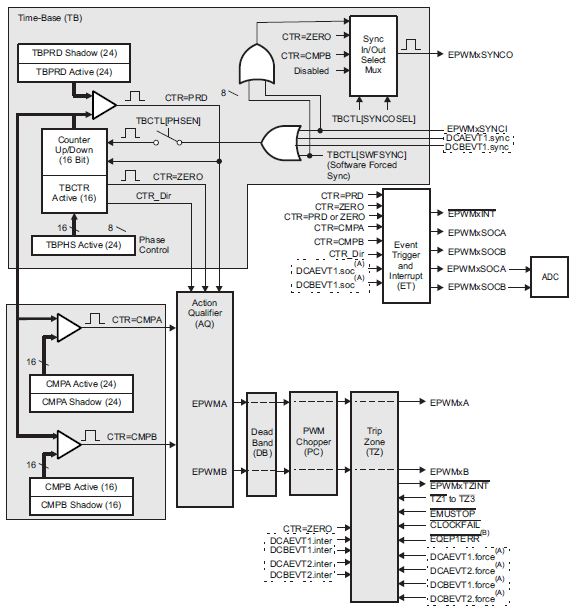
  • I was looking the Time-Base Submodule Block Diagram and because the forcing is made to Action Qualifier block then you should be also able to use TZ block and that will in the end decide what happens in PWM pins. So I think this case is solved.

  • Hi JHi,

    I agree, the documents are quite confusing and the difference between SW-force and continuous SW-force is not explained. Even two years after your initial question the ePWM documents could need some improvement.

    TB

  • Thomas, JHi,

    The key to this discussion is the order of the submodules within the ePWM module.  You should be able to find a good diagram for your particular device within documentation, but I've attached an example one for convenience.

    Note that the Action Qualifier submodule feeds the Dead Band submodule which feeds the Chopper submodule which feeds the Trip Zone submodule.

    This means that any trip zone submodule forcing will supersede the settings of the continuous force (which is in the Action Qualifier module).


    Thank you,
    Brett