This thread has been locked.

If you have a related question, please click the "Ask a related question" button in the top right corner. The newly created question will be automatically linked to this question.

TMS320F28377S: 16-Bit differential Mode ADC in combination with AMC1302 isolated current sensing

Part Number: TMS320F28377S
Other Parts Discussed in Thread: AMC1302, , THS4522, C2000WARE, ISO7842, THS4551

Hallo,

we want to use the 16Bit differential mode ADC to sample the currents in a motor driving application. As we need the isolation, we plan to use the AMC1302 as an isolated current sense amplifier, together with a shunt resistor.

As we are using a Delfino TMS320F28377S we want to connect the OUT_P and OUT_N directly to the ADC-inputs of the controller.

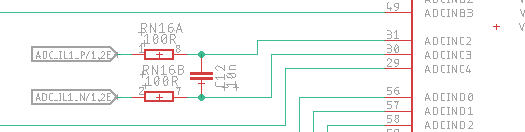
From my understanding this should work, but if you have a closer look to the datasheets you see, that the AMC1302 ist rated with a common mode voltage of 1,44V (1,39-1,49V).

In the datasheet for the TMS320F28377S in Table 5-42 the ADC input signal common mode voltage  for 16-Bit needs to be in the range of VrefCM +/- 50mV. For a standard 3V reference the range is then 1,45-1,55V. This means that it is not possible to use the AMC1302 together with TMS320F28377S. 

And even when I reduce my uC reference voltage to 2,88V, the range ist then exactly the same as the AMC1302 and there is no headroom for potential common mode disturbance. So I think it makes no sense to use the differential mode.

So is there a solution for using the AMC1302 family together with TMS320F28377S?

regards

Juergen


  • Hi Juergen,

    I'm not sure why the output common mode of the isolated amplifier is typically 1.44V; this will make it incompatible with directly driving the F2837xS ADC in differential mode with common VREF voltages of 3.0V or 2.5V. 

    I think you'd probably be OK from a practical perspective if you set the F2837xS VREFHI to 2.88V;  performance of differential 16b mode would always at least be better than 12B single-ended mode. 

    Note also that the output bandwidth of the isolated amplifier is typically 280kHz; I think this will require a S+H time longer than the minimum of 320ns.  

    Any reason not to use a sigma-delta modulator directly (with isolation of course) instead of the isolated amplifier?  The F2837x has dedicated sigma-delta bit-stream decoder modules.

    Another popular strategy is to put one or more F28004x devices on the hot-side and then send the (possibly oversampled and/or pre-filtered) ADC results over FSI via an optoisolator to a F2837x device.   

  • Hi Devin,

    many thanks for your feedback. I really can not understand, why TI offers the Isolators with specifications, that will not fit to their most popular controllers for exactely such power applications. What will be the purpose of the 16Bit ADC-Option at TMS320, if you will not be able to connect your own sensors.....

    As a "probably OK" is no option for me, I think there are 3 possible solutions:

    1) Digital sigma delta solution:

    I thought about the sigma-delta solution, but honestly I have no experience with that. We are planing a motor controller with a switching frequency of about 70kHz with SiC-MosFETs. Is the sigma-delta solution really fast enough to get the current values just in time synchronised with the PWM?

    Do you have some application notes or software project or examples to do this?

    2) Use an OPV to convert the differential signal back to a single ended signal. After that I can use the 12Bit mode of the ADC. As the performance will be reduced - this is the worst solution.

    3) If I have to us an OPV for signal conversion - I think it should be possible to use a fully differential OPV (like THS4522) to do a common mode voltage shift. So I can connect to VOC the 1,5V (Uref/2 of ADC) and will get a fully differential output voltage, which is exactely in the range of the TMS320 and I can use the 16Bit option.

    Do you think this will work?

    I found something in this note (page 37):

    http://www.ti.com/lit/an/slyt119/slyt119.pdf

    regards

    Juergen

  • Hi Juergen,

    Maybe 'probably OK' wasn't a great term. If you set the F2837x VREFHI to exactly 2.88V then the DC common mode will be within the +/-50mV range across the range of possible AMC output variation.  I verified that the CMRR was measured with a 1MHz 200mVpp AC signal on top of the worst case +/-50mV DC common mode, so even at the extremes you should get the rated 60dB of CMRR.  Things get a little more interesting since you won't be able to set the VREFHI to exactly 2.88V, but it appears that the degradation should be graceful past DC common mode of +/-50mV so your performance in 16B differential should always be better than the equivalent 12B single-ended signal.   

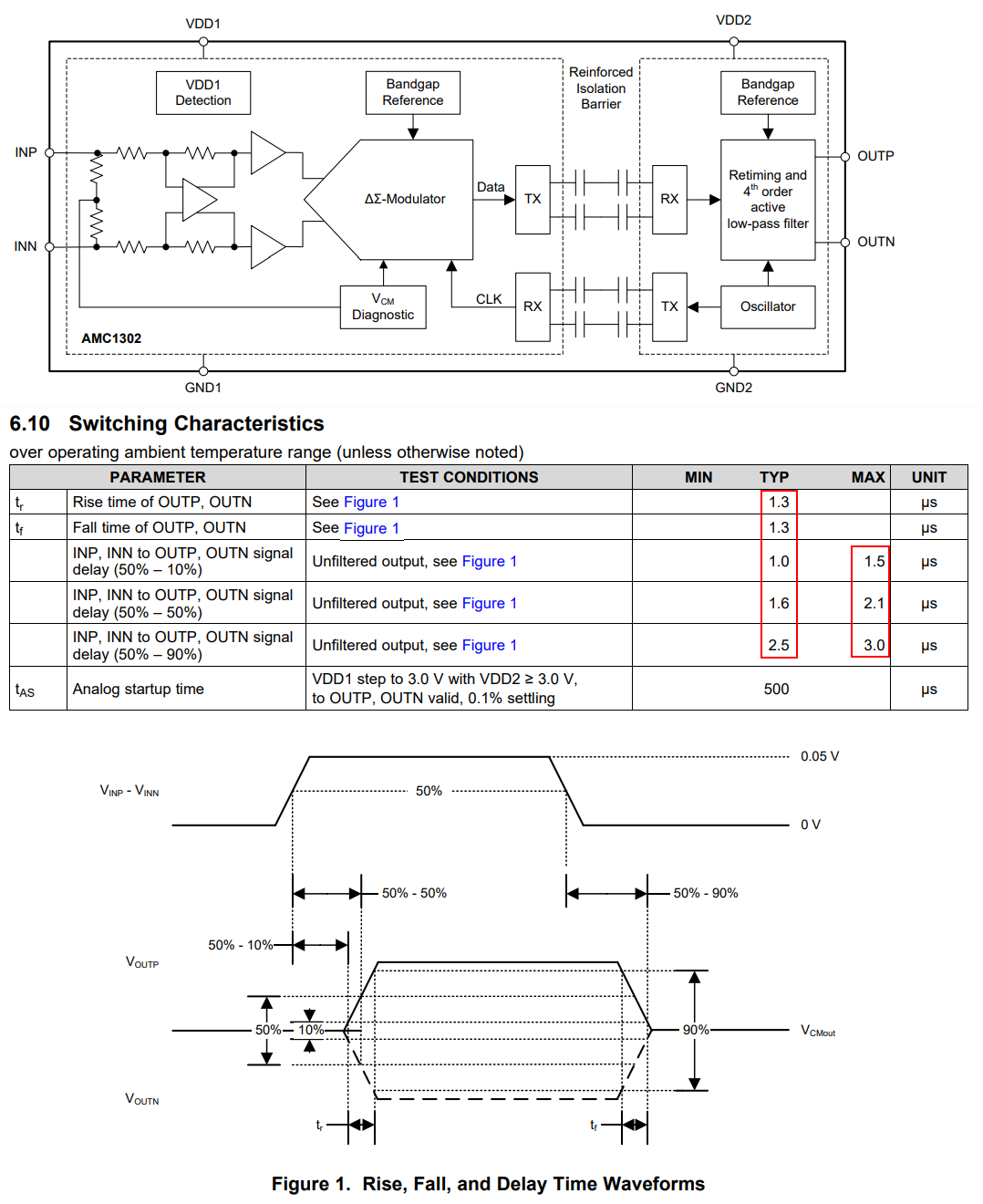
    If you look at the architecture of the isolated amplifier, it is a sigma-delta ADC followed by a DAC to re-constitute the signal.  This analog-to-digital-to-analog conversion process (which you then follow with your own analog-to-digital conversion) will incur several us of delay (see below from the AMC datasheet) unlike a non-isolated amplifier. 

    I'm not sure if feeding the sigma-delta bit stream directly to the decoders on the F2837x will be faster (the internal AMC bit-stream clock is 480MHz vs the decoders on the F2837x run at I believe 25MHz).  It will certainly result in one less DAC and one less ADC conversion, which should improve fidelity.  I'll ask the SDFM expert to comment on latency for a 13-bit resolution signal.  

    As far as the SW for the built-in sigma-delta decoders, have a look at the TRM (http://www.ti.com/lit/ug/spruhx5g/spruhx5g.pdf) chapter "Sigma Delta Filter Module (SDFM)" and also have a look at the SW examples for the SDFM in c2000ware:

    bit field based (4 examples): \device_support\f2837xs\examples\cpu1\sdfm_*

    driverlib based (1 example): \driverlib\f2837xs\examples\cpu1\sdfm\*

    Yes, you can absolutely use a fully differential amplifier to get the desired common mode via the Vocm input of the amplifier.  This will also have the benefit of greatly increasing the bandwidth of the source driving the ADC, allowing you to use a much shorter S+H window.  Note that it is also possible to set the common mode voltage and/or buffer a fully differential signal via a pair of single-ended op-amps. 


  • Juergen,

    Which modulator are you planning to use?

    Latency of Sinc filter depends on the following parameters:-

    1) SD-modulator sampling frequency

    2) Order of Sinc filter

    3) OSR configuration settings of Sinc filter

    Latency of Sinc filter = (Order of Sinc filter) x OSR / SD-modulator sampling frequency.

    For example, when AMC1305 SD- modulator operating @ 20 MHz, You can get ENOB of 13 bits of resolution when using SInc3 and OSR = 200

    Latency = 3 (order of Sinc3) x OSR (200) / SD-modulator freq (20 MHz) = 30 us

    Regards,

    Manoj

  • Hi Juergen,

    So for completeness:

    SDFM + Modulator @ 13 bit ENOB = ~30us

    Isolated amplifier + 16-bit ADC = ~2us + ~1.5us = ~3.5us (possibly closer to 3.0us if using a fully differential buffer)

    Hot side over-sampled F28004x via FSI:

    • Over-sample 12-bit ADC x 16 to get to about 13-bit ENOB: ~5us
    • Send single-word FSI packet:  48 bits @ 100mbps = 0.5 us
    • ISO7842 prop delay = 20ns
    • Total = ~5.5us 

    Note that it looks like only F2838xS has FSI, not F2837xS.  It is also worth noting that F28004x devices have PGAs with gain up to x24, so you may not need to over-sample as much to get equivalent resolution if your current sense signal is small.  

  • Hello to all,

    many thanks to you for your great support. 

    I think the best solution with lowest latency should be the use of a fully differential amplifier. So I have the advantage of the 16Bit ADC, the usage of differential wiring and the isolation with AMC-ICs

    As the advise of your colleague from local TI sales I am planing to use THS4551.

    Many thanks 

    Jürgen