


Other Parts Discussed in Thread: LAUNCHXL-F28379D, C2000WARE,
Note: This error is occurring on a LAUNCHXL-F28379D development kit
The C2000 example code I'm using is located at: \c2000\C2000Ware_2_00_00_03\driverlib\f2837xd\examples\cpu1\can\can_ex4_simple_transmit.c
To my understanding TX_MSG_OBJ_ID is synonymous with mailbox and interface. However when I run the code, I am receiving the messages on every single option for interface.
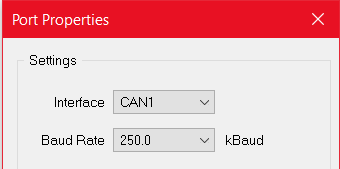
(The code specifies 500k baud but actually sends it out at 250k)
National Instruments NI USB-8473s High Speed CAN
My intention is that one message is sent on interface CAN1 and the other message is sent on CAN2
I am using the following defines to achieve this
#define TX_MSG_OBJ_ID 1
#define TX_MSG_OBJ_ID2 2
setting them up with this function
CAN_setupMessageObject(CANB_BASE, TX_MSG_OBJ_ID, 0x95555555, CAN_MSG_FRAME_EXT, CAN_MSG_OBJ_TYPE_TX, 0, CAN_MSG_OBJ_NO_FLAGS, MSG_DATA_LENGTH);
CAN_setupMessageObject(CANB_BASE, TX_MSG_OBJ_ID2, 0x95555556, CAN_MSG_FRAME_EXT, CAN_MSG_OBJ_TYPE_TX, 0, CAN_MSG_OBJ_NO_FLAGS, MSG_DATA_LENGTH);
and looping on this to send
CAN_sendMessage(CANB_BASE, TX_MSG_OBJ_ID, MSG_DATA_LENGTH, txMsgData);
CAN_sendMessage(CANB_BASE, TX_MSG_OBJ_ID2, MSG_DATA_LENGTH, txMsgData);
However I am getting both messages on every interface (CAN7 shown below)

P.S. I seem to be experiencing the same issue with the other CAN example project too:
\c2000\C2000Ware_2_00_00_03\device_support\f2837xd\examples\cpu1\can_external_transmit\cpu01\can_external_transmit.c
Here is the function from can.h:
objID is the variable in question
//*****************************************************************************
//
//! Setup a Message Object
//!
//! \param base is the base address of the CAN controller.
//! \param objID is the message object number to configure (1-32).
//! \param msgID is the CAN message identifier used for the 11 or 29 bit
//!        identifiers
//! \param frame is the CAN ID frame type
//! \param msgType is the message object type
//! \param msgIDMask is the CAN message identifier mask used when identifier
//!        filtering is enabled
//! \param flags is the various flags and settings to be set for the message
//!        object
//! \param msgLen is the number of bytes of data in the message object (0-8)
//!
//! This function sets the various values required for a message object.
//!
//! The \e frame parameter can be one of the following values:
//! - \b CAN_MSG_FRAME_STD - Standard 11 bit identifier
//! - \b CAN_MSG_FRAME_EXT - Extended 29 bit identifier
//!
//! The \e msgType parameter can be one of the following values:
//! - \b CAN_MSG_OBJ_TYPE_TX          - Transmit Message
//! - \b CAN_MSG_OBJ_TYPE_TX_REMOTE   - Transmit Remote Message
//! - \b CAN_MSG_OBJ_TYPE_RX          - Receive Message
//! - \b CAN_MSG_OBJ_TYPE_RXTX_REMOTE - Receive Remote message with
//!                                     auto-transmit
//!
//! The \e flags parameter can be set as \b CAN_MSG_OBJ_NO_FLAGS if no flags
//! are required or the parameter can be a logical OR of any of the following
//! values:
//! - \b CAN_MSG_OBJ_TX_INT_ENABLE    - Enable Transmit Interrupts
//! - \b CAN_MSG_OBJ_RX_INT_ENABLE    - Enable Receive Interrupts
//! - \b CAN_MSG_OBJ_USE_ID_FILTER    - Use filtering based on the Message ID
//! - \b CAN_MSG_OBJ_USE_EXT_FILTER   - Use filtering based on the Extended
//!                                     Message ID
//! - \b CAN_MSG_OBJ_USE_DIR_FILTER   - Use filtering based on the direction of
//!                                     the transfer
//! - \b CAN_MSG_OBJ_FIFO             - Message object is part of a FIFO
//!                                     structure and isn't the final message
//!                                     object in FIFO
//!
//! If filtering is based on message identifier, the value
//! \b CAN_MSG_OBJ_USE_ID_FILTER has to be logically ORed with the \e flag
//! parameter and \b CAN_MSG_OBJ_USE_EXT_FILTER also has to be ORed for
//! message identifier filtering to be based on the extended identifier.
//!
//! \note The \b msgLen Parameter for the Receive Message Object is a "don't
//!       care" but its value should be between 0-8 due to the assert.
//!
//! \return None.
//
//*****************************************************************************
extern void
CAN_setupMessageObject(uint32_t base, uint32_t objID, uint32_t msgID,
                       CAN_MsgFrameType frame, CAN_MsgObjType msgType,
                       uint32_t msgIDMask, uint32_t flags, uint16_t msgLen);

