This thread has been locked.

If you have a related question, please click the "Ask a related question" button in the top right corner. The newly created question will be automatically linked to this question.

TMS320F28375S: ADC conversion error

Part Number: TMS320F28375S


Hi experts,

Please let me know about TUE(total un-adjusted error) distribution.

I think TUE is not normal distribution because it consists of various errors(DNL, INL, gain error, offset error, etc...).

Is this correct?

Best regards,

Sasaki

  • Hi Sasaki,

    Overall, you can assume that TUE as derived via the RMS sum method approximately follows:

    • A normal distribution
    • With mean = 0 LSBs
    • And Standard deviation = (1/6)TUE 

    If you want the reasoning behind that, the way we are modelling TUE in this post:

    https://e2e.ti.com/support/microcontrollers/c2000/f/171/p/587441/2170045?tisearch=e2e-sitesearch&keymatch=TUE#2170045

    Uses a linear combination of random variables to estimate the TUE (where the linear weights are all '1' because each error is given equal weight).

    A linear combination of random variables has mean equal to:

    And variance equal to:

    (see https://online.stat.psu.edu/stat505/lesson/2/2.3)

    Where

    • x is a vector of the error component means
    • Sj are the error standard deviations
    • Sjk are the error co-variances (for all the possible combination pairs of variables) 
    • c is a vector of coefficient weights, in this case just [1 1 1...] since we equally weight the errors

    If we assume

    • The ADC error parameters in the datasheet are trimmed (so mean error is 0),
    • The min/max values have been set using 6-sigma or similar statistical margin (so all the error comes from the parameter variation)
    • The parameters are uncorrelated

    Then mean TUE becomes 0 (all the individual mean errors are 0).

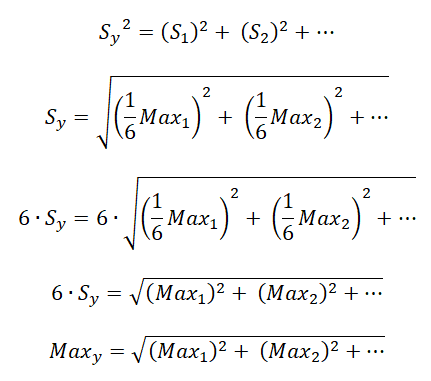
    And the Min/Max becomes the RMS sum of the individual Min/Max values, maintaining the same level of statistical margin previously used.

    e.g. 

    If the parameters have 6-sigma margin, the min/max for TUE at 6 sigma ends up being the RMS sum of the individual min/max values:

    (note, the co-variances all equal 0 because the parameters are assumed to be uncorrelated) 

  • Hi Devin-san,

    Thank you for your special support !!

    I understood that TUE is normal distribution.

    I have one more question.

    For example, if the AD conversion result has an error of ± 10 LSB, is it possible to assume that if the same voltage is sampled 100 times and averaged, the average error will be ± 1 LSB?

    When "N" standard deviations "S" are averaged, I think the standard deviation of the mean is s/sqrt(N).
    (The "S" is random variables following the same normal distribution.)

    If the variance is regarded as an error, the error of the average value of N times sampling is 1/sqrt(N), so the error of ± 10LSB is considered to be the following by sampling 100 times.

    ± 10LSB/sqrt (100) = ± 1LSB

    Is this correct?

    Best regards,
    Sasaki

  • Hi Sasaki,

    Yes, that is correct. 

    That property leads to the rule of thumb that for every factor of 4 you over-sample and average the signal, SNR effectively increases by 1 bit (6dB):

    SNR = 20*log(Vsignal_RMS / Vnoise_RMS)

    SNR_OSR4 = 20*log(Vsignal_RMS / (Vnoise_RMS/sqrt(4)))

    SNR_OSR4 = 20*log(Vsignal_RMS / Vnoise_RMS) + 20*log(sqrt(4))

    SNR_OSR4 = SNR + 6.02dB

  • Hi Devin-san,

    Thank you for your support !

    I learned a lot from your comment.

    Best regards,

    Sasaki