This thread has been locked.

If you have a related question, please click the "Ask a related question" button in the top right corner. The newly created question will be automatically linked to this question.

TMS320F28377D: EMIF: EMxWAIT and WAIT state consideration?

Part Number: TMS320F28377D

Team,

I have looked at the below E2E post :

https://e2e.ti.com/support/microcontrollers/c2000/f/171/t/489473

https://e2e.ti.com/support/microcontrollers/c2000/f/171/t/783573

but I could not find a definitive answer for the below question. Could you please help?

For EMIF with EW = 1 (EMxWAIT activated, with E = 5 ns) how should the below piece of information (a and b) be interpreted in relation to the EMxWAIT ?
      a) seem to indicate that granularity of the « sampling/evaluation» is 16*E of EMxWAIT
      b) seem to indicate that the EMxWAIT is evaluated after the EMIF transfer is closed
Are those 2 assumptions correct?
Can you clarify what is really taking place in the EMIF for the WAIT state evaluation?

a) According to datasheet data below the EMIF « sample/evaluate» EMxWAIT (after the EMxOE/EMxWE  falling edge? At the end of the strobe?) every 16*E (ie 80 ns) until EMxWAIT is found desactivated.
The EMIF considered that the transfer is closed if one of the below condition is TRUE:
     - The SLAVE has effectively desactivated EMxWAIT before the EMIF « sample/evaluate» it next time.
     - The EMIF has evaluated that EWC = MEWC, which means that the SLAVE has exceeded the maximum WAIT state allowed.


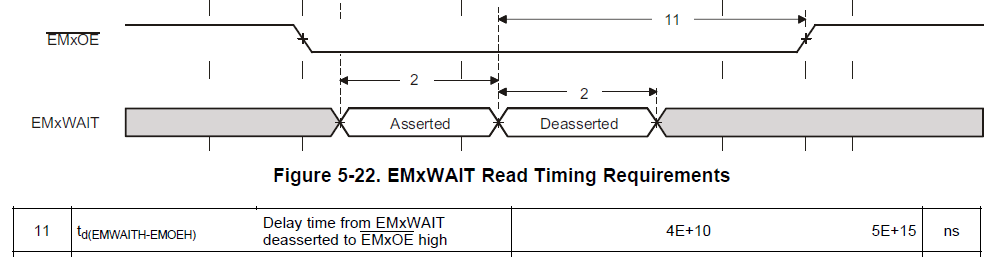
b) The EMIF meets the below READ/WRITE timing between EMxWAIT de-activation done by SLAVE and the EMxOE/EMxWE rising edge.
Those timings need to meet a maximum time of 5*E + 15 (ie 40 ns).
Read:
 Write:

Thanks in advance,

A.

  • Hi,

    For EMIF with EW = 1 (EMxWAIT activated, with E = 5 ns) how should the below piece of information (a and b) be interpreted in relation to the EMxWAIT ?
          a) seem to indicate that granularity of the « sampling/evaluation» is 16*E of EMxWAIT
          b) seem to indicate that the EMxWAIT is evaluated after the EMIF transfer is closed
    Are those 2 assumptions correct?

    Not exactly.

    a) 16*E granularity is not for sampling but that is timeout time hence it has been included in MIN and MAX pulse width of WAIT signal.

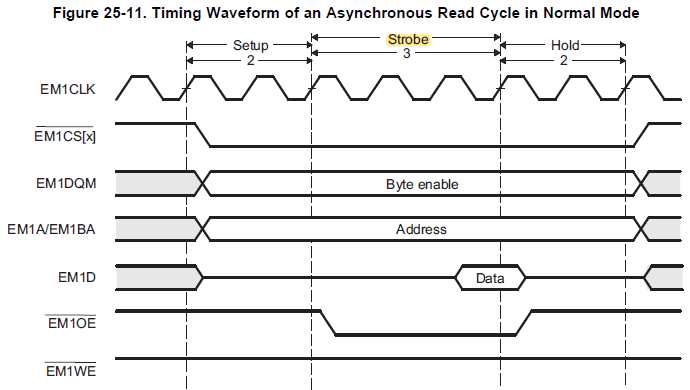
    b) This is also not correct. WAIT can not be evaluated after transfer is closed. EMIF transfer has SETP+STROBE+HOLD and WAIT is evaluated during STROBE time.

    a) According to datasheet data below the EMIF « sample/evaluate» EMxWAIT (after the EMxOE/EMxWE  falling edge? At the end of the strobe?) every 16*E (ie 80 ns) until EMxWAIT is found desactivated.

    EMxOE/EMxWE falling edge is not end of STROBE cycle but start of STROBE cycle.

    The EMIF considered that the transfer is closed if one of the below condition is TRUE:
         - The SLAVE has effectively desactivated EMxWAIT before the EMIF « sample/evaluate» it next time.
         - The EMIF has evaluated that EWC = MEWC, which means that the SLAVE has exceeded the maximum WAIT state allowed.

    This is correct.

    b) The EMIF meets the below READ/WRITE timing between EMxWAIT de-activation done by SLAVE and the EMxOE/EMxWE rising edge.
    Those timings need to meet a maximum time of 5*E + 15 (ie 40 ns).

    Yes, this is output switching Characteristics meaning device will have that much delay between two transition.

    Regards,

    Vivek Singh

  • AnBer said:
    I have looked at the below E2E post :

    https://e2e.ti.com/support/microcontrollers/c2000/f/171/t/489473

    https://e2e.ti.com/support/microcontrollers/c2000/f/171/t/783573

    but I could not find a definitive answer for the below question. Could you please help?

    You will find more details in the TRM.

    AnBer said:
    a) seem to indicate that granularity of the « sampling/evaluation» is 16*E of EMxWAIT

    Yes, this is shown in the register field definition for MAX_EXT_WAIT:


    AnBer said:
    b) seem to indicate that the EMxWAIT is evaluated after the EMIF transfer is closed
    Are those 2 assumptions correct?
    Can you clarify what is really taking place in the EMIF for the WAIT state evaluation?

    This is best explained by the TRM:

    And for reference, here is an EMIF read operation where you can see that STROBE is in the middle of the transaction.

    AnBer said:
    a) According to datasheet data below the EMIF « sample/evaluate» EMxWAIT (after the EMxOE/EMxWE  falling edge? At the end of the strobe?) every 16*E (ie 80 ns) until EMxWAIT is found desactivated.

    EMIF looks for the WAIT signal during STROBE.

    AnBer said:
    b) The EMIF meets the below READ/WRITE timing between EMxWAIT de-activation done by SLAVE and the EMxOE/EMxWE rising edge.
    Those timings need to meet a maximum time of 5*E + 15 (ie 40 ns).

    EMxOE and EMxWE are both EMIF output signals so this is providing some guidance as to when the EMIF can be expected to de-assert the signals.

  • Hi,

    Thanks for yours responses, 

    1)

    Vivek Singh said:

    a) 16*E granularity is not for sampling but that is timeout time hence it has been included in MIN and MAX pulse width of WAIT signal.

    So timings 10 and 24 of the Datasheet describe the case where EMxWAIT signal is never de-asserted and the EMIF timeout is reach ?

    If it is right, it could be relevant to precise it into the datasheet.

    2)

    Vivek Singh said:

    b) This is also not correct. WAIT can not be evaluated after transfer is closed. EMIF transfer has SETP+STROBE+HOLD and WAIT is evaluated during STROBE time

    When the STROBE phase is engaged, at which moment the EMIF will start to sample the EMxWAIT signal to detect if extra strobe cycles are requested by the slave ?

    - Just after the falling edge of the EMxOE/EMxWE signal ?

    - After a time set after the falling edge of the EMxOE/EMxWE signal ? if yes what is this time ?

    3)

    if the strobe phase is equal to 15 ns and the EMIF detects EMxWAIT asserted after 5 ns, it will add extra strobe cycles until EMxWAIT is sampled de-asserted by the EMIF.

    But then the EMIF will finish the 10 ns of the strobe phase before to enter into the HOLD phase ? or this time will be shorted ?

    Vivek Singh said:
    b) The EMIF meets the below READ/WRITE timing between EMxWAIT de-activation done by SLAVE and the EMxOE/EMxWE rising edge.
    Those timings need to meet a maximum time of 5*E + 15 (ie 40 ns).

    Yes, this is output switching Characteristics meaning device will have that much delay between two transition.

    4)

    So here it is the common case where EMxWAIT signal is de-asserted before timeout defined at 1) ?

    Regards,

    Alexandre.

  • DA_AGL said:
    So timings 10 and 24 of the Datasheet describe the case where EMxWAIT signal is never de-asserted and the EMIF timeout is reach ?

    If it is right, it could be relevant to precise it into the datasheet.

    Good point, I'll try to get this clarified.

    DA_AGL said:
    When the STROBE phase is engaged, at which moment the EMIF will start to sample the EMxWAIT signal to detect if extra strobe cycles are requested by the slave ?

    - Just after the falling edge of the EMxOE/EMxWE signal ?

    - After a time set after the falling edge of the EMxOE/EMxWE signal ? if yes what is this time ?

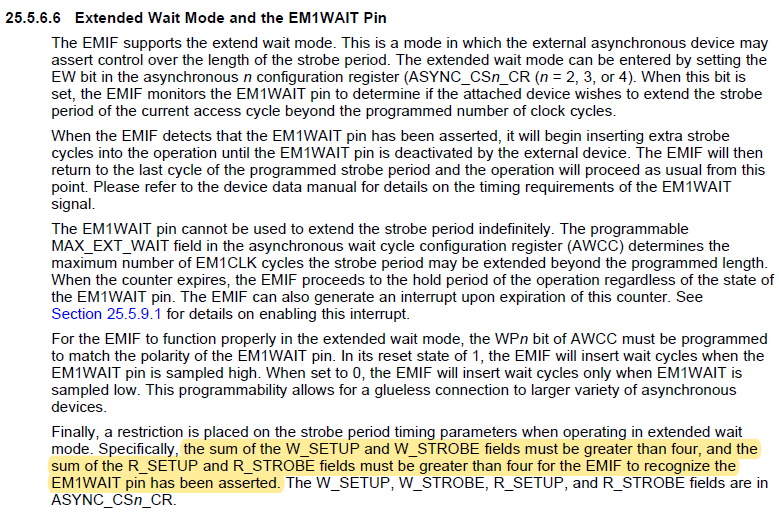
    Note that there is a requirement for SETUP+STROBE > 4:

    And the EMxWAIT has minimum Duration and Setup time requirements:

    I would recommend thinking of it in terms of the EMIF state machine looking for the EMxWAIT signal on the last cycle of the programmed STROBE period.

    DA_AGL said:
    3)

    if the strobe phase is equal to 15 ns and the EMIF detects EMxWAIT asserted after 5 ns, it will add extra strobe cycles until EMxWAIT is sampled de-asserted by the EMIF.

    But then the EMIF will finish the 10 ns of the strobe phase before to enter into the HOLD phase ? or this time will be shorted ?

    The STROBE period will be the greater of either the programmed STROBE or the Extended WAIT STROBE.

    DA_AGL said:
    4)

    So here it is the common case where EMxWAIT signal is de-asserted before timeout defined at 1) ?

    I don't understand this question. Are you asking about this timing diagram?

  • Hi,

    Thanks again for your response, it is now clear to me.

    tlee said:
    DA_AGL
    4)

    So here it is the common case where EMxWAIT signal is de-asserted before timeout defined at 1) ?

    I don't understand this question. Are you asking about this timing diagram?

    Yes it is exactly this, timings 11 and 25.

    I suppose that these times define the case where EMxWAIT is de-asserted before the EMIF timeout as described in timings 10 and 24.

    Regards,

    Alexandre.


  • Correct, 11 and 25 describe the behavior for when EMxWAIT is de-asserted before the WAIT timeout is reached.